49 works in this view — arrow keys or swipe to move between them.
Dance in Art
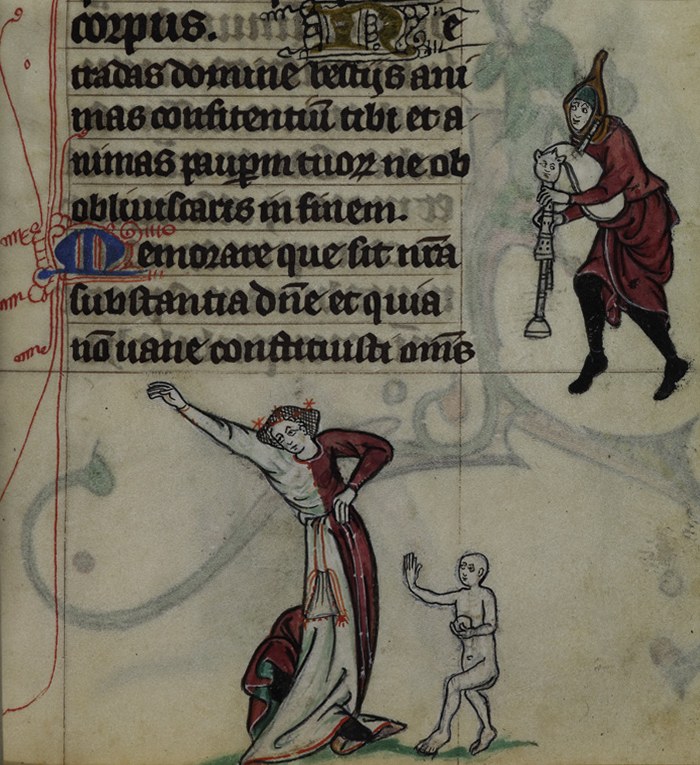
Maastricht Book of Hours, BL Stowe MS17 f234r (detail)
Unknown miniaturist from Liège-Maastricht area, ca. 1300-1325
- Source:
- Wikimedia Commons
- Rights:
- Public domain — free to use, share and adapt.
- Recorded as:
- public_domain
This marginal image is one of the few surviving visual documents of how ordinary people actually danced in the early 14th century, captured by an artist with a keen eye for movement and physicality. The woman's arched back, extended arm, and off-balance posture provide evidence about the kinetic qualities of medieval social dance—its improvisational, weight-shifting character—that would otherwise remain invisible to us. Dancers and historians of medieval movement, social history, and manuscript culture will find in this small drawing a vivid snapshot of embodied life in a period from which few other such records survive.
What you are looking at
A marginal illustration in a medieval manuscript shows three figures in animated interaction. At right stands a bagpiper in burgundy robes and a pointed hood, playing a large bagpipe and facing leftward. In the center, a woman in a burgundy dress with white undergarment leans backward with her right arm extended upward in an arc, her body weight shifted into a dynamic pose; her left arm is not visible. At left, a small naked child or putti figure stands upright, arms raised in a gesture of greeting or participation. The scene occupies the lower margin of a page of Latin text in a gothic hand, with a decorative initial letter (in blue and gold) at the top of the written passage. The figures are rendered in the lively ink and color wash typical of early 14th-century Flemish manuscript illumination, with careful attention to the texture of fabric and the play of weight in the woman's posture.
The dancing
The woman's body is the focal point: she is caught mid-movement, leaning back with her torso extended and her right arm raised high, suggesting either the apex of a turn or a moment of exuberant abandon. Her left side is compressed and her weight appears to be on her back foot, a posture consistent with courtly or festive social dancing. The bagpiper stands firmly planted, supporting the weight of the instrument. The child's raised arms and frontal stance suggest mimicry or participation in the celebration rather than formal dance training.
The dance depicted
This appears to depict a moment of recreational or festive social dancing, likely a courtly or bourgeois entertainment of the early 14th century in the Liège-Maastricht region. The woman's posture—arched back, raised arm, dynamic lean—is consistent with the undulating, improvisational movement of medieval carole or branle dances, which were often accompanied by bagpipes and sung or played music in courtly and popular contexts. The presence of a bagpiper, the woman's exuberant physical abandon, and the informal setting in a manuscript margin (rather than a formal historiated initial) suggest a depiction of social or recreational rather than ceremonial dance. The figure's movements show an understanding of weight shift and momentum consistent with social dances of this period, though the artist has chosen to freeze a moment of maximum extension rather than a formal closed position.
How it was made
This is an illuminated manuscript detail in ink, tempera, and gold leaf on parchment, part of a larger book of hours. The technique allowed the artist to render precise linework in the faces and fine details of the clothing while using areas of flat color and subtle modeling to suggest three-dimensionality in the drapery. The marginal placement and lively subject matter suggest that such drolleries—humorous or secular scenes unrelated to the liturgical text—were a distinctive feature of Flemish manuscript practice in this period, with some freedom for the artist to include observational or fantastical content in the margins. The durability of parchment and the prestige of illuminated manuscripts meant such works circulated in aristocratic and wealthy merchant households.
About this work
This is a marginal drollery from a Maastricht Book of Hours, one of a series of lively secular vignettes interspersed throughout a liturgical manuscript made for an aristocratic patron in the early 14th century. The image captures a moment of social dance—a woman in courtly dress dancing to the music of a bagpiper, accompanied by a small child—rendered with careful observation of the body's movement and the textures of contemporary clothing. The work belongs to a rich tradition of manuscript marginalia in Flemish and Netherlandish art, in which scribal and artistic workshops used the spaces around text to explore the everyday life, humor, and physicality of their contemporaries.
As a depiction of secular, non-courtly dance, this manuscript illumination offers rare visual evidence of how people actually moved in celebration during the medieval period. The woman's posture—arched, extended, and off-balance in a way that suggests real motion rather than formal pose—is notable for its dynamism and suggests that the artist had observed or understood the bodily logic of improvised social dance. The presence of the bagpipe, an instrument associated with popular rather than elite entertainment, reinforces the secular and possibly rural or lower-class associations of the scene.
How to look at it
Notice the woman's body position: she is not standing upright or in a formal closed hold, but rather leaning back with her weight shifted, her arm raised and extended in a way that suggests the crest of a movement or a moment of exuberant abandon. The artist has captured the precise moment when her body is most extended and most off-balance—not the beginning or end of a movement, but its peak. Observe how the bagpiper's stance is stable and rooted, in contrast to the woman's dynamic lean, suggesting the relationship between musician and dancer. The bare child at left, with arms raised, may be a cupid or a deliberately comic figure, a touch of the grotesque or supernatural that was common in manuscript marginalia and that complicates any simple reading of the scene as straightforward documentation.
The artist
The artist is unknown, as is typical for manuscript illuminators of the period. The work is attributed to the Liège-Maastricht region based on stylistic features, script, and decoration, suggesting a workshop practice in one of the major manuscript-producing centers of the Southern Low Countries. Such workshops often employed multiple hands and maintained recognizable regional styles; the quality of the figure drawing and the confidence of the drapery studies suggest an experienced hand, likely a master illuminator working for a high-end commission.
The period
The early 14th century in the Low Countries saw a flourishing of manuscript culture, with wealthy urban and aristocratic patrons commissioning richly illuminated books of hours—personal devotional texts that combined religious instruction with displays of taste and wealth. Alongside this formal liturgical tradition, manuscript margins became spaces for artists to explore secular and observational subject matter, from animals and grotesques to scenes of daily life, labor, and entertainment. In the same period, social dances like the carole and branle were evolving in courtly and urban contexts, increasingly accompanied by instrumental music (bagpipes, fiddles, shawms) rather than purely vocal performance. The manuscript tradition of marginal annotation and drollerie allowed artists to document these entertainments in ways that formal religious art did not.
Where it lives
The manuscript is held in the British Library as part of the Stowe Collection (BL Stowe MS 17). It was likely made in the Liège-Maastricht region in the first quarter of the 14th century for an aristocratic or wealthy merchant patron. In the 18th century it was owned by the 1st Duke of Buckingham and Chandos; it was subsequently part of the Ashburham collection before being acquired by the British Library in 1883 as part of the Stowe purchase.
Dance in this work
Questions about this work
What is a 'drollery' in medieval manuscripts?
A drollery is a humorous, whimsical, or secular scene placed in the margins or between text of a medieval manuscript, often unrelated to the main religious content. Medieval manuscript workshops, particularly in Flemish centers like Liège, included such scenes as a form of visual entertainment and as a means of documenting everyday life. They range from grotesques and hybrid creatures to scenes of labor, play, and social interaction.
What kind of dance is this likely to be?
The woman's posture—arched back, raised arm, dynamic lean—is consistent with the carole or branle, social dances that were popular in medieval courtly and urban contexts. These were often accompanied by bagpipes and were characterized by improvisational, weight-shifting movement rather than the formal holds and positions of later ballroom dance. The presence of the bagpiper and the informal setting support this identification.
Why is a bagpiper shown with a woman dancing?
The bagpipe was a popular instrument for accompanying social and festive dances in the medieval period, particularly outside courtly circles. Its association here with a secular, energetic scene suggests that this is a depiction of popular rather than elite entertainment, consistent with the informal, marginal placement of the image within the formal liturgical text.
Why is there a naked child in the scene?
The presence of a small, nude figure—likely a cupid or putto—was a common device in medieval and early Renaissance art to suggest divine blessing, innocence, or the supernatural. In the context of a drollery, it may also be a touch of the grotesque or comic, a typical feature of manuscript marginalia that played with scale, propriety, and the mixing of sacred and secular imagery.
More dance artwork





