49 works in this view — arrow keys or swipe to move between them.
Dance in Art
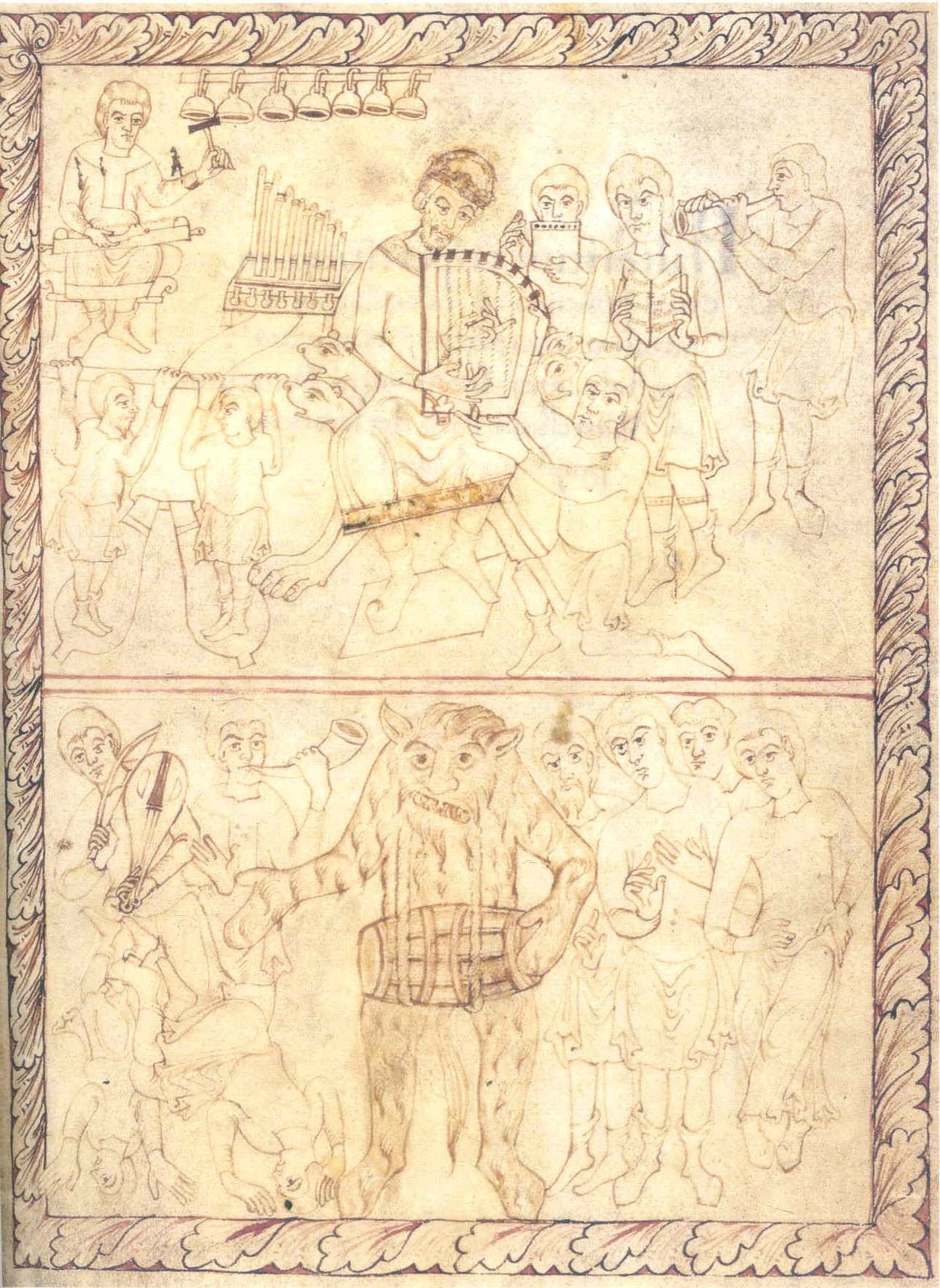
B.18, f.1r, PSALTERIUM TRIPLEX, St John's College Cambridge
unknown artist, early 12th century A.D.
- Source:
- Wikimedia Commons
- Rights:
- Public domain — free to use, share and adapt.
- Recorded as:
- public_domain
For dance historians, this image is significant evidence of 12th-century Christian attitudes toward secular dancing and the body. The contrast between David's ordered, clothed musicians and the nude, energetic dancers surrounding the demon reveals the moral and spiritual registers medieval culture assigned to different movement practices—sacred music associated with hierarchy and restraint, secular dance with chaos and carnality. The specific rendering of the dancers' gestures and postures—raised arms, flexed knees, twisted torsos in apparent freedom—provides visual documentation of how dancing was imagined (and condemned) in this period.
What you are looking at
A medieval manuscript leaf divided into two registers showing contrasting musical and dance scenes. In the upper frame, King David sits enthroned on the left, playing a harp with his fingers spread across the strings. He is attended by a group of standing musicians: one plays a large pipe organ, others hold wind instruments (pipes and horns), and figures gesture or sing. All wear simple tunics. The lower register depicts a demonic figure—horned, with a grotesquely distorted face and a barrel-shaped body bound with straps—dancing or cavorting at the center. This creature is surrounded by a crowd of smaller nude or lightly clad figures: some play instruments (a fiddle is visible), others dance with raised arms and bent knees, a few touch or gesture toward the central demon. The composition uses the hierarchies of medieval manuscript illumination: David is largest and placed highest, the demon is prominent but coarser in execution, and the surrounding dancers are smaller and more schematic. The parchment is cream-colored with brown ink and minimal shading; a decorative acanthus border frames the entire composition.
The dancing
The dancers in the lower register display energetic, informal postures: raised arms, flexed knees, torsos leaning forward or back in exuberant arcs. Several appear to move in a loose circle around the central demon. The gestures are unstructured and expressive rather than codified—hands reach upward, bodies twist. In contrast, David's musicians in the upper register maintain more formal, symmetrical stances, their arms raised to play instruments or gesture in measured song. The nude or near-nude figures surrounding the demon have simpler musculature rendered in outline; their small scale and repetitive poses suggest a crowd of revelers rather than individual performers. Weight appears grounded but mobile, with hips and torsos initiating motion.
The dance depicted
This is a didactic religious image contrasting sacred and profane music-making, possibly illustrating Psalms or commentary on spiritual versus carnal pleasure. The upper scene shows David as the biblical ideal of sacred music and worship; the lower scene represents the Devil's domain and worldly, sensual dancing. The dancers in the lower register likely represent a generic 'folk' or secular revelry rather than a specific named dance of the 12th century. Their movements—energetic, communal, undisciplined—embody the moral critique medieval clerics directed at secular entertainment. The image does not depict a recognizable court dance, processional, or liturgical form, but rather uses dancing bodies as a symbol of carnal distraction and sin in contrast to David's pious music-making.
How it was made
This is a pen-and-ink drawing or sketch on parchment, likely a preparatory or working page from a decorated manuscript (the psalter). The linear technique—fine brownish lines defining forms with minimal internal modeling—is consistent with 12th-century manuscript production. The decorative acanthus border in the margin suggests this was part of a formal manuscript. The simplicity of the line-work and the absence of gold leaf, bright colors, or dense shading indicate this may be an outline or working stage before full illumination, though it may also represent the actual finished state for this particular codex. The technique allows the artist to render numerous figures with economy and to emphasize gesture and narrative content over volumetric form.
About this work
This is a didactic medieval manuscript illumination from early 12th-century Rheims that uses contrasting scenes of music-making and dance to embody theological opposition between the sacred and the profane. The upper register depicts King David at worship with orderly, formal musicians; the lower register shows a demon surrounded by leaping, gesturing nude figures in what appears to be worldly revelry. The image is drawn in brown ink on parchment with a decorative border, characteristic of liturgical or biblical manuscript production of the period.
The work belongs to a widespread medieval tradition of illustrating moral and spiritual concepts through visual contrast—in this case, the difference between divine music (associated with order, hierarchy, and piety) and demonic music (associated with chaos, nudity, and sensual pleasure). The dancing figures are rendered with energetic, informal gesture to signal their moral status as representatives of earthly distraction and sin. As a rare visual record of how medieval clerics conceptualized secular dance, the image is valuable evidence of attitudes toward the dancing body and the social meanings attributed to different kinds of musical and movement practice.
How to look at it
Attend first to the spatial and hierarchical division between the two registers: David is calm, seated, central to his scene; the demon is at the center of the lower scene but surrounded by a chaotic crowd. Notice the difference in costume—David and his musicians wear simple but covering tunics; the dancers are nude or nearly so. Look at the hands and arms: David's musicians raise them in controlled gesture (playing or singing in measure), while the dancers' hands reach upward in apparent abandon, their arms akimbo. The artist captures a single suspended moment in each scene—David is mid-performance, the dancers mid-movement—but the compositions signal very different moral states through posture, spacing, and dress. The nude or light-clad bodies of the dancers would have signaled sin and shame to a medieval viewer; the contrast was intentional and didactic.
The period
This manuscript was likely produced in Rheims, a major cathedral scriptorium and center of manuscript production in the 12th century. The Psalterium Triplex was a scholarly psalter combining three versions of the Psalms (Hebraica, Gallica, and Romana) and was used for study and devotion. The image reflects a period when anxiety about secular entertainment—particularly dancing, music, and performance—was high in clerical circles. Augustine, Tertullian, and later medieval theologians condemned dancing as an invitation to lust and demonic influence; images like this one illustrated those warnings in visual form. The early 12th century saw increased codification of monastic life and renewed emphasis on the contrast between spiritual and worldly pursuits, making such didactic imagery common in biblical manuscripts intended for clerical and monastic audiences.
Where it lives
This is a page (folio 1 recto) from MS B.18, held in the collection of St John's College, Cambridge. It is part of a bound medieval psalter (Psalterium Triplex) believed to have been produced in Rheims in the 12th century. The manuscript is a scholarly biblical text for clerical use, combining multiple versions of the Psalms for comparative study.
Dance in this work
Questions about this work
Why is the bottom figure depicted as a demon?
The demon represents the Devil or demonic forces associated with worldly pleasure and sin. In medieval theology, secular music and dancing were understood as temptations of the flesh and the Devil's work, in contrast to sacred music devoted to God. By placing a demon at the center of the dancing scene, the artist makes explicit the moral message: that secular revelry is spiritually dangerous.
Are these real dances or invented for the moral lesson?
These are not depictions of specific named dances of the 12th century. Instead, they represent generic 'worldly revelry' as conceived by medieval clerical imagination. The nudity, the circular arrangement around a central figure, and the energetic gesture convey an idea of secular entertainment rather than documentary record. The image tells us what medieval clergy feared about dance, not necessarily how people actually danced.
Why are the dancers nude?
Nudity in medieval Christian imagery signaled shame, sin, and separation from grace. The absence of clothing marked the dancers as outside Christian community and morality, in contrast to David and his musicians, who are clothed and orderly. Nudity also emphasized the body and bodily pleasure—carnal rather than spiritual—reinforcing the didactic contrast.
What does this tell us about medieval attitudes toward dance?
The image reveals deep Christian suspicion of secular music and dance as spiritually dangerous, associated with the Devil, the flesh, and loss of rational control. Dancing was understood not as neutral entertainment but as a form of moral corruption that could seduce even the righteous. Such imagery was common in manuscripts intended for clergy and was used to reinforce monastic and clerical discipline.
More dance artwork





