49 works in this view — arrow keys or swipe to move between them.
Dance in Art
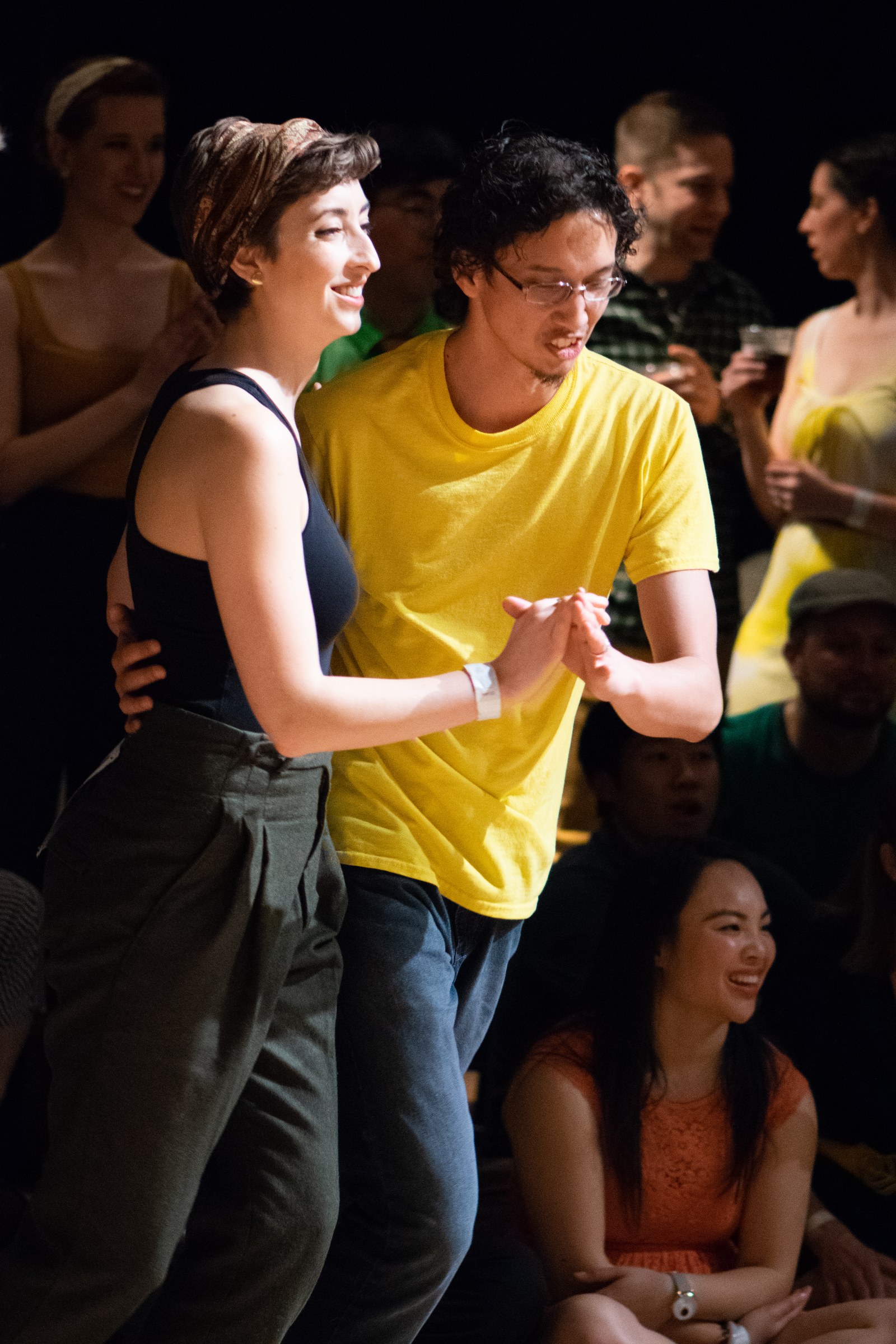
Lindy Hop dancers in black and yellow
quinet
- Source:
- Wikimedia Commons
- Rights:
- Reusable with conditions: credit the creator. Source record ↗
- Recorded as:
- cc by 2.0
Lindy Hop is often documented in either historical archives or highly polished performance contexts. This image is valuable because it captures the dance in its contemporary vernacular setting—a competition that is also a social gathering, showing how the form lives not in museums but in active practice by dancers who choose to learn and perform it. For historians, it provides evidence of how a centurial-old African-American dance form continues to circulate and evolve in diaspora communities; for dancers, it shows the aesthetic and social values of contemporary Lindy Hop culture.
What you are looking at
A group of dancers in casual contemporary dress performs together in a darkened venue lit by theatrical lighting. The central couple occupies focus: a woman in a black sleeveless top with short reddish-brown hair and a man in a bright yellow t-shirt, both smiling and energetic. They are framed by an audience of onlookers arranged in loose groups around them—some seated on the floor in the foreground, others standing in the background. The floor appears to be a performance or dance studio space. The overall mood is celebratory and social rather than formal; the lighting is warm on the dancers against the deep black surround, and the gathered spectators suggest this is a live competition or social dance event with active participation and spectatorship.
The dancing
The two central dancers are in close contact but with open frame and playful positioning rather than a fixed hold. The man's arm is around the woman's back; both are smiling downward toward each other with relaxed, buoyant upper bodies and engaged knee action. Their posture suggests weight is active and bouncy rather than smooth or held. The surrounding dancers visible in the frame show varied positioning—some couples dancing, others standing in casual social stances—indicating a social setting where multiple couples are dancing simultaneously. The overall body language across the scene reads as joy and informality rather than technical precision.
The dance depicted
This is Lindy Hop at a swing dance competition, as identified in the catalogue. Lindy Hop is an aerobic swing dance with roots in African-American vernacular dance and Harlem in the 1920s–1930s. The image captures the social and celebratory character of the form—Lindy Hop competitions and events are known for this blend of technical skill and joyful sociability. The open frame, the couple's engagement with each other and the surrounding dancers, the casual clothing, and the democratic lighting of both dancers and spectators all reflect how Lindy Hop exists as both a performance and participatory social practice. The man's bright yellow shirt and the woman's deliberate styling suggest they are among the featured dancers at this competition.
How it was made
This is a digital photograph, likely taken during an event or rehearsal documentation rather than a posed studio portrait. The theatrical lighting, visible depth of field, and capture of movement and expression suggest it was shot by someone present at the venue—either a competition photographer or social documentarian. The warmth of the tungsten or stage lighting against the black background creates strong contrast, allowing the dancers' faces and bodies to read clearly to the camera while the audience remains in shadow. This lighting choice is typical of performance documentation and makes the dancers' expressions and details of movement legible in what would have been a dynamic, fast-moving scene.
About this work
This photograph documents a moment at Lindy Bout XII, a swing dance competition held in Vancouver in 2018. It captures not a formal performance but a living, interactive moment in contemporary swing dance culture—the kind of moment that defines Lindy Hop's identity as a dance that belongs to both stage and social floor. The image shows the dance as it is actually practiced: joyful, social, collaborative, and embedded in community. The photograph works as evidence of how Lindy Hop exists today as a diaspora practice—rooted in early 20th-century African-American innovation, but sustained and evolved by diverse communities across the globe in the 21st century.
How to look at it
Notice the couple's faces and how they are looking at each other rather than outward—this is characteristic of Lindy Hop, which prioritizes connection and conversation between partners over display to an external audience. Watch the knee and hip action visible even in a still image: there is a springy, grounded quality that distinguishes Lindy Hop from smoother ballroom forms. The theatrical lighting is strategic: it makes the dancers legible and celebratory while keeping the audience in ambient shadow, reinforcing that this is a moment of participation and community rather than performer-vs-spectator division. The photographer's choice to capture this moment of joy and eye contact, rather than a more formally posed or technically impressive moment, tells you something about what contemporary Lindy Hop culture values.
The artist
The photograph is credited to 'quinet,' a photographer who appears to document swing dance events and community. Beyond this attribution, little is established about the photographer's broader practice or identity in the record provided.
The period
Lindy Hop experienced a major revival and globalization beginning in the 1980s, sustained by enthusiast communities and historical scholarship. By 2018, swing dance competitions and social events like Lindy Bout were established fixtures in cities worldwide, including Vancouver. Contemporary Lindy Hop culture emphasizes inclusivity, historical awareness, and the dance's roots in Black vernacular culture, though this remains contested terrain. The casual, mixed-gender, multi-ethnic character of this group reflects the demographics of 21st-century swing dance communities, which differ significantly from the 1930s–1940s historical moment from which the dance emerged.
Where it lives
The photograph is held in Wikimedia Commons, a public repository of media licensed for reuse. It documents Lindy Bout XII, a swing dance competition held in Vancouver, Canada, in 2018. Such images in Wikimedia Commons typically serve as documentation of cultural events and community practice rather than as fine art objects.
Dance in this work
Questions about this work
What is Lindy Hop?
Lindy Hop is an energetic partner dance that emerged in Harlem in the late 1920s and early 1930s. It combines elements of jazz, tap, and African-American vernacular movement with swing music. It is characterized by aerobic movement, improvisation, and the ''swing-out,'' a signature figure where partners break connection and return. Lindy Hop nearly disappeared after the 1950s but was revived by enthusiasts beginning in the 1980s and is now practiced in communities worldwide.
Is Lindy Hop still danced today?
Yes. Contemporary Lindy Hop exists as both a competitive form and an active social dance. Dancers gather for social events, workshops, and competitions like the one pictured here. Modern Lindy Hop communities are diverse and global, and many contemporary practitioners emphasize historical knowledge and the dance's roots in Black culture. However, questions persist about cultural ownership, appropriation, and whose histories are centered in revival contexts.
What does the yellow shirt tell us?
The bright yellow shirt likely indicates that the man is one of the featured dancers or competitors at this event. In swing dance competitions, dancers often wear distinctly colored or coordinated clothing to make them legible to judges and photographers. The woman's styling (short hair, fitted black top) also suggests intentionality about appearance, consistent with competition participation.
Why is the audience sitting on the floor?
In social and competitive swing dance events, audiences often sit close to the dance floor on risers, chairs, or the floor itself to remain part of the social atmosphere. This democratic positioning—where spectators are not separated from dancers by a formal stage barrier—reflects Lindy Hop culture's emphasis on community and participation. Sitting at floor level also gives photographers and spectators a better angle to see the dancers' footwork and connection.
More dance artwork





