49 works in this view — arrow keys or swipe to move between them.
Dance in Art
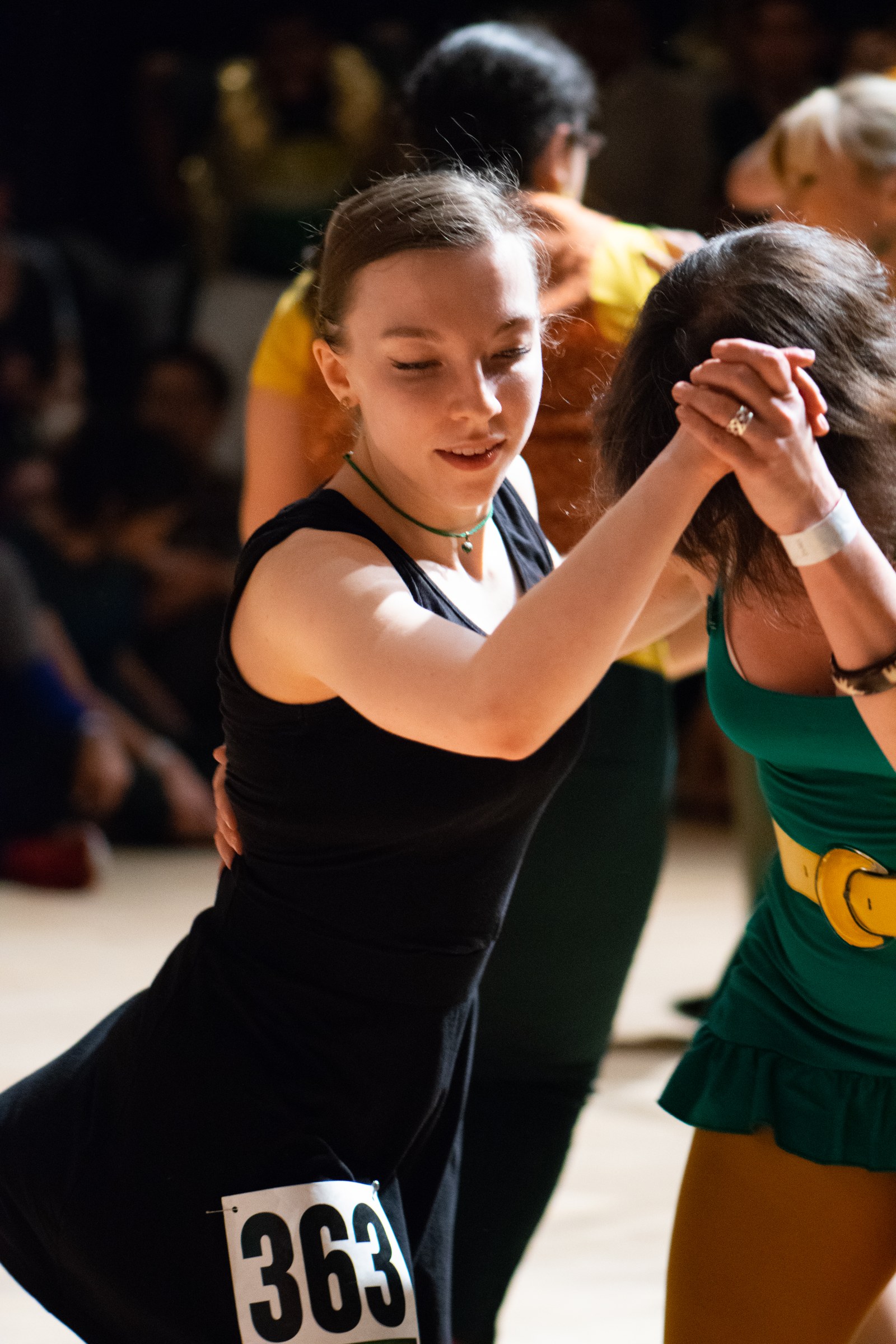
Lindy Hop dancer in black dress
quinet
- Source:
- Wikimedia Commons
- Rights:
- Reusable with conditions: credit the creator. Source record ↗
- Recorded as:
- cc by 2.0
This image documents Lindy Hop not as a historical artifact but as a living, competitive practice in the 2010s, showing how the dance has been preserved, standardized, and evolved through the global swing dance revival community. For historians and dancers, it offers concrete visual evidence of contemporary performance standards, costume conventions, and competition formats that define modern swing dancing. The photograph also captures the demographic and cultural reality of 21st-century Lindy Hop, which has become far more geographically diverse and gender-balanced than the mid-20th-century ballroom scene.
What you are looking at
A young female dancer in a black sleeveless competition dress performs at what appears to be an indoor swing dance competition. She is captured mid-movement, her body angled in an energetic, dynamic pose characteristic of Lindy Hop. Her face shows concentration and enjoyment as she executes the movement. The dress is practical and fitted, allowing freedom of movement, with a white wristband visible on her left arm—standard competition attire. The setting is an indoor venue with spectators visible but out of focus in the background, suggesting a formal competition environment. The lighting is bright and warm, illuminating the dancer against the darker background of the crowd. A competition number—363—is visible on her dress, confirming this is a sanctioned event.
The dancing
The dancer's weight is forward and active, her legs in a dynamic stride. Her arms are engaged in what appears to be a lead or follow position characteristic of partnered swing, though her partner is partially visible at the edge of the frame, slightly out of focus. Her upper body is tilted, her face animated, showing the spirited engagement demanded by the style. Her posture and line suggest she is an experienced dancer executing a smooth, controlled movement rather than a static pose—the frame captures her in the middle of a traveling step or turn.
The dance depicted
This is Lindy Hop, a partnered swing dance that emerged in Harlem in the 1920s and became a dominant social and competitive dance form throughout the mid-20th century and continuing to the present. The catalogue confirms this is from the 2018 Lindy Bout XII competition in Vancouver, indicating the image documents contemporary competitive Lindy Hop. The dancer's position, the indoor competition setting with numbered bibs, and the energetic but controlled execution all confirm active participation in the competitive swing dance scene, which has experienced significant revival since the 1980s.
How it was made
This is a color photograph, likely digital given the date (2018) and the quality of the image. The photographer has captured the motion and energy of the dance through a relatively fast shutter speed that freezes the movement while maintaining sharp focus on the primary dancer. The composition isolates the foreground dancer while allowing spectators to fall softly out of focus, directing attention to the performance itself. The warm lighting and indoor venue suggest either flash photography or existing venue lighting, typical of sports and competition photography.
About this work
This photograph documents a moment from contemporary competitive Lindy Hop, capturing a young dancer in the midst of an energetic, controlled movement at a formal swing dance competition. Lindy Hop, born in African American communities in 1920s Harlem, has experienced a sustained global revival since the 1980s, with organized competitions like Lindy Bout now held across North America and Europe. The image is valuable both as a record of how the dance is performed and taught in the 21st century, and as evidence of its continued vitality as a social, competitive, and cultural practice. The photograph shows the technical demands of the style—weight control, frame, responsive partnership—and the joy that characterizes the dance's culture.
How to look at it
Notice the dancer's engagement with the floor—her weight is committed and active, not held back or posed. Watch how her upper body relates to her lower body; there is rotation and flexibility through the core, not a rigid frame. The expression on her face matters; this is not a distant, balletic presentation but an embodied enjoyment of the music and movement. The competition number and indoor setting contextualize this not as a social or informal moment but as a formalized, judged performance, which affects how we read the precision and control in her execution.
The artist
The photographer is credited as 'quinet' in the Wikimedia Commons record. No further information about the artist's practice or context is available from the catalogue.
The period
Lindy Hop experienced a dramatic revival beginning in the 1980s, driven initially by swing dancers seeking to recover and learn the dance from aging practitioners and archival footage. By 2018, swing dancing had become an organized international competitive scene with regular competitions, standardized rules, and dedicated teaching communities. The Lindy Bout series, of which this 2018 edition was the twelfth iteration, represents the infrastructure and cultural legitimacy the dance had achieved. In the same period, swing dancing was being taught in academic contexts, featured in popular media, and recognized as a significant cultural heritage practice deserving preservation and study.
Where it lives
This photograph is held in Wikimedia Commons, a freely licensed repository. The catalogue record identifies it as documentation of the 2018 Lindy Bout XII swing and jazz dance competition held in Vancouver, Canada.
Dance in this work
Questions about this work
What is Lindy Hop and where did it come from?
Lindy Hop is a partnered swing dance that emerged in Harlem, New York, in the late 1920s, developing in African American communities and spreading rapidly during the swing era of the 1930s and 1940s. It combines elements of jazz, tap, and breakaway movements, and is characterized by energetic, improvisational partnering, aerial tricks, and rhythmic connection to jazz music. The dance nearly disappeared after the 1950s but was revived starting in the 1980s by dancers who learned from remaining elders and from film and archival sources, and it has since become a global competitive and social practice.
How is Lindy Hop judged in competition?
Competitive Lindy Hop is typically judged on connection and lead-follow relationship between partners, musicality and synchronization with the music, technique and execution of moves, frame and posture, presentation and performance quality, and general dancing ability. Dancers may compete in different categories based on experience level, partnership status, and age, and competitions often include both choreographed performances and improvised jack-and-jill (random pairing) competitions.
Why does the dancer wear a number?
The competition number (363 in this case) is how judges and organizers track individual dancers or partnerships throughout the competition. It allows judges to identify competitors during performances, facilitates scoring and bracket management, and makes the competition official and transparent.
Is Lindy Hop still danced socially, or only in competitions?
Lindy Hop is danced both competitively and socially. While competitions like Lindy Bout have become visible markers of the dance's cultural status, the majority of Lindy Hop dancing occurs in social settings—at swing dance venues, dance halls, festivals, and social nights organized by local communities. Competition and social dancing feed each other; competitors often teach and dance socially, and social dancers may eventually compete.
More dance artwork





