49 works in this view — arrow keys or swipe to move between them.
Dance in Art
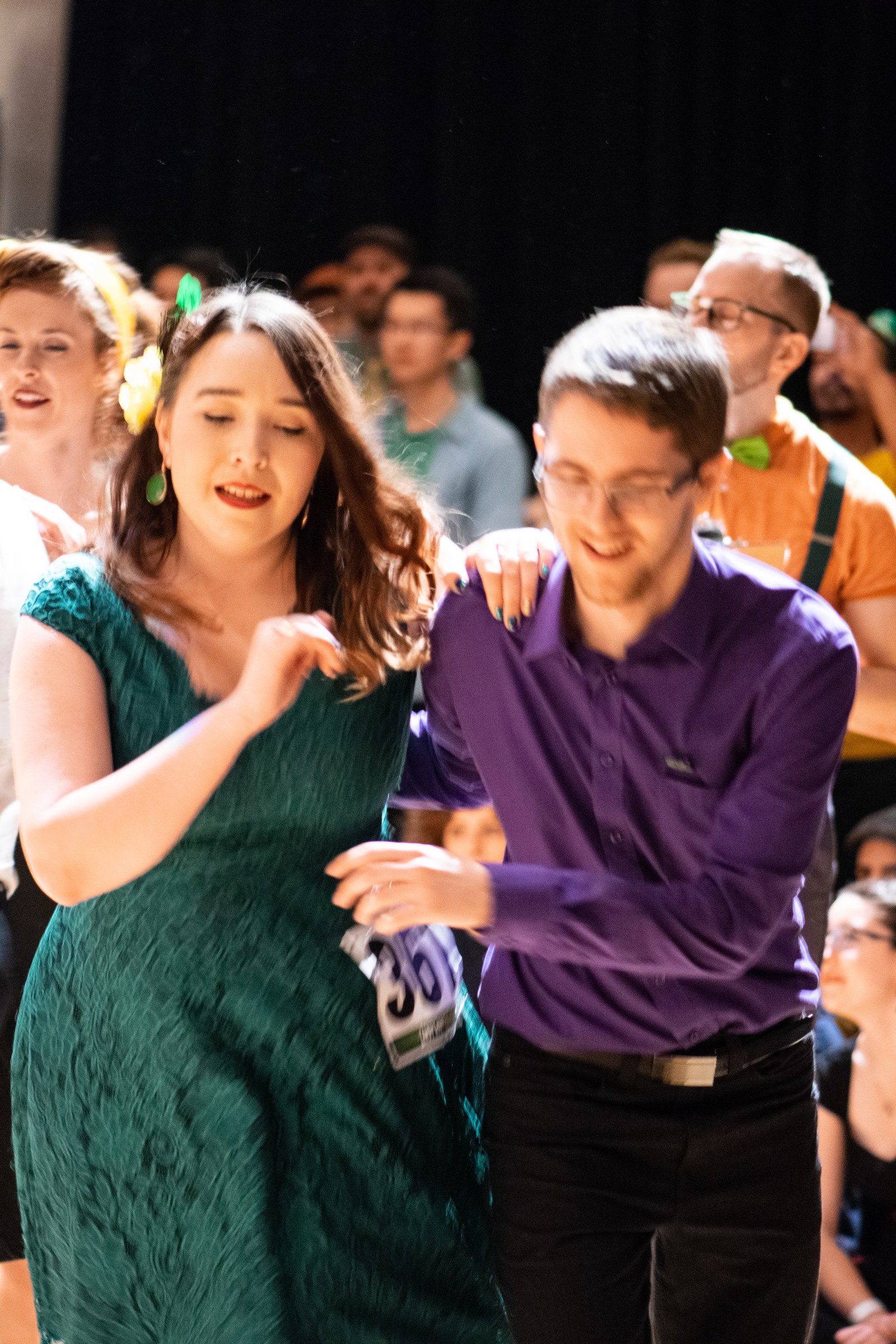
Lindy Hop dancers in purple and green
quinet
- Source:
- Wikimedia Commons
- Rights:
- Reusable with conditions: credit the creator. Source record ↗
- Recorded as:
- cc by 2.0
Lindy Hop's competitive revival is one of the most significant developments in early-21st-century social dance, yet it remains underrepresented in visual documentation. This image shows the dance not as exhibition or nostalgia but as an active, joyful practice with real participants, mixed ages, and genuine partnership—the aesthetic that defines why people dance it now rather than simply study it historically. For dance historians, it documents an important moment in how vernacular dances are sustained, transmitted, and evolve when communities choose to continue them.
What you are looking at
A competition moment captured mid-performance at what appears to be an indoor swing dance event. The foreground shows a couple in the midst of an energetic Lindy Hop: a woman in a fitted teal or petrol-blue textured dress with short sleeves, her dark hair waved and adorned with a yellow flower clip, dances with a man in a purple button-front shirt and dark trousers. Both are smiling, their bodies angled toward each other in an engaged frame. Behind them, other competitors and spectators fill the space—some in period-inspired dress including suspenders and fedoras, others in casual modern clothing. The lighting is theatrical, with strong illumination on the dancing couple against a dark background, creating a stage-like quality typical of ballroom competition photography. The scene captures the social, joyful energy of swing dancing rather than a polished studio pose.
The dancing
The primary couple displays the hallmarks of Lindy Hop partnering: the woman is positioned at a slight angle to the man, their upper bodies engaged in conversation while maintaining frame. Their posture is upright and sprung, with the kind of natural bend in the knees that allows for the characteristic bounce and resilience of swing dancing. The woman's arm position suggests she is either in a connection hold or just coming out of a swing-out or basic step. Both dancers show relaxed, smiling faces—the expression of social dancers enjoying the moment rather than executing steps with tension. The man's hand placement and her responsive lean indicate active partnership and mutual engagement in the movement.
The dance depicted
This is competitive Lindy Hop, a social swing dance that emerged in Harlem in the 1930s and evolved as a partner dance characterized by improvisation, connection, and aerials. The image documents the dance as it is performed in the 21st-century competitive revival: the couple's dress nods to 1940s styles (swing era references) while the competition setting and photography style are contemporary. Lindy Hop at competition level maintains the social, connected quality visible here—this is not a choreographed pattern but a responsive partnership where both dancers read each other's movement and adjust in real time. The setting and other competitors suggest this is from an organized event where dancers from multiple regions gathered, indicating Lindy Hop's status as an active, thriving dance culture in the 2010s.
How it was made
This is a photograph, almost certainly digital (given the 2018 date and the image quality), taken with professional event lighting that isolates the dancing couple from the background. The photographer has captured a candid moment of performance rather than a posed studio shot, which is typical of competition documentation. The depth of field keeps the primary couple in sharp focus while rendering the background and spectators slightly soft, a technique that emphasizes the action. This kind of photography serves multiple purposes: it documents the event for participants, provides imagery for promotion and social media, and creates a visual record of contemporary swing dance practice.
About this work
This is a photograph from the 2018 Lindy Bout XII swing dance competition in Vancouver, documenting the contemporary competitive Lindy Hop revival. Lindy Hop, originating in 1930s Harlem as a partner social dance to jazz, nearly disappeared after the 1950s but experienced a dramatic global resurgence beginning in the 1980s. By the 2010s, it had become an organized competitive scene with international events, youth participation, and a blend of historical costume reference and modern practice. This image captures that revival at a specific moment: a couple mid-performance at a regional competition, dressed in swing-era-inspired clothing, dancing with the partner connection and improvised responsiveness that defines the style. The photograph is valuable evidence of how Lindy Hop functions as both historical reconstruction and living social dance—a community practice that honors the dance's African American origins while creating new performance contexts.
How to look at it
Watch the couple's frame and the quality of connection between them. The slightly angled positioning and the way both dancers' weights appear engaged shows the active partnership that characterizes Lindy Hop—this is not a formation where one person leads and the other follows passively. Notice the relaxed, smiling faces: in Lindy Hop, the emotional tone of the dance matters as much as the steps. The moment captured here is during what appears to be a basic weight-sharing phrase, not a dramatic aerial or big swing-out, which is typical of competition footage—photographers and dancers both favor the moments where connection and partnership are visible over the moments of maximum extension.
The artist
The photograph is credited to user 'quinet' on Wikimedia Commons, indicating it was taken by an event participant or documentarian and released under a Creative Commons licence. This points to the role of amateur and community documentation in recording contemporary dance culture—the image exists because someone at the event had access to a camera and chose to share their documentation publicly, a practice enabled by digital photography and open image licensing.
The period
The 2010s saw Lindy Hop firmly established as an international competitive and social dance scene, with regular events across North America, Europe, and beyond. The swing revival that began in the 1980s had matured into an organized culture with teaching lineages, competitions, and stylistic debates. Simultaneously, there was increasing scholarly and popular interest in African American dance history and in how vernacular dances are preserved and revived. The costume choices visible here—the woman's 1940s-inspired dress, the man's suspenders—reflect a common practice in the community of referencing the swing era while dancing in contemporary contexts, rather than attempting strict historical recreation.
Where it lives
The photograph was uploaded to Wikimedia Commons, a public image repository, indicating it is available for reuse under whatever licence the uploader selected. The catalogue record identifies it as from the 2018 Lindy Bout XII competition in Vancouver; Lindy Bout is an established annual or biennial swing dance competition series in North America.
Dance in this work
Questions about this work
Why are they dressed like that?
Lindy Hop dancers often wear clothing inspired by the 1930s–1940s swing era when the dance originated, as a form of cultural and historical reference. However, this is contemporary competitive dress, not historical recreation—the woman's dress is a modern garment designed to evoke that period, and the overall look blends vintage inspiration with modern comfort and function. Many swing dancers adopt this aesthetic as part of how they identify with and honor the dance's history.
Is Lindy Hop an African American dance?
Yes. Lindy Hop originated in Harlem, New York, in the 1930s within African American communities and was developed to jazz music in Black-led jazz clubs. The dance nearly disappeared from practice after the 1950s but was kept alive by a small number of original dancers and historians. The contemporary global Lindy Hop community includes people of all backgrounds, but practitioners generally acknowledge and seek to honor the dance's African American roots and the original dancers who created it.
What is a Lindy Bout?
Lindy Bout is a series of swing dance competitions held in North America, typically featuring Lindy Hop, Charleston, and other swing dances. Competitors dance in partnerships (usually mixed-gender, though not exclusively) and are judged on connection, musicality, and execution. These events serve as gatherings for the international swing dance community and are important occasions for dancers to showcase their skills and connect with others who practice the dance.
How do you judge Lindy Hop?
Competitive Lindy Hop is judged on partnering and connection (how well the dancers read and respond to each other), musicality (how well they interpret the music), technique (execution of steps and body mechanics), choreography or improvisation (whether they are dancing planned patterns or responding spontaneously—both are valid), and overall performance quality. Judges typically look for dancers who maintain frame, respond to their partner, and dance with apparent enjoyment rather than tension.
More dance artwork





