49 works in this view — arrow keys or swipe to move between them.
Dance in Art
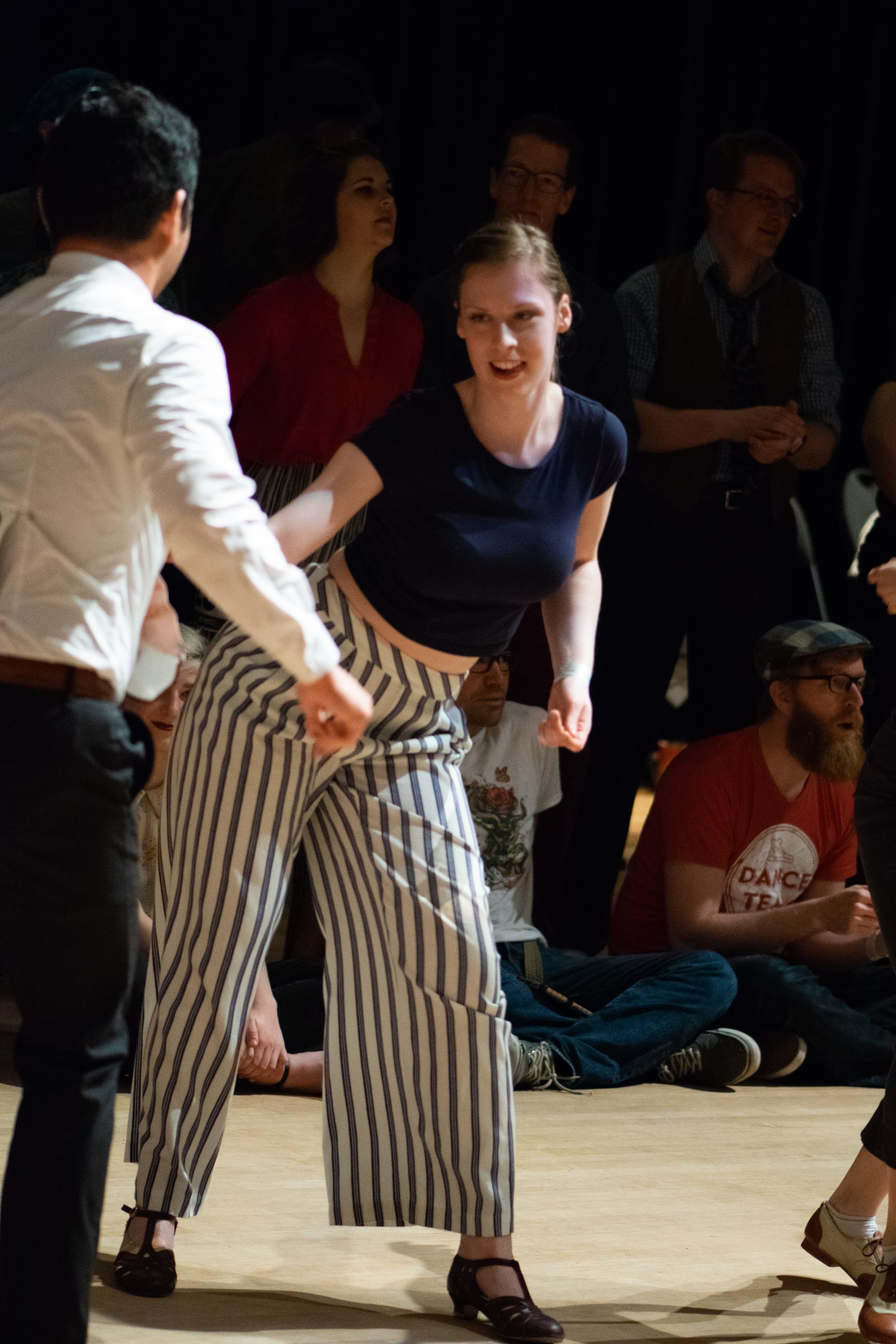
Lindy Hop dancer in striped pants
quinet
- Source:
- Wikimedia Commons
- Rights:
- Reusable with conditions: credit the creator. Source record ↗
- Recorded as:
- cc by 2.0
Lindy Hop has been central to discussions of cultural ownership, African American artistic legacy, and how marginalized dance forms survive and thrive outside their originating communities. This photograph documents the modern competitive Swing scene—a space where the dance continues to evolve, be transmitted across generations and continents, and be claimed by dancers of all backgrounds. For historians and dancers, it is evidence of how a vernacular social dance has become formalized into a competitive practice while retaining connection to its era of origin.
What you are looking at
A Lindy Hop dancer in the center of a wooden floor performs for an audience seated and standing around them in darkness. The dancer wears a navy blue short-sleeved t-shirt tucked into high-waisted, wide-legged striped trousers (navy and white vertical stripes) with dark loafers; the cut and fit of the clothes evoke 1940s swing-era menswear. A male dance partner in a white shirt faces the soloist, mid-interaction. The setting appears to be an indoor competition or showcase, with spectators visible in the background—some seated on the floor, others standing—creating an intimate, close-quarters performance space typical of swing dance competitions. The lighting is theatrical and focused on the dancers, with the audience in near-total darkness.
The dancing
The featured dancer is in a moment of weight shift or footwork emphasis, with knees slightly bent and the body engaged in the characteristic bouncy, grounded energy of swing dancing. The posture is upright but fluid, with the torso remaining relatively still while the legs and feet carry the movement. The facing dancer in the white shirt appears to be in connection, suggesting this is a partnership moment rather than a solo. Both dancers show the relaxed yet controlled frame typical of Lindy Hop—not ballroom-formal, but clearly structured and intentional.
The dance depicted
This is Lindy Hop, the African American swing-era partner dance that emerged in Harlem in the 1920s–30s. The 2018 Lindy Bout XII competition in Vancouver confirms the context: this is modern competitive swing dancing, where dancers from around the world gather to perform the style in a social, battle-like format. The dress—particularly the high-waisted trousers and loafers—references the authentic 1940s menswear aesthetic of the golden age of swing, a deliberate choice in contemporary Lindy Hop culture to honor the dance's roots. The close-quarters audience and floor-level performance space reflect how Lindy Hop is often danced in modern competitions: intimate, social, with spectators as witnesses rather than distant observers.
How it was made
This is a digital photograph, likely taken during a live competition event. The theatrical lighting, focused on the dancers with the audience rendered nearly black, suggests either the photographer's deliberate exposure choice or the actual venue lighting design. The close framing and hand-held perspective give an immediate, on-the-moment quality; this is documentary rather than staged portraiture. The image resolution and color reproduction are consistent with contemporary smartphone or semi-professional digital photography, which is now the standard for capturing competitive dance events.
About this work
This photograph documents a moment in 21st-century competitive Lindy Hop, capturing both the movement itself and the cultural practice of Swing dancing preservation and transmission. Lindy Hop—born in Depression-era Harlem and nearly lost after the 1950s—has experienced a sustained revival since the 1980s, particularly in Europe and North America. This 2018 competition scene shows the dance not as historical reconstruction but as living, evolving practice, with contemporary dancers intentionally adopting period dress to signal respect for origins. The image matters because it shows Lindy Hop as a working social dance with its own contemporary competition culture, not as a museum piece or novelty revival.
How to look at it
Notice the stillness of the torso contrasted with the engaged, slightly bent knees: this is the characteristic 'bounce' or elasticity of Lindy Hop, where momentum comes from the legs and feet rather than the upper body. Watch for the facial expression—focused and present, not performing for the camera. The striped trousers are not mere costume; they are a deliberate citation of 1940s menswear worn by the original Lindy Hop pioneers, a visual argument about the dance's history and the dancer's respect for it. The close-quarters performance and audience placement tell you that this is a social/competitive dance, not a theatrical spectacle—Lindy Hop belongs on a dance floor with people, not on a stage.
The artist
The photographer is credited as 'quinet' on Wikimedia Commons. No further biographical information is available in the record. The image appears to be user-generated event photography, likely taken by an attendee or volunteer photographer at the competition.
The period
Lindy Hop emerged in Harlem in the late 1920s and reached its peak popularity in the 1930s–40s, evolving in African American dance halls like the Savoy Ballroom. The dance nearly disappeared after the 1950s as musical fashion shifted. Beginning in the 1980s, primarily in Sweden and California, Lindy Hop experienced a deliberate revival led by dancers determined to research and preserve the style through historical film, interviews with surviving dancers, and reconstruction of technique. By the 2010s, when this photograph was taken, Lindy Hop had become an established international competitive dance form with a self-conscious connection to its historical roots. The aesthetic choice of vintage dress in modern competitions reflects this revival culture's relationship to authenticity and historical consciousness.
Where it lives
This photograph is held in Wikimedia Commons, a freely licensed media repository. It was uploaded to document the 2018 Lindy Bout XII competition in Vancouver, Canada, a recurring international swing dance competition.
Dance in this work
Questions about this work
What is Lindy Hop?
Lindy Hop is a partner swing dance that originated in Harlem, New York, in the late 1920s in African American dance halls and speakeasies. It evolved alongside big-band jazz and is characterized by a grounded, bouncy movement quality, improvisation within structure, and dynamic partnership. The dance nearly disappeared mid-century but experienced a major international revival beginning in the 1980s.
Why the vintage clothes?
In modern competitive Lindy Hop, dancers often wear 1930s–40s-era clothing as a deliberate homage to the original dancers and the dance's golden age. This is both aesthetic choice and historical claim—it signals that the dancer knows and respects the dance's roots in Depression-era Harlem.
How is this different from ballroom swing?
Lindy Hop is a social/vernacular dance with roots in African American culture, whereas ballroom swing (East Coast Swing) is a formalized, technique-standardized version. Lindy Hop emphasizes improvisation, flexibility, and a closer connection to the music's rhythmic complexity. The frame is looser, the energy grounded rather than lifted, and the aesthetic is casual and playful rather than formal.
What is 'Lindy Bout'?
Lindy Bout is an international swing dance competition held annually in Vancouver since the early 2000s. Dancers compete in categories including solo jazz, Lindy Hop partnerships, and showcase performances, making it a hub for the global competitive swing dance community.
More dance artwork





