49 works in this view — arrow keys or swipe to move between them.
Dance in Art
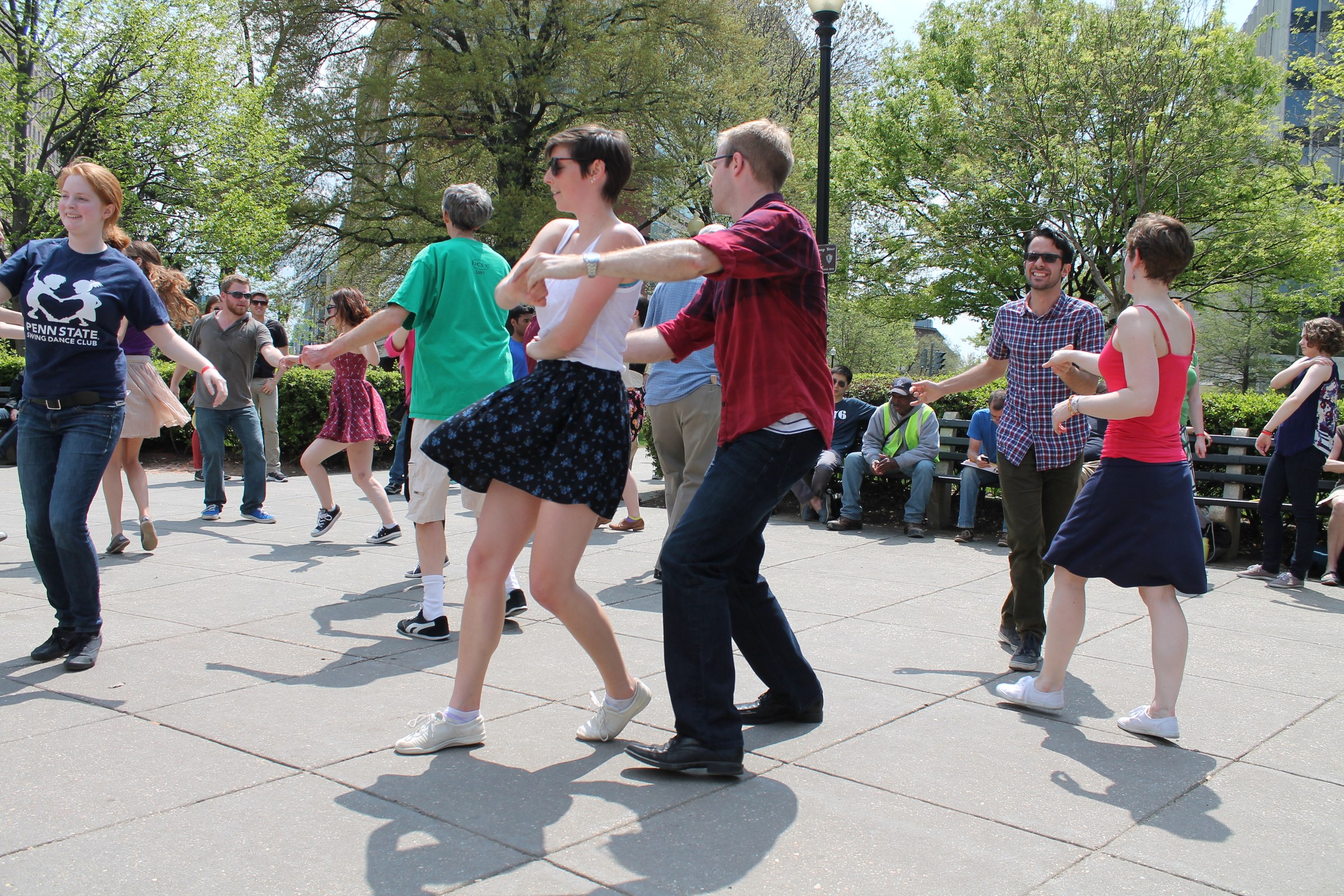
Lindy Hop at Washington, DC's DuPont Circle
Elvert Barnes
- Source:
- Wikimedia Commons
- Rights:
- Reusable with conditions: credit the creator; share any adaptation under the same license. Source record ↗
- Recorded as:
- cc by-sa 2.0
For dancers and historians, this image provides contemporary evidence of how Lindy Hop is taught, learned, and danced as a social practice today. It shows the partnered frame, the rotational movement, and the physical connection between dancers in a clear daylight setting, making it possible to analyze technique and transmission across a century. It also documents the public, community-centered social practice that is fundamental to understanding swing dance culture—not as museum piece, but as living tradition.
What you are looking at
A large group of dancers and spectators occupy a sunlit plaza at DuPont Circle in Washington, DC. The setting is urban and public: manicured shrubs, lamp posts, and leafy trees frame the scene, with office buildings visible in the background. Two dozen or more people are distributed across pale stone pavement, some dancing in pairs or small clusters, others standing and watching from benches and the margins. The afternoon light casts sharp shadows across the ground. Dancers wear casual contemporary dress—jeans, skirts, t-shirts, sneakers, sunglasses—not period costume. The mood is social and recreational: this is a festival day when swing dancers gather in public space to dance together, teach one another, and perform the social dances of their culture.
The dancing
At least six pairs are visible in various stages of movement. The most prominent couple in the center frame shows a man in a burgundy shirt and a woman in a floral skirt and sunglasses executing what appears to be a swing-era partnered turn, with his arm extended to support her rotational movement. Their posture is upright and connected. Other couples nearby show similar partnered holds and weight-sharing characteristic of partner dances. Arms are extended, frames are open, bodies are angled to accommodate circular or pivoting movement. The dancers' weight appears mobile and responsive rather than fixed.
The dance depicted
This is Lindy Hop, the swing dance that emerged in African American communities in Harlem in the late 1920s and became a major social dance of the swing era. The photograph documents a contemporary social dance event—the 13th Lindy Hopping Festival at DuPont Circle in April 2014—where dancers gather to continue the tradition as a living social practice. The image shows the characteristic paired structure, the open and closed positions, the rotational momentum, and the responsive connection between partners that define the style. No theatrical performance is taking place; this is vernacular social dancing in public space, a practice that echoes the dance halls and streets where Lindy Hop was born.
How it was made
This is a color photograph, digital or film-based, taken in bright afternoon daylight with natural outdoor illumination. The photographer (credited as Elvert Barnes) has chosen a wide enough frame to capture multiple couples and the surrounding urban plaza, anchoring the dance within its public community setting. The clarity of the image and the visibility of dancers' faces, feet, and framing allows analysis of technique and historical authenticity. Photography is the ideal medium for documentary evidence of social dance practice: it captures multiple dancers simultaneously, freezes a moment of movement, and serves as a record for researchers, practitioners, and archivists.
About this work
This is a color photograph of Lindy Hop dancers at a contemporary social dance festival in Washington, DC. The work documents the persistence and celebration of a twentieth-century African American vernacular dance as a living social practice in the early twenty-first century. It shows not a theatrical performance or a historical reconstruction, but the ongoing cultural life of a dance community—multiple couples dancing together in public, teaching one another, embodying the partnered technique, musical responsiveness, and social pleasure that have always defined Lindy Hop.
The photograph belongs in a dance gallery because it captures both the technique and the cultural context of one of the most influential American dances. It shows how Lindy Hop has been sustained, transmitted, and celebrated across generations, and it documents the physical reality of partner connection, frame, and movement that historians and dancers study when they seek to understand how the dance was and is performed.
How to look at it
Watch the couple at center: the man's right arm extended to support the woman as she pivots or spins, her body angled away from him, his weight balanced to lead and follow her momentum. This is the fundamental partnered connection of Lindy Hop—responsive, shared, requiring continuous communication through the hands and frame. Notice too that multiple couples are dancing simultaneously in the same space, sometimes navigating around one another; this reflects the social, non-theatrical context in which swing dancing actually happened and still happens. The casual dress and daylight setting are essential: this is not a performance for an audience, but a community practice in which spectators and dancers intermix.
The artist
Elvert Barnes is a Washington, DC-based photographer known for documentary photography of community events, cultural practices, and public life in the DC area. The photograph is credited to Elvert Barnes Photography and appears in the Wikimedia Commons, suggesting distribution through open-access digital archives rather than fine-art gallery circulation.
The period
Lindy Hop emerged in the 1920s in Harlem and reached peak popularity in the swing era of the 1930s and 1940s. After World War II, the dance declined in mainstream American culture, displaced by rock and roll and subsequent popular dances. From the 1980s onward, a global revival movement has sustained and celebrated swing dancing through social dance communities, weekend events, competitions, and festivals. This photograph from 2014 documents that revival at the moment it had become well-established enough to support large public festivals in major US cities. The dancing visible here is informed by historical research, video documentation, and transmission from older dancers who remembered the original swing era.
Where it lives
This photograph is held in Wikimedia Commons, a free-access digital archive. It was taken by Elvert Barnes, credited as Elvert Barnes Photography, on April 26, 2014, at an outdoor public festival in Washington, DC. The photograph was likely uploaded to Wikimedia Commons as a documentary record of a community cultural event.
Dance in this work
Questions about this work
Is this the original swing era, or a revival?
This is a contemporary social dance community (2014), part of the global swing dance revival that began in the 1980s and continues today. The dancers learned Lindy Hop through modern classes, video documentation, and transmission from older dancers or historical communities, rather than through the original 1930s–1940s cultural context. However, they are practicing an authentic version of the dance—the same technique, partnership, and musical responsiveness that characterized the original social practice.
Why is Lindy Hop danced in the street?
Lindy Hop is a social dance, not a theatrical one, and the original practice happened in dance halls and social spaces where dancers came together to dance for pleasure and community. Contemporary Lindy Hop festivals often take place in public parks or plazas to celebrate the dance openly, recruit new dancers, and reclaim public space as a site of cultural practice. This mirrors the original social, non-theatrical context of the dance.
How can you tell this is Lindy Hop and not another swing dance?
Lindy Hop is characterized by partnered movement with continuous frame connection, rotational and circular motion, and a particular style of turn and footwork. The image shows multiple couples in open and closed positions, extended arms for frame and lead-follow communication, and the kind of rotational momentum that defines the style. The event itself is identified in the archival record as a Lindy Hop festival, which the photograph documents.
Who dances Lindy Hop?
In its original form (1920s–1940s), Lindy Hop was danced primarily in African American communities in Harlem and later spread to other communities. Today, Lindy Hop is danced by a global, racially diverse community of social dancers who have chosen to learn and celebrate the dance. The photograph shows a contemporary community event in Washington, DC, reflecting that modern practice.
More dance artwork





