49 works in this view — arrow keys or swipe to move between them.
Dance in Art
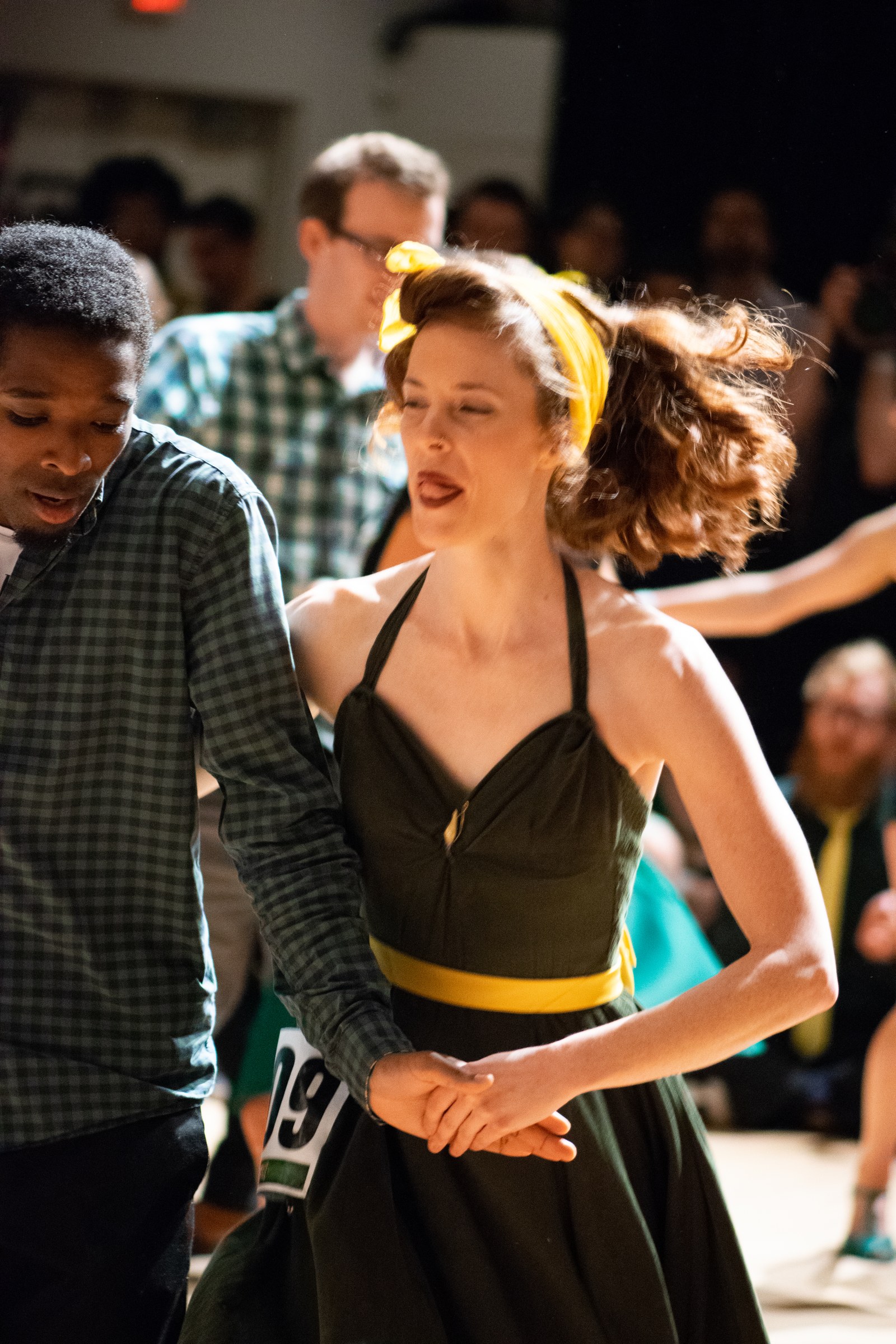
Hand-in-hand Lindy Hop dancers
quinet
- Source:
- Wikimedia Commons
- Rights:
- Reusable with conditions: credit the creator. Source record ↗
- Recorded as:
- cc by 2.0
For Lindy Hop dancers and historians, this image documents the hand-in-hand connection and frame that define modern competitive Lindy Hop, showing the posture, weight distribution, and energy level expected in contemporary performance. It also illustrates the retro-styling convention in the swing dance community, where dancers deliberately adopt period costume and grooming to honor the dance's historical roots while competing in the present day.
What you are looking at
A competition Lindy Hop partnership caught mid-dance at what appears to be an indoor venue with spectators lining the edges. The woman, nearest to the camera, wears a striking black halter-neck dress with a yellow belt and headband, her brown hair styled in vintage waves. She holds a competition number (19) pinned to her dress. Her partner, in a blue-and-white checked shirt, dances beside her in a hand-in-hand position. The lighting is warm and theatrical, casting the dancers in sharp relief against the darker background where judges or audience members sit blurred but visible. The framing captures the dancers mid-movement, with the woman's body angled and engaged, suggesting an active step or swing-out in progress.
The dancing
The couple dances in a hand-in-hand connection rather than the closed ballroom hold, which is characteristic of Lindy Hop. Both dancers are upright and energized, with bent knees indicating active weight transfer through the feet. The man's left hand clasps the woman's right hand at roughly chest height; their arms are relatively straight and connected but not rigid. The woman's free arm (left) is positioned actively, and her body shows the slight sway and hip action typical of swing dancing. The spacing between them suggests they are in a variant of the swing-out or a traveling figure, with good frame and connection despite the open position.
The dance depicted
This is definitively Lindy Hop, a swing dance born in Harlem in the 1930s that became the dominant partner dance of the swing era and survives in competitive form today. The hand-in-hand hold, the energized upright posture, the bent-knee action, and the competition context (the numbered dress, the formal venue, the judges' presence) all confirm this identification. The woman's vintage-styled hair and makeup, paired with the 1940s-inspired dress, suggests the dancers are embracing the retro aesthetic common in modern Lindy Hop competition, where dancers often adopt period costume. This image documents how Lindy Hop persists as a living competitive dance form with its own rules, judging criteria, and community events, as evidenced by the 2018 Vancouver competition setting.
How it was made
This is a color photograph, likely taken with a digital camera in an indoor competitive setting. The shallow depth of field—sharp focus on the dancers, with spectators and background blurred—indicates either a telephoto lens or portrait-mode processing, a technique that isolates the subjects and emphasizes their movement. The warm tungsten or LED lighting of the venue is preserved in the image's color temperature. As a candid competition photograph, it captures a live moment rather than a posed or staged scene, giving it documentary immediacy. The quality and color saturation suggest professional or semi-professional documentation, typical of competition photography intended for publicity or archival purposes.
About this work
This photograph documents a moment from the 2018 Lindy Bout XII swing competition in Vancouver, showing a male-female partnership executing a hand-in-hand Lindy Hop figure. The woman, wearing competition number 19 and period-styled costume, dances with full engagement, her partner matching her energy and frame. Lindy Hop remains a globally practiced competitive dance form, and this image captures how the style maintains continuity with its 1930s–1940s origins while existing as a contemporary sport with its own judging standards, venues, and international circuits. The photograph is valuable precisely because it shows the dance in context: under competition conditions, in costume, with visible technique and connection between partners.
How to look at it
Watch for the hand connection and the slight angle of both dancers' bodies—neither is perfectly upright, and both show the characteristic Lindy Hop 'bounce' or sway that comes from driving through the knees. Note how the woman's frame remains open and responsive despite the open hand-in-hand position; she is not sagging into her partner but actively dancing her own steps. The moment captured appears to be early in a traveling figure, with both dancers moving forward and to the side, which is why the woman's weight appears slightly forward and her body angled. The stadium lighting and the visible audience mark this as a formal competitive setting, not a social dance, and the precision of both dancers' posture reflects training and match experience.
The artist
The photographer is credited as quinet on Wikimedia Commons. No further information about their background or practice is recorded in the catalogue.
The period
Lindy Hop experienced a revival beginning in the 1980s and 1990s, driven by enthusiasts in Europe and North America who learned the dance from aging masters and archival sources. By the 2010s, Lindy Hop had established itself as a competitive ballroom-adjacent dance form with international competitions, regular social dances, and a community that spans multiple continents. The 2018 date places this image well into the era of modern competitive swing, where dancers balance historical authenticity with contemporary athleticism. Competition venues, rules, and judging criteria have been formalized, and events like Lindy Bout (held annually in Vancouver) attract dancers from North America and beyond.
Where it lives
The image is held on Wikimedia Commons under a public license. It is documented as coming from the 2018 Lindy Bout XII competition in Vancouver, Canada, one of the major recurring Lindy Hop competitions in North America.
Dance in this work
Questions about this work
What is the hand-in-hand position in Lindy Hop?
Hand-in-hand is an open position in which partners face the same direction or at a slight angle, connected only by one hand (or sometimes both hands). It allows for quick weight changes, spins, and directional shifts that would be impossible in a closed ballroom frame. It is a fundamental building block of Lindy Hop, used for traveling figures, directional changes, and leading into other moves like swing-outs and aerials.
How do you tell this is a competition and not a social dance?
The competition number pinned to the woman's dress (19), the formal indoor venue with spectators seated around the perimeter, the theatrical stage lighting, and the high level of synchronization and polish all mark this as a formal competitive event. Social Lindy Hop dances occur in crowded dance halls or clubs, often with live music and less rigid framing. Competition dances are judged on technique, musicality, connection, and performance.
Why are they dressed like it's the 1940s?
The vintage aesthetic is a deliberate choice in the modern Lindy Hop community, rooted in respect for the dance's historical origins and the Golden Age of swing (1930s–1940s). Many competitive Lindy Hop dancers adopt period hairstyles, makeup, and clothing as part of the performance. This practice honors the dancers who originated Lindy Hop in Harlem and maintains a visible link to the dance's past.
More dance artwork





