49 works in this view — arrow keys or swipe to move between them.
Dance in Art
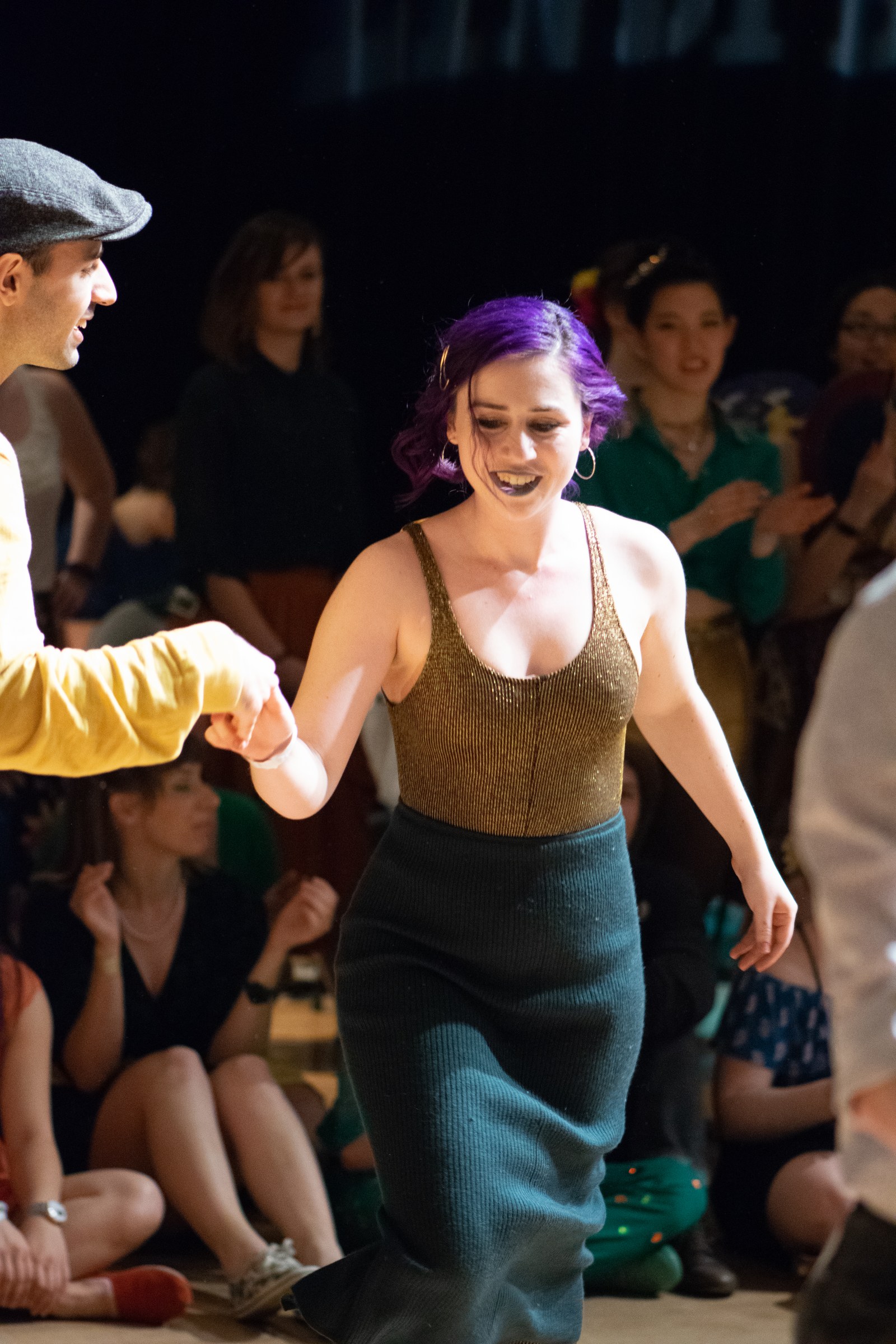
Purple-haired Lindy Hop dancer
quinet
- Source:
- Wikimedia Commons
- Rights:
- Reusable with conditions: credit the creator. Source record ↗
- Recorded as:
- cc by 2.0
Lindy Hop is one of the most important vernacular dances of the 20th century and remains a major social dance worldwide. This photograph captures the contemporary swing scene at a specific moment and place, showing how the dance is taught, learned, and celebrated outside theatrical or commercial contexts. For historians and dancers, it is evidence of how Lindy Hop exists now: not as nostalgia or recreation, but as an evolving practice shaped by its current dancers.
What you are looking at
A competition moment frozen mid-swing at Lindy Bout XII in Vancouver. A woman with striking purple-tinted hair dances in a closed position with her male partner, who wears a grey flat cap and yellow shirt. She wears a bronze-gold ribbed tank top and dark teal ribbed skirt, moving with visible momentum and joy. The couple occupies the center of what appears to be a dance floor or performance space, surrounded on three sides by seated and standing spectators in casual dress—a clear sign of a social swing dance competition rather than a theatrical stage. The lighting is theatrical and focused, highlighting the dancers while leaving much of the crowd in shadow. The woman's expression shows delight; her body is angled slightly away from her partner in the characteristic momentum of a swing-out or similar traveling figure.
The dancing
The dancers maintain a closed position (ballroom frame) with the woman's right hand on the man's left shoulder and his right hand on her back or side. Both dancers show weight on their back legs with forward momentum, suggesting they are in the middle of a traveling step or swing-out figure. The woman's posture is upright but relaxed, her body showing the slight counterbalance typical of swing dancing when both partners are moving in opposing directions. Her skirt shows movement and sway, indicating the rhythm is active and she is moving with spring in the basic 6-count or 8-count timing of Lindy Hop.
The dance depicted
This is Lindy Hop, documented at a live swing dance competition. Lindy Hop is a partner swing dance with roots in 1930s Harlem, characterized by an 8-count basic step, closed and open positions, aerials, and improvised partnering. The image captures the social and competitive side of the contemporary swing dance revival: not stage performance but floor dancing in front of an audience of peers. The competitive context is essential—this is not a rehearsal or practice social, but a judged event where dancers are assessed on musicality, connection, technique, and entertainment value. The purple hair and modern clothing confirm this is 21st-century swing dancing, not a historical recreation.
How it was made
This is a photograph, likely digital, captured during a live event. The theatrical spotlight on the couple and the contrast between the lit dancers and shadowed crowd suggests either professional event lighting or digital enhancement in post-processing. The clarity and color saturation indicate a modern digital camera, probably a DSLR or mirrorless camera with fast enough shutter speed to freeze motion without blur despite the movement. The framing and focus place the dancers in sharp detail while the crowd remains visible but softer, a technique common in event photography that keeps the viewer's eye on the primary subjects.
About this work
This photograph documents Lindy Hop as a living, evolving social dance rather than a historical artifact or stage art form. Taken at Lindy Bout XII, a swing dance competition in Vancouver in 2018, it shows the dance as it is practiced and celebrated in the 21st century: competitive, social, diverse, and joyful. Lindy Hop has experienced a major global revival since the 1990s, drawing in new dancers who approach it as a contemporary social dance rather than a retro hobby. This image belongs in a dance gallery because it is evidence of the dance's vitality, its embedding in community and competition, and the way dancers use performance to express musicality and connection.
How to look at it
Watch the couple's relative position and the woman's expression. The moment is joyful and present: she is looking at her partner, not at the camera. The positioning—both dancers with weight back, the woman's body angled away—suggests this is mid-swing-out or a similar traveling figure where the partners are moving apart slightly before coming back together. Notice how the closed position frame is maintained despite the forward momentum; this is the defining skill of swing dancing. The visible swaying of her skirt and the slight extension of her arms shows this is not a slow, formal waltz frame but an energetic, bouncy one.
The artist
The photographer is credited as 'quinet' on Wikimedia Commons. Beyond that attribution and the date, no information about the artist's practice or training is recorded. The photograph's technical competence and framing suggest professional or advanced-amateur event photography.
The period
By 2018, Lindy Hop had been revived globally for over two decades. The World Swing Dance Council had established international competition standards; regional competitions like Lindy Bout had become established fixtures in swing dance culture. The revival had diversified the dance's practice: dancers of all ages, backgrounds, and body types learned it; queer and mixed-gender partnerships became normalized; and the dance had moved beyond its historical Harlem context to become a global phenomenon. Photography and digital media had also transformed how dancers documented and learned the dance—Instagram and YouTube had become primary channels for sharing technique and celebrating social dancing.
Where it lives
This photograph is held in Wikimedia Commons, a publicly accessible media repository. It was uploaded in 2018 and tagged with information about the event and location, making it one of thousands of images of contemporary swing dance on public platforms.
Dance in this work
Questions about this work
What is Lindy Hop?
Lindy Hop is a partner swing dance that emerged in Harlem in the 1930s. It is danced to swing and jazz music, uses both closed and open positions, includes aerials and tricks, and emphasizes improvisation, musicality, and partnership. The dance was nearly extinct by the 1980s but has experienced a major global revival since the 1990s.
What is Lindy Bout?
Lindy Bout is an annual swing dance competition held in Vancouver, Canada, attracting competitors and spectators from across North America. Dancers compete in different categories (Jack and Jill, strictly swing, showcases) and are judged on technique, musicality, connection, and entertainment value.
Why is the woman's hair purple?
The purple hair is a choice by the individual dancer. It reflects contemporary swing dance culture, which tends to be creative, expressive, and inclusive of diverse styles and identities. Hair color in swing dancing is purely a matter of personal expression.
Is this performance or social dancing?
It is competitive dancing: a formal competition event judged by panels. Competitive swing dancing sits between 'pure' social dancing (where dancing for fun is primary) and staged theatrical performance (where the audience's view is the primary concern). Competitors dance for judges and audience simultaneously.
More dance artwork





