49 works in this view — arrow keys or swipe to move between them.
Dance in Art
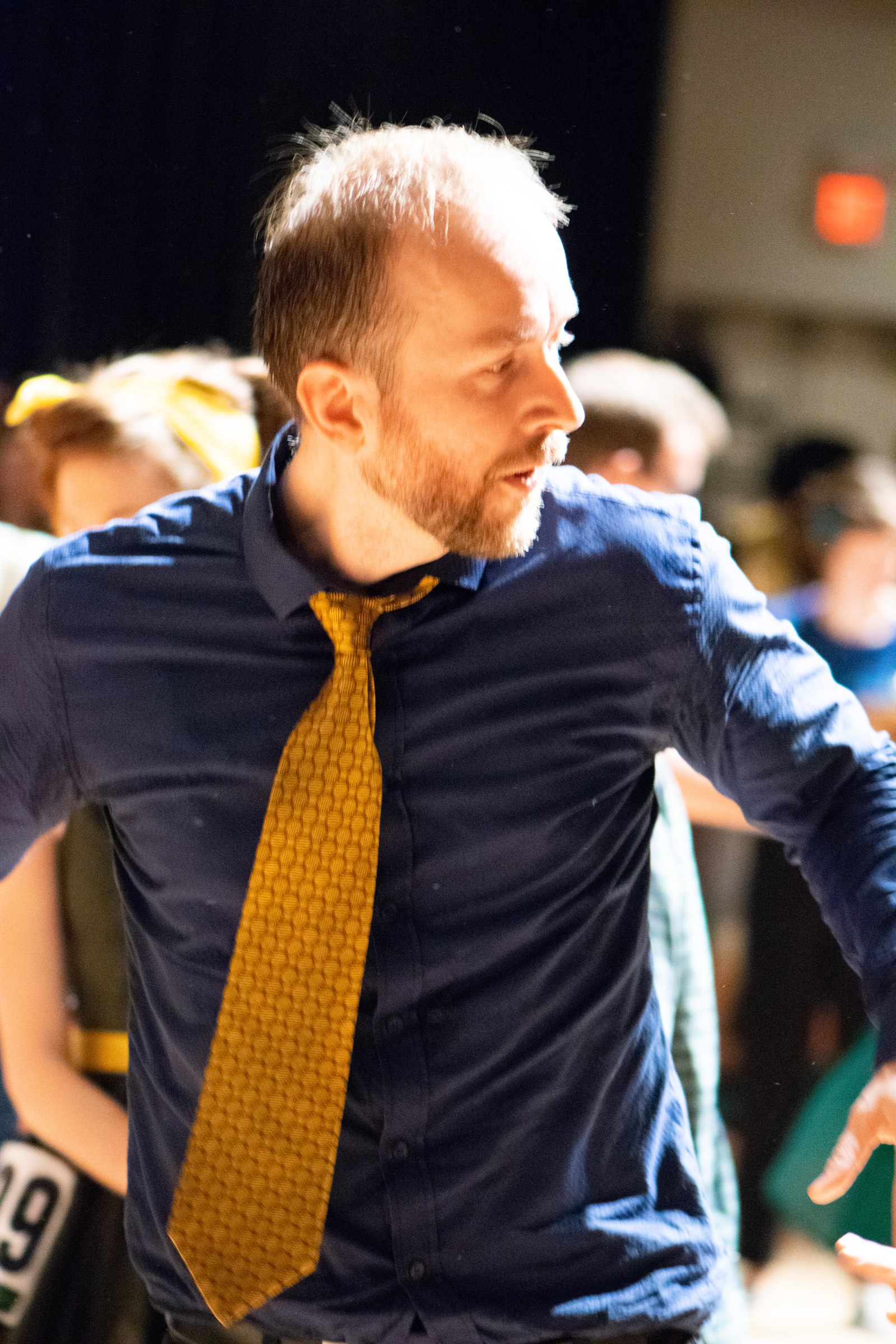
Lindy Hop dancer with yellow tie and blue shirt
quinet
- Source:
- Wikimedia Commons
- Rights:
- Reusable with conditions: credit the creator. Source record ↗
- Recorded as:
- cc by 2.0
Lindy Hop is foundational to American dance culture and continues to evolve; this photograph shows how the dance is preserved, taught, and performed in the 21st century through competition. For historians and dancers, it is evidence of how swing culture has transformed from social dance into a globally distributed, formally judged competitive discipline with its own conventions and standards. The image captures the athleticism and control that modern Lindy demands — information that cannot be found in written history.
What you are looking at
A man in formal business dress — navy shirt and golden-yellow tie — stands at what appears to be an indoor competition or event venue. His body is caught mid-movement, weight shifted forward with a dynamic lean, mouth open in what reads as exertion or enthusiasm. The lighting is stage-quality, with warm amber tones illuminating his figure against a dark background. Behind him, other dancers and spectators are visible but out of focus, suggesting a crowded competition floor. The setting and the energy captured — the forward momentum, the intensity of focus — suggest the heat of a competitive moment rather than a casual social dance.
The dancing
The lead dancer is alone in sharp focus, his weight and balance centered in his torso with forward momentum. His posture shows the athletic engagement typical of swing competition — shoulders engaged, slight forward lean, the whole frame alive with energy. No partner is visible in frame, or only barely out of focus, which may indicate the photographer has isolated the lead figure or that the moment captured shows him between figures in a complex pattern. His formal shirt and tie suggest this is a sanctioned competitive event where dress codes are enforced.
The dance depicted
This is Lindy Hop, captured at a competitive swing and jazz dance event. The catalogue confirms the context as Lindy Bout XII (2018) in Vancouver. Lindy Hop developed in African American dance culture in the 1930s and remains a partner social dance with competitive and performance variants. What the image shows is the athletic, committed physicality of competitive Lindy — the body fully engaged, the moment chosen to show effort and control rather than relaxation. The formal dress code reflects the evolution of swing from street dance to ballroom standard; by 2018, competitive Lindy operated within structured judging frameworks and presentation standards.
How it was made
This is a photograph, likely digital given the date and the image quality. The photographer (credited to quinet on Wikimedia Commons) has composed a tight frame isolating the lead dancer against the competition background, using stage lighting to create separation. The shutter speed is fast enough to freeze energetic movement while maintaining sharpness — a technical choice that emphasizes the dancer's control and power. The photograph's clarity and its circulation on Wikimedia Commons as a public record of a competitive event makes it a form of event documentation as much as artistic photography.
About this work
This photograph documents a moment from Lindy Hop competition at Lindy Bout XII, a major swing dance event. It shows how Lindy Hop — a dance born in Depression-era social halls and street culture — had by 2018 become a formally structured competitive discipline with judging standards, dress codes, and international tournament circuits. The image is valuable not as a single artistic statement but as a record of how swing is danced and presented in contemporary competition: the athletic commitment, the formal presentation, the intensity required to succeed at this level. It belongs in a gallery of dance in art because it documents the actual practice and culture of a major dance form in real time, showing viewers what competitive Lindy looks like from the inside.
How to look at it
Look at the dancer's center of gravity and weight distribution — the forward lean and engaged core show how Lindy in competition demands constant center control while traveling through space. The open mouth and facial intensity are part of competitive presentation and genuine exertion. Notice the formal dress code: this is not a social dance captured in street clothes or practice wear, but a sanctioned performance within institutional frameworks. The stage lighting and background blur show this is an official event with professional documentation standards, not a casual gathering.
The artist
quinet is credited as the photographer on Wikimedia Commons. Beyond this, no further artist information is available in the catalogue record.
The period
By 2018, Lindy Hop had undergone a complete transformation from its 1930s origins as an improvised partner social dance in African American working-class venues. The 1980s and 1990s saw a global Lindy revival among cultural enthusiasts, historical dancers, and competitive athletes. By the early 21st century, swing dancing had become formalized into competing styles: pure Lindy revival (attempting historical authenticity), competitive Lindy (optimized for judging and spectacle), and fusion variants blending swing fundamentals with other movement vocabularies. Lindy Bout is a major competition in this ecosystem, hosting hundreds of dancers and operating within established rules for partnership, musicality, execution, and presentation. The photograph captures this moment of formalization and global circulation.
Where it lives
The photograph is held on Wikimedia Commons under a public license and is attributed to photographer quinet. It documents Lindy Bout XII, held in Vancouver, Canada in 2018. Lindy Bout is an annual competitive swing dance event that draws dancers from across North America and internationally.
Dance in this work
Questions about this work
What is Lindy Hop and where did it come from?
Lindy Hop is a partner swing dance that emerged in 1930s Harlem in African American communities and spread across the United States as part of the swing era of jazz. It is characterized by 8-count patterns, aerials, partner connection, and musical responsiveness. The dance nearly died out after the 1950s but has undergone a continuous revival since the 1980s, now danced globally in social contexts and competitions.
Why is he wearing formal business dress to a dance event?
Competitive Lindy Hop, like ballroom dance, operates within dress codes designed to present dancers as serious athletes and performers. The formal shirt and tie are required or strongly encouraged at sanctioned competitions like Lindy Bout. This reflects how swing, once a street and social-hall dance, has been institutionalized into formal competitive structures.
Is this a solo or a partner dance?
Lindy Hop is fundamentally a partner dance, but the photograph isolates the lead dancer. In competition, leads and follows are judged partly as individuals on their technique, frame, and execution, so focusing on the lead's effort and control is a valid compositional choice for event photography.
What does the intensity in his face tell us?
In competitive Lindy, facial expression and energy projection are part of the performance standard. The open mouth and engaged expression show both genuine physical exertion — partner swing is aerobic — and conscious performance. Competitive judges in modern swing events reward dancers who show commitment and connection to the music.
More dance artwork





