49 works in this view — arrow keys or swipe to move between them.
Dance in Art
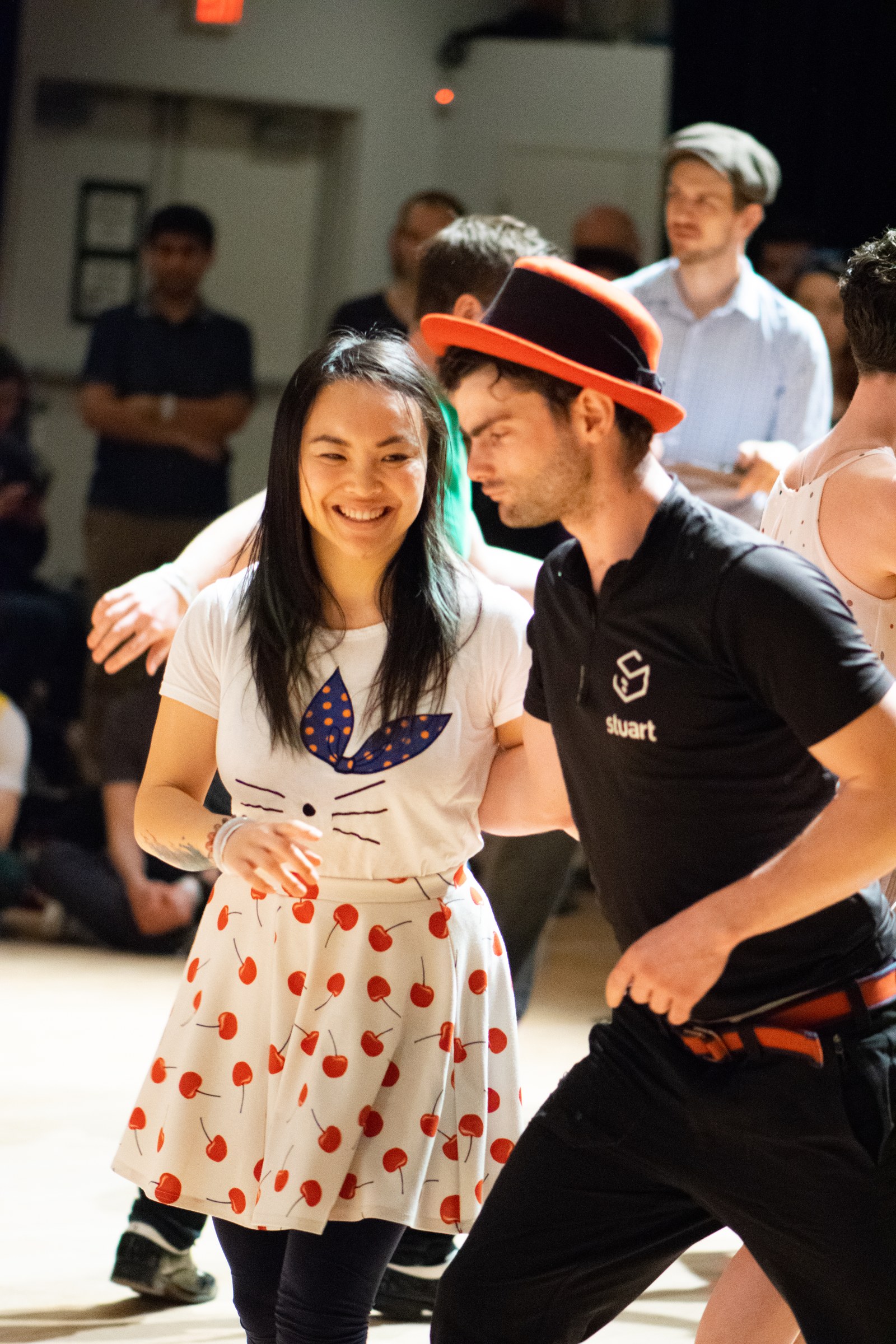
Lindy Hop dancer with red hat and red belt
quinet
- Source:
- Wikimedia Commons
- Rights:
- Reusable with conditions: credit the creator. Source record ↗
- Recorded as:
- cc by 2.0
Lindy Hop is a foundational American vernacular dance, born in Black communities and spread globally, and it remains a vital social practice today. This image is valuable because it shows the dance as it actually lives—not as a historical reenactment or theatrical recreation, but as a contemporary social practice with its own community, aesthetics, and values. For historians of dance, it documents how swing culture has adapted and persisted into the twenty-first century, including the ways modern dancers individualize and play with costume and presentation.
What you are looking at
Two dancers occupy the center of an indoor venue's dance floor, surrounded by onlookers in a casual social setting. The woman wears a playful cat-themed outfit: a white t-shirt printed with a stylized feline face in blue and orange, paired with a cream-colored skirt printed with red cherries and dark blue leggings beneath. A green feather or decoration is visible in her dark hair. Her partner wears a black t-shirt with white branding (reading "stuart"), paired with black trousers, and sports a striking orange and black wide-brimmed hat. Both dancers are in motion, smiling broadly, captured mid-movement on what appears to be a polished concrete or wooden floor. The background shows a gymnasium or community space with white walls, an exit sign visible overhead, and a loose crowd of spectators standing at the perimeter, some in casual dress and others in dance attire, watching the performance. The lighting is bright and even, typical of an indoor competition or social dance event.
The dancing
Both dancers are upright and energetic, with relaxed frames and wide smiles suggesting social enjoyment rather than technical precision. The woman's body is angled slightly toward her partner, her arms positioned naturally at her sides and in light contact. The man's arm appears to be around her back or at her shoulder in a casual lead position. Both are mid-stride or mid-turn, their weight distributed across the floor in a grounded, bouncy rhythm rather than the lifted extension of ballroom frame. Their postures and the informality of their hold suggest social swing dancing rather than competitive ballroom technique.
The dance depicted
This is Lindy Hop, a partner swing dance that emerged in Harlem in the 1930s and became a staple of social dance floors and competitions throughout the twentieth century and into the present. The image documents a moment from the 2018 Lindy Bout XII competition in Vancouver—a regional swing dance championship. Lindy Hop is characterized by its relaxed, playful social frame, elastic timing, and improvisational quality, all visible here: the dancers are clearly having fun rather than executing a rehearsed routine, their clothing is streetwear rather than formal competition dress (which suggests this may be a social round or practice moment rather than a scored heat), and their body language shows the call-and-response, conversational quality typical of authentic swing dancing. The casual hat and decorated outfit signal the playful, individualistic aesthetic of the contemporary swing dance community.
How it was made
This is a color photograph, shot in natural indoor light with a shallow depth of field that keeps the dancers sharp while the background spectators are slightly out of focus. The photographic medium captures the moment in high detail, recording costume, expression, and body position with documentary clarity. The image has the character of social media or event documentation—the kind of candid performance photograph that circulates within dance communities to record events and celebrate participants. The bright, even lighting and the spontaneity of the framing (the photographer is at floor level, capturing movement as it happens) suggests this was shot by a participating community member or event photographer rather than a formal studio portrait.
About this work
This photograph documents a moment from a twenty-first-century swing dance competition, capturing the social energy and playful aesthetic of contemporary Lindy Hop. The 2018 Lindy Bout XII in Vancouver was one of many regional championships that have kept this 1930s partner dance alive and vital nearly a century after its emergence. The image shows not a polished theatrical performance but a social dance in its native habitat: two people dancing together for the pleasure of it, watched by peers and fellow dancers. What makes this work significant for a gallery of dance in art is precisely that it resists the theatrical frame. These dancers are not performing for an art audience; they are participating in a living tradition, and the photograph preserves that authenticity—the genuine joy, the informal costume, the casual setting, the community context.
How to look at it
Watch how the dancers' weight moves through their bodies: notice the relaxed knees, the engaged torso, the easy connection between partners. The photograph captures them mid-turn or mid-step, so their feet are not in a posed position—this is movement, not stillness. The setting is crucial: the gymnasium, the watching crowd, the casual dress all signal that this is social dance, not theater. Compare their frame and posture to a formal ballroom photograph and you will immediately see the difference. The smiles and direct gaze are also important—these dancers are present to each other and aware of their community around them, not lost in artistic abstraction.
The artist
The photographer is credited as "quinet" on Wikimedia Commons, but no additional information about their practice or identity is available from the catalogue record. The image was uploaded to Wikimedia and is publicly circulated, suggesting the photographer intended it as a community document rather than a signed artistic work.
The period
Lindy Hop experienced a major revival beginning in the 1980s and 1990s, when a new generation of dancers began researching historical swing dancing and establishing a global swing dance community. By 2018, when this photograph was taken, the contemporary swing scene included regional competitions, international festivals, and a thriving social dance culture in major cities across North America, Europe, and beyond. This period also saw growing attention to the African American origins of swing dance and efforts within the community to center Black dancers and choreographers. The playful, individualistic costumes visible here—the cat shirt, the decorative hat—reflect the contemporary swing aesthetic, which values personal expression and humor alongside technical skill.
Where it lives
The image was sourced from Wikimedia Commons, a digital repository of freely licensed media. It is catalogued as documenting the 2018 Lindy Bout XII swing and jazz dance competition held in Vancouver, Canada, but no museum or institutional collection is recorded.
Dance in this work
Questions about this work
What is Lindy Hop and why is it important?
Lindy Hop is a partner swing dance that emerged in Harlem in the 1930s and became one of the most influential vernacular dances of the twentieth century. It was danced in ballrooms and at social venues, and it shaped the development of many later dances. Today it remains a vital social dance tradition, with communities of dancers worldwide maintaining and evolving the practice. It is historically important as a central expression of African American culture and as a foundational partner dance form.
How can you tell this is Lindy Hop and not another swing dance?
The frame and style are characteristic of Lindy Hop: a relaxed, connected partnership with upright posture, grounded weight, and elastic, bouncy movement. The dancers are smiling and engaged with each other in the playful, conversational way typical of Lindy Hop social dancing. The catalogue record also confirms this is from a Lindy Hop competition (Lindy Bout), which is an annual event for the contemporary swing dance community.
Why photograph a social dance rather than a theatrical performance?
Social dance is where most people actually encounter dance in their lives, and where vernacular dances like Lindy Hop truly live. A competition photograph like this documents the dance as a practice, a community, and a way of being together—not just as a finished artistic product. It is also a way for the swing dance community to celebrate and circulate images of their members and events.
What do the costumes tell us about contemporary swing dancing?
The playful, individualistic costumes—the cat-themed shirt, the decorative hat—reflect a contemporary aesthetic that values personal expression and humor. Swing dancing in the twenty-first century is no longer confined to formal dress codes; dancers use clothing as a form of self-expression and community identity. The costumes also suggest that swing dancing is perceived as a joyful, social activity rather than a serious technical discipline, though of course skilled dancers take it very seriously.
More dance artwork





