49 works in this view — arrow keys or swipe to move between them.
Dance in Art
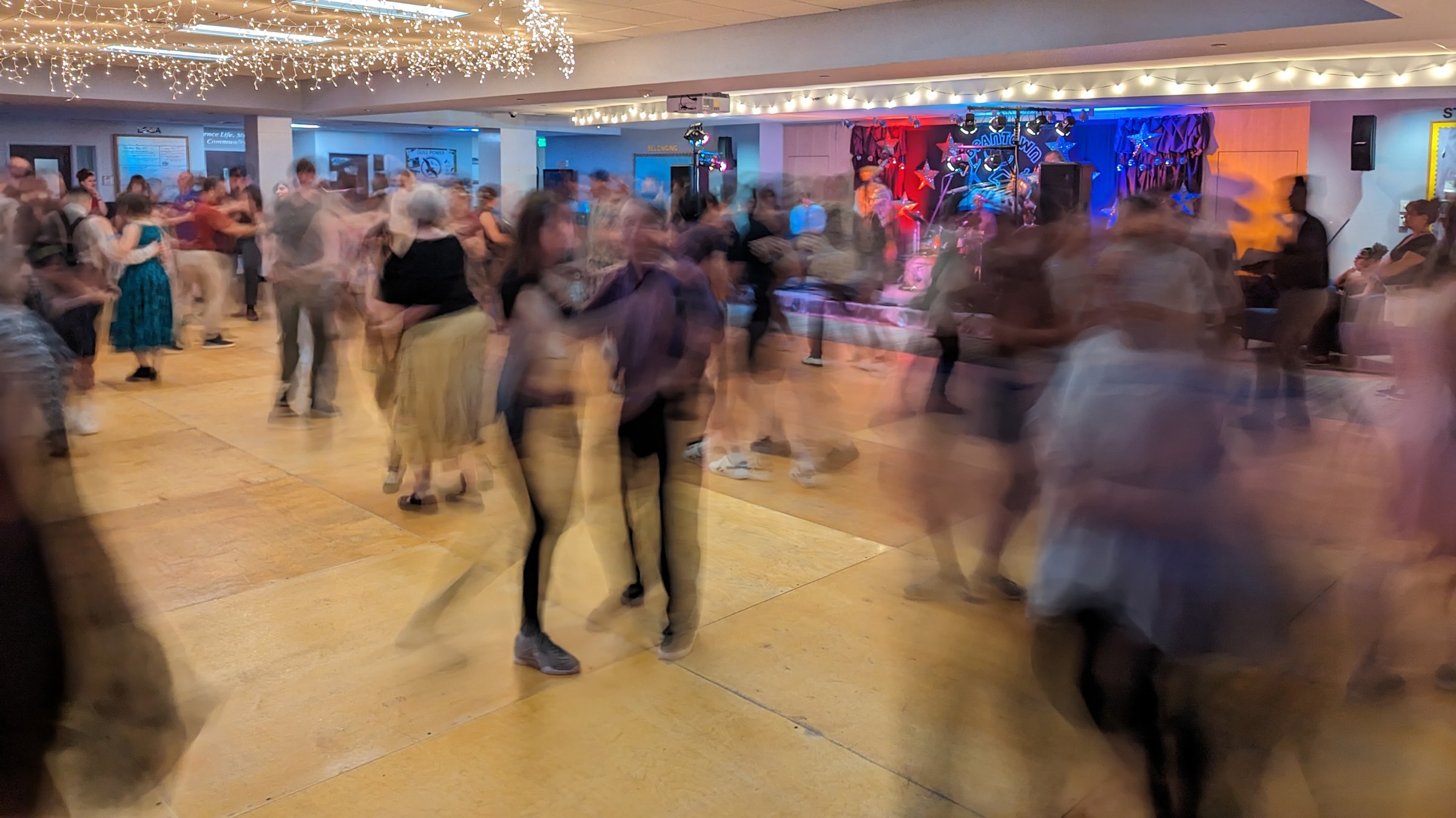
Beantown Lindy Hop Dance Camp 2023 long exposure 1
Sdkb
- Source:
- Wikimedia Commons
- Rights:
- Reusable with conditions: credit the creator; share any adaptation under the same licence. Source record ↗
- Recorded as:
- cc by-sa 4.0
Lindy Hop, developed in African American communities, became a touchstone of twentieth-century partner dancing and remains actively practiced in contemporary swing dance communities like Beantown Camp. This photograph documents the living tradition of social Lindy Hop—how contemporary dancers continue the practice, the venues they use, and the communal experience of the dance floor. For historians and practitioners, the image preserves evidence of swing dancing as a vital contemporary social practice, not a historical artifact.
What you are looking at
A long-exposure photograph captures the main dance floor of Beantown Camp during a Lindy Hop social dance event. The image shows dozens of dancers in motion across a wooden floor, their bodies blurred by movement into soft, ghostly trails of color and form. The setting is an indoor venue with a high ceiling hung with crystalline chandeliers and strung with warm white lights. The far wall glows with colored uplighting—blues, reds, and purples—creating a festive atmosphere. On the right side, a DJ booth or stage area is visible. The photograph freezes not a single moment but the accumulated motion of many dancers over several seconds, creating an impressionistic record of the event's energy and density. Dancers wear contemporary casual clothing, the men in shirts and trousers, the women in dresses and pants, with no period costume. The long exposure technique renders individuals barely recognizable; what emerges instead is the collective kinetic pattern of the social dance floor.
The dancing
The motion blur obscures specific holds and frames, but the overall pattern suggests pairs in close proximity, with bodies angled and leaning into movement typical of swing dancing. Some figures appear to be in the characteristic frame of Lindy Hop—leader and follower in open and closed positions—though the blur makes confident identification of arm placement and weight distribution impossible. The dancers are distributed across the floor in loose clusters rather than lines or formations, consistent with a social dance floor where multiple couples move simultaneously without choreographed spacing. The blur direction suggests rotational movement and traveling steps characteristic of swing rather than stillness or stationary footwork.
The dance depicted
This is a Lindy Hop social dance, one of the swing-era couple dances developed in African American communities in 1930s Harlem and refined through the mid-twentieth century. Lindy Hop is danced to swing music, typically in 4/4 time, with a distinctive 8-count pattern featuring a 'swingout' and various traveling and turning movements. The social setting and contemporary dress confirm this is modern recreational swing dancing by contemporary enthusiasts, not a historical recreation or theatrical performance. The long-exposure technique reveals the spatial density and continuous motion of a social dance floor, where multiple couples dance simultaneously in a shared space, a defining feature of Lindy Hop culture.
How it was made
This is a long-exposure photograph, a digital or film technique that keeps the camera's shutter open for several seconds, accumulating light from all movement within the frame during that interval. The technique renders moving subjects as blur trails while stationary elements (ceiling, lights, walls, floor) remain sharp. Long exposure in dance photography collapses temporal sequence into a single image, showing not where dancers were but where they moved and how long they occupied each space. This technique emphasizes pattern and flow over individual technique, making it well suited to documentary of social dance events rather than technical analysis of partnering or footwork.
About this work
This is a documentary photograph of a contemporary Lindy Hop social dance event at Beantown Camp, an annual week-long swing dance workshop held at Endicott College in Massachusetts. The image captures the kinetic character of the swing dance floor—multiple couples in simultaneous motion, the accumulation of movement and music that defines social swing dancing. Rather than freezing a moment, the long-exposure technique renders the event as a continuous flow, revealing the spatial and temporal density of partner dancing in a social setting. The photograph belongs in a gallery of dance imagery because it documents not movement itself but the lived experience of a dance event: the atmosphere, the scale, the simultaneity, and the energy that a single-frame capture could not convey.
How to look at it
Attend to the blur patterns: the direction and length of the trails show the dancers' pathways and the speed and duration of movement. The spatial clustering reveals how dancers share the floor—not evenly distributed but in conversational clusters of couples. The lighting design (overhead crystalline fixtures, colored wall uplighting) is contemporary event production, not period recreation. The casual modern dress makes clear that these are contemporary dancers engaging with a historical dance form, not performers in a theatrical or competitive costume. The long exposure foregrounds the collective experience—the sound and community and simultaneity—over the technical detail that a sharp photograph would show.
The artist
Sdkb is credited as the photographer. The source is Wikimedia Commons, indicating the work was shared under a free license intended for public use and reuse. No other information about the artist's practice or identity is recorded.
The period
Lindy Hop originated in the 1930s in Harlem during the swing era and was suppressed and erased from mainstream dance history for decades. Beginning in the 1980s and accelerating through the 1990s and 2000s, swing dancing experienced a major revival led by enthusiasts committed to learning the dance from surviving original dancers and from archival footage. By 2023, when this photograph was taken, Lindy Hop had become an established international subculture with regular competitions, workshops, socials, and camps. Beantown Camp itself is a long-running annual event, reflecting the maturity and geographic distribution of the contemporary swing dance community. The photograph documents this revival as lived practice rather than as nostalgia or reenactment.
Where it lives
The work is held on Wikimedia Commons, a public-access digital repository. It was created and shared by Sdkb, a photographer documenting the Beantown Camp event in 2023.
Dance in this work
Questions about this work
Is this the original Lindy Hop from the 1930s?
No. Lindy Hop originated in 1930s Harlem as an African American social dance. This photograph documents a contemporary revival community, where modern dancers learn and practice Lindy Hop from historical sources and living practitioners. Contemporary Lindy Hop uses the same basic patterns and music (swing), but the dancers, clothing, venue, and lighting are entirely modern.
What is Beantown Camp?
Beantown Lindy Hop Dance Camp is an annual week-long workshop held at Endicott College in Massachusetts. Participants attend classes, social dances, and competitions focused on Lindy Hop and related swing dances. It is part of a global network of swing dance camps and festivals that emerged from the late-twentieth-century revival of swing dancing.
Why use a long-exposure photograph instead of a regular dance photo?
Long exposure creates a visual record of motion and flow rather than a single frozen moment. For social dance—where the experience is continuous, communal, and built from many couples dancing together—long exposure captures something that conventional photography cannot: the accumulated presence and movement of the event itself, the density and simultaneity that define the social dance floor.
Can you identify individual dancers or couples?
Not clearly. The long-exposure blur obscures individual identity and specific technique. The photograph sacrifices technical detail to capture the event as a whole. For analysis of individual footwork or partnering, a sharp action photograph would be more useful.
More dance artwork





