49 works in this view — arrow keys or swipe to move between them.
Dance in Art
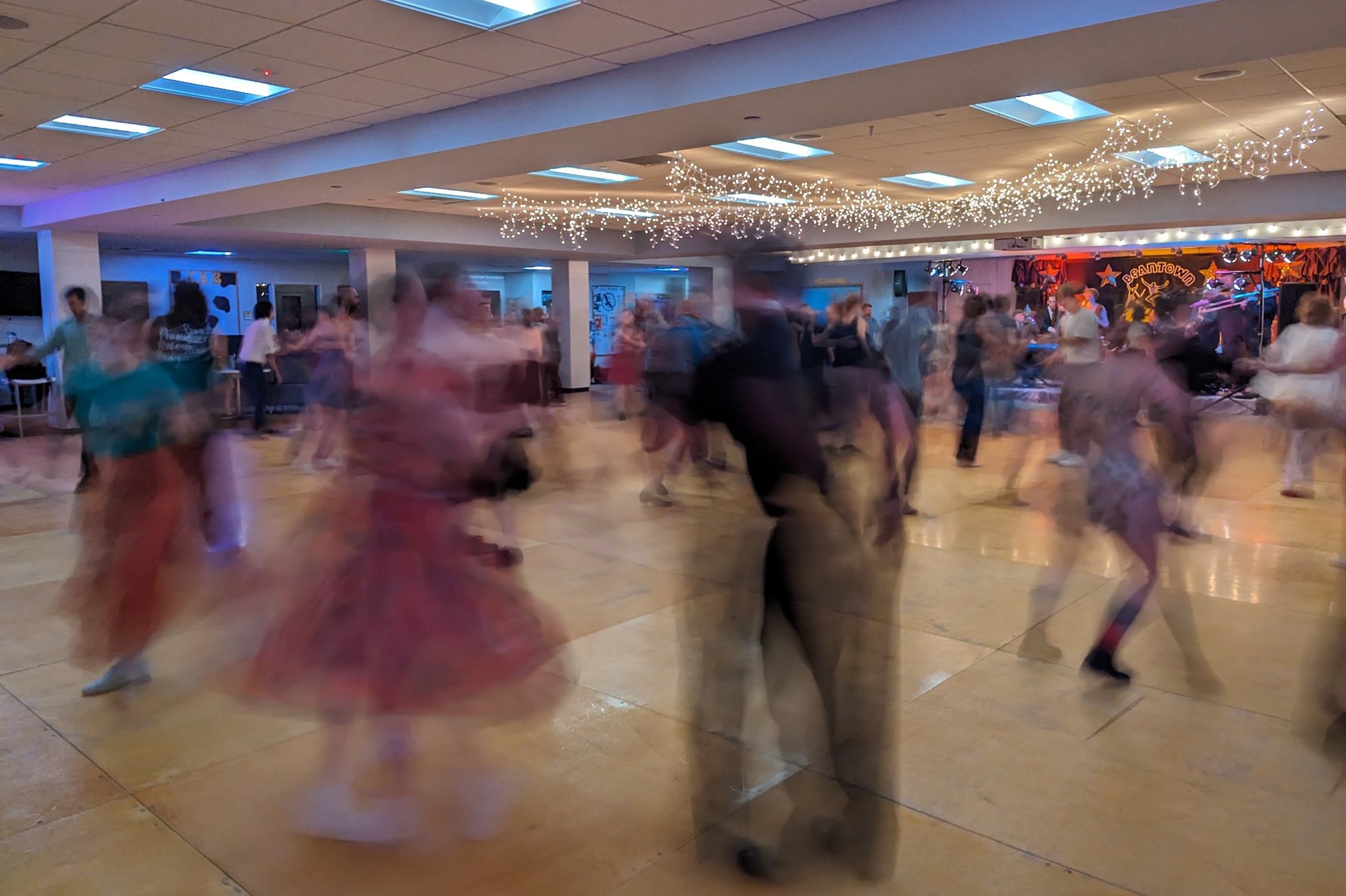
Beantown Lindy Hop Dance Camp 2023 long exposure 3
Sdkb
- Source:
- Wikimedia Commons
- Rights:
- Reusable with conditions: credit the creator; share any adaptation under the same licence. Source record ↗
- Recorded as:
- cc by-sa 4.0
For Lindy Hop dancers and historians, this image documents the scale and character of modern swing dance community practice—the camps, the participatory social structure, and the geographic distribution of the dance. The long-exposure technique makes visible something usually invisible in single-frame photography: the accumulated path of movement and the simultaneous participation of many dancers, which are central to the experience and identity of swing social dancing. It is evidence of a thriving African American vernacular dance tradition actively maintained and transmitted outside of theatrical contexts.
What you are looking at
A long-exposure photograph captures the main dance floor at Beantown Camp, a Lindy Hop social dance event. Multiple dancers move across a polished wooden floor in a large, bright indoor space with dropped ceiling panels and recessed lighting. The long exposure creates ghostly trails and overlapping figures—some clearly defined, others blurred into semi-transparent forms—giving the scene a sense of continuous, flowing motion. The composition shows dozens of dancers at various stages of movement across the full width and depth of the frame. Decorative strings of lights hang from the ceiling, and the space opens into adjacent areas where more dancers and spectators can be seen. The lighting is even and bright, with blue-tinted overhead panels and warm accent lighting, creating a contemporary social dance venue atmosphere. On the right edge, colorful signage or decorative elements in orange and red suggest the event infrastructure and branding typical of a dance camp.
The dancing
The dancers display the characteristic posture and carriage of Lindy Hop: upright spines, bent knees, and the distinctive weight-forward alignment of swing dancing. Most visible couples maintain closed or semi-closed positions, with leaders and followers oriented toward one another. The long exposure renders some figures as sharp profiles mid-motion while others blur into streaks, capturing the rapid weight shifts and traveling steps essential to the dance. Arms are raised and extended in the typical swing frame, and the dancers' bent-knee stance and apparent forward momentum suggest the bouncy, grounded rhythm of Lindy Hop. The scale and density of dancers—easily thirty or more across the frame—reflects the social nature of a dance camp with simultaneous dancing rather than formal performance.
The dance depicted
This is unambiguously Lindy Hop, as stated in the catalogue record and confirmed by the visible dancers' posture, frame, and movement quality. Lindy Hop is a swing social dance that emerged in Harlem in the 1920s–30s and remains a vibrant community practice. The image shows the dance as it is typically experienced at modern social camps: open, democratic, and participatory, with multiple couples dancing simultaneously in a casual social setting. The bent-knee 'bounce' step, the connection between partners, and the forward momentum are all characteristic of how Lindy Hop is danced today. The long exposure technique makes the continuous and voluminous nature of swing dancing visible—the repeated circuits and patterns that would be invisible in a single frozen moment.
How it was made
This is a long-exposure color photograph, a technique that accumulates light across an extended shutter duration, rendering moving subjects as trails or semi-transparent overlays. Long exposure is particularly effective for dance photography because it visualizes the path and volume of movement rather than isolating a single instant. The photographer (Sdkb, per the record) used this approach to convey the energy, density, and continuity of the dance event—something a conventional snapshot would not show. Digital long exposure such as this is typically created with a tripod-mounted camera at a relatively high ISO and narrow aperture, allowing the accumulation of multiple frames or a prolonged exposure without catastrophic overexposure. The technique is well-suited to documentation of social dance events and has become more common in dance community photography since the 2000s.
About this work
This is a documentary long-exposure photograph of a contemporary Lindy Hop social dance gathering at Beantown Camp 2023, held at Endicott College. The work captures the scale, motion, and energy of a modern swing dance community event through a technique that renders multiple dancers and their movement paths simultaneously, creating a visual record of participatory social dance rather than a performance moment. The image is historically significant as documentation of how Lindy Hop—an African American vernacular dance originating in the 1920s–30s—continues to be practiced, taught, and celebrated in organized community spaces in the 21st century. It belongs in a dance gallery as evidence of contemporary swing dance culture and as an example of how photography can be used to visualize the temporal and spatial dimensions of social dancing.
How to look at it
Examine the image by following individual dancers from left to right and front to back: some figures are sharp and frozen, others are rendered as translucent streaks or multiple overlapping positions. Notice where bodies cluster and where they spread across the floor, and how the bent-knee carriage and forward tilt remain consistent even across blurred figures—this is the 'weight' and rhythm of Lindy Hop. The long exposure creates a palimpsest effect, where you can see the repeated footfall and direction of travel of many dancers at once. The ceiling, lighting, and spatial openness are typical of a modern sports or event facility repurposed for social dancing, which is now the standard venue for organized swing dance communities.
The artist
Sdkb is a Wikimedia Commons contributor who documents dance and social events through photography. The artist has contributed images of contemporary dance communities and cultural events to open-access archives, supporting public documentation and accessibility of dance culture.
The period
Lindy Hop experienced a major revival beginning in the 1980s–90s, growing into an international social dance community with organized camps, competitions, and social venues by the 2000s. Beantown Camp is part of this landscape of organized swing dance education and community building in North America. In 2023, Lindy Hop was firmly established as a living social dance form with active participants ranging from teenagers to elders, taught through weekly social dances, workshops, and annual camps. Photography of dance, particularly long-exposure and documentary approaches, became more prevalent in dance community practice as digital cameras and social media enabled rapid circulation of images among dancers.
Where it lives
The image is held at Wikimedia Commons, a freely licensed, publicly accessible media repository. It is identified as documentation from Beantown Camp 2023, a week-long annual Lindy Hop social dance and instruction event.
Dance in this work
Questions about this work
What is Beantown Camp?
Beantown Camp is an annual week-long Lindy Hop event held in the Boston area (at Endicott College in Salem, Massachusetts) that combines social dances, technique classes, competitions, and performances. It is part of the global swing dance camp circuit and attracts participants from across North America and internationally.
Why use long exposure for dance photography?
Long exposure makes visible the paths, volume, and continuity of movement that a single-frame photograph cannot show. For social dancing, where multiple dancers are moving simultaneously in repeating patterns, long exposure captures the accumulation and rhythm of motion. It is also an aesthetic choice that emphasizes energy and flow.
How does this image document Lindy Hop?
The image shows Lindy Hop as a living social practice rather than a historical artifact: upright posture, bent knees, partner connection, and forward momentum are all visible. The density of dancers and informal venue show that Lindy Hop is danced in participatory community settings by many people simultaneously, not as staged performance. This contrasts with theatrical representations and provides evidence of how the dance is actually practiced and experienced.
More dance artwork





