49 works in this view — arrow keys or swipe to move between them.
Dance in Art
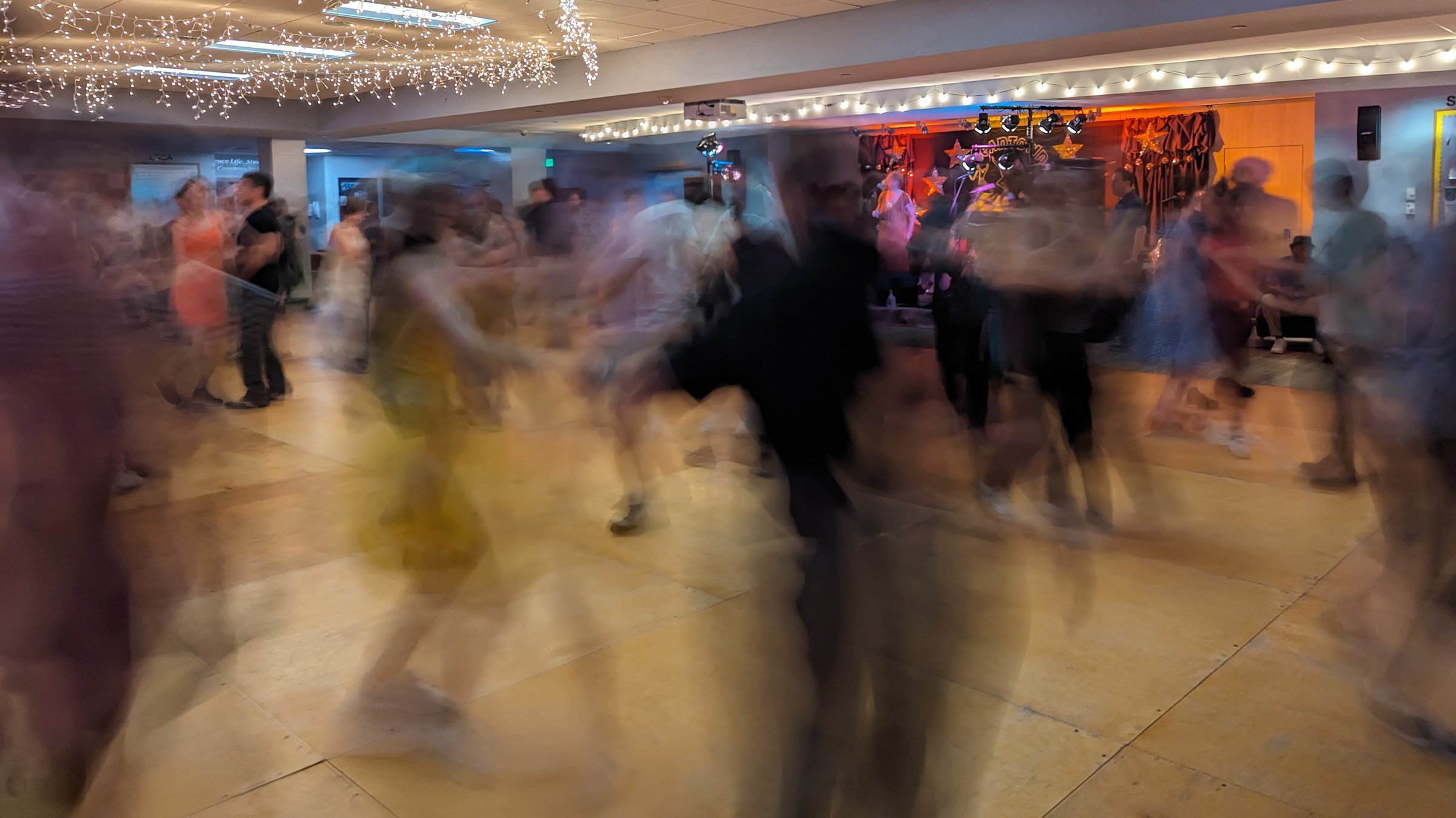
Beantown Lindy Hop Dance Camp 2023 long exposure 5
Sdkb
- Source:
- Wikimedia Commons
- Rights:
- Reusable with conditions: credit the creator; share any adaptation under the same licence. Source record ↗
- Recorded as:
- cc by-sa 4.0
This image documents swing dance culture in the contemporary moment, showing how Lindy Hop persists not as a historical curiosity but as a living social practice. The long-exposure technique visually embodies what participants value: the collective, energetic, participatory nature of social swing dancing rather than technical mastery or individual performance. For dancers and historians, it is evidence of how swing culture has been transmitted, learned, and continuously revitalized through organized camps and social events.
What you are looking at
A crowded social dance floor captured mid-motion through long-exposure photography, creating ghost-like trails and blurred silhouettes of dozens of dancers moving simultaneously across a polished wooden surface. The setting is a modern indoor venue—the Callahan Center at Endicott College—with a dropped ceiling, fluorescent overhead lights, and decorative string lights creating pools of warm illumination. On the right side, an orange-lit stage or performance area is visible with what appear to be decorative props or stage elements. The photograph's long exposure renders individual dancers as streaked forms in various colors—orange shirts, black clothing, skin tones—their bodies captured mid-rotation, mid-step, creating an impressionistic blur that suggests energetic, continuous movement across the entire space. No single moment is frozen; instead, the image shows the accumulated traces of many moments, emphasizing the frenetic social energy of the event.
The dancing
The motion blur obscures precise hand holds and frame, but the streaked forms suggest dancers in varied configurations—some appearing to move as couples, others in solo movement across the floor. The traces suggest upright posture and rapid footwork typical of swing dancing, with lateral movement and rotational energy evident in the directional blur. Dozens of bodies occupy the frame simultaneously, indicating a packed social dance floor with multiple partnerships dancing concurrently. The blurred quality means footwork and frame details cannot be reliably assessed from this image.
The dance depicted
This is a Lindy Hop social dance event, explicitly documented as taking place at Beantown Lindy Hop Dance Camp, a week-long gathering featuring classes, competitions, and social dancing. Lindy Hop is a partner dance and swing style that emerged in 1930s Harlem, characterized by 8-count and 6-count movements, aerials, and improvisational connection between partners. The long-exposure technique captures the defining characteristic of Lindy Hop social events: the continuous, energetic, simultaneous dancing of many couples on a crowded floor, all improvising within the foundational rhythm.
How it was made
This is a long-exposure photograph, a digital technique that accumulates light over an extended shutter opening (likely 1–2 seconds), creating motion trails and blur from moving subjects. Long exposure is well-suited to capturing dance energy and social vitality that a traditional snapshot would freeze into stasis; here it emphasizes movement and crowd density over individual form. The technique is commonly used in contemporary dance photography to suggest dynamism and collective participation rather than to document technique. The photograph's source on Wikimedia Commons indicates it was created for documentary/educational purposes, not as fine art.
About this work
This is a long-exposure photograph of a Lindy Hop social dance session at a 2023 swing dance camp. The image documents the social rather than competitive or instructional aspect of the event—the crowded floor where participants dance for pleasure and connection. Lindy Hop is a historically African American partner dance with deep roots in jazz culture, and its contemporary social dance scene remains centered on community, improvisation, and inclusive social participation. This photograph captures that collective energy: dozens of dancers moving together in shared musical time, their individual forms dissolved into an impressionistic record of motion and presence.
How to look at it
Attend to the cumulative effect rather than individual bodies. The streaks and blurred forms collectively suggest the density and continuous motion of a social dance floor—how many dancers move simultaneously and how the space fills with energy. Notice the directional flow and the sense of rotation and lateral movement, which gives a visual impression of the kinetic vocabulary of swing dancing. The long exposure trades legibility of technique for a truer sense of the social and communal experience of the event: this is what it *feels* like to be on that floor, surrounded by moving bodies in musical time.
The artist
Sdkb is a Wikimedia Commons contributor who has uploaded dance and event photography. No additional biographical or practice information is available from the record.
The period
Lindy Hop experienced a major resurgence beginning in the 1980s as historical dancers and enthusiasts revived the style from archival footage and living memory. By the 2020s, Lindy Hop exists as a global social dance community with organized camps, competitions, and social events in North America, Europe, and beyond. Beantown Lindy Hop Camp is one of many week-long dance camps that emerged in this revivalist era, blending instruction in historical technique with contemporary social dance culture. The use of long-exposure photography as a documentary tool reflects 21st-century digital photography practice and the role of social media and open-access platforms (Wikimedia Commons) in documenting grassroots cultural events.
Where it lives
The photograph is held in Wikimedia Commons, a public repository of freely licensed media. It was contributed by Sdkb in 2023 and appears to be documentary photography of a public event, not commissioned artwork.
Dance in this work
Questions about this work
What is Lindy Hop?
Lindy Hop is a partner swing dance that originated in Harlem in the 1930s and became popular in the 1940s. It evolved alongside jazz music and is characterized by 8-count and 6-count basic steps, rapid footwork, rotation, and aerials. It nearly disappeared mid-century but was revived starting in the 1980s and now exists as a vibrant global social dance community.
Why use long exposure for dance photography?
Long exposure creates motion blur that emphasizes the energy, speed, and dynamism of dance rather than freezing a single moment. For social dance events in particular, it captures the collective experience and continuous participation better than a traditional snapshot, which would show individual couples frozen mid-movement.
What is a Lindy Hop camp?
A Lindy Hop camp is a multi-day event (often a week) where swing dancers gather for classes from experienced teachers, social dancing, competitions, and community building. Beantown Lindy Hop Camp is an annual event held in Massachusetts. These camps serve as important transmission points for technique, style, and community values within the contemporary swing dance world.
How many dancers are in this photograph?
The long exposure makes an exact count impossible, but the frame contains dozens of dancers simultaneously occupying the floor. The blur suggests consistent, overlapping movement rather than the clearing of space, which indicates a densely populated social dance floor—a typical feature of popular social dance events.
More dance artwork





