49 works in this view — arrow keys or swipe to move between them.
Dance in Art
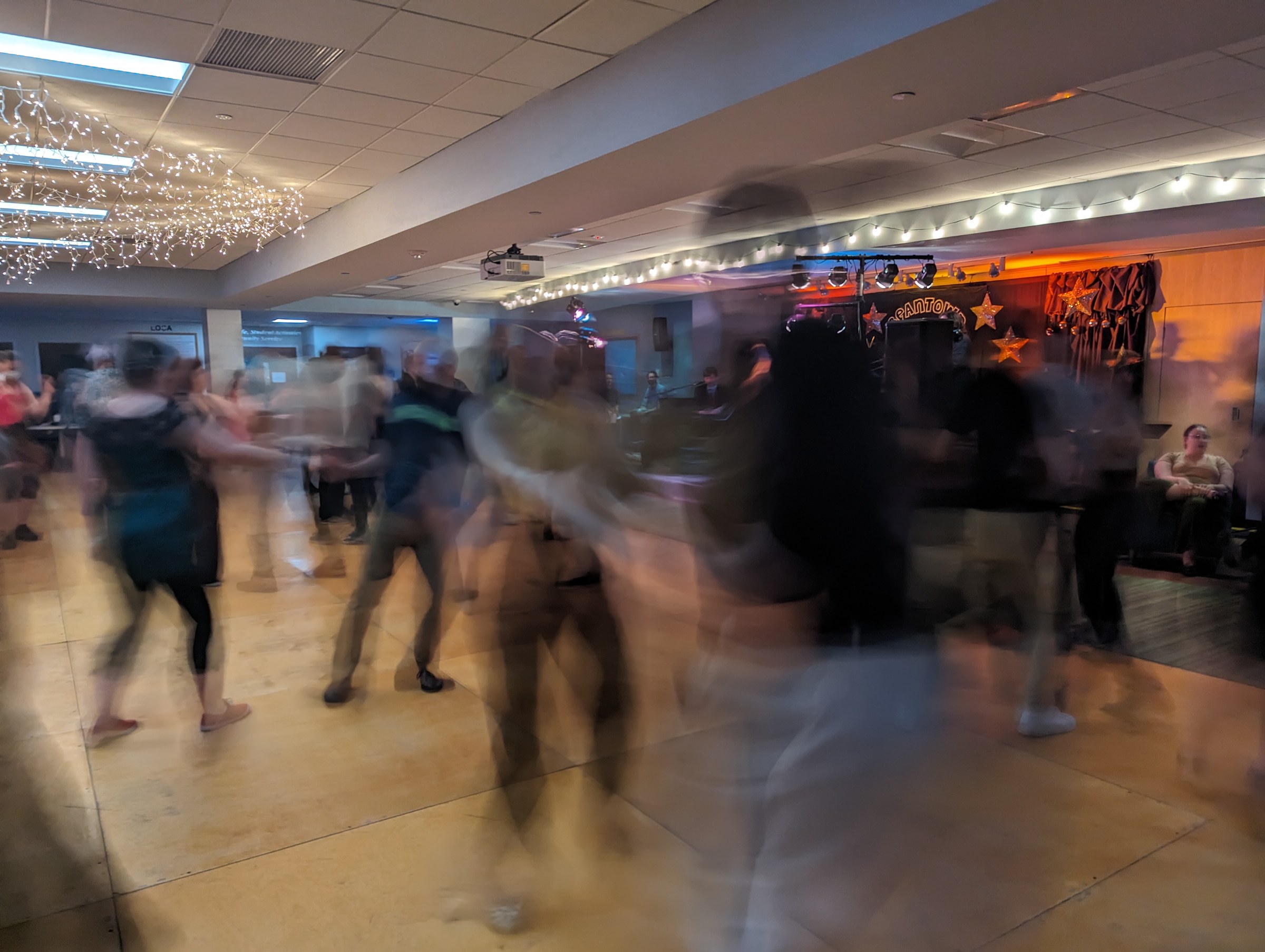
Beantown Lindy Hop Dance Camp 2023 long exposure 6
Sdkb
- Source:
- Wikimedia Commons
- Rights:
- Reusable with conditions: credit the creator; share any adaptation under the same licence. Source record ↗
- Recorded as:
- cc by-sa 4.0
This image documents the living practice of Lindy Hop in its contemporary revival form, showing that swing is an active social dance, not a historical curiosity. For dancers and historians, it provides evidence of how swing dance communities sustain and transmit knowledge outside concert or competition contexts, through repeated social events that privilege participation over observation.
What you are looking at
A long-exposure photograph captures the main dance floor at Beantown Camp 2023, a week-long Lindy Hop event held in the Callahan Center at Endicott College. The motion blur of dozens of dancers fills the frame, their bodies streaking across a wooden dance floor in an amber and orange glow. The ceiling features decorative strung lights and a prominent crystal chandelier, while orange and black star-shaped decorations hang from the far wall, suggesting a festive evening social. Spectators sit along the edges in darker areas. The long exposure renders the moving dancers as fluid, ghostly forms—some in pairs, others in groups—creating an impressionistic record of continuous motion and social energy.
The dancing
The blur prevents precise analysis of individual frames, but the composition shows multiple couples in close hold, the characteristic embrace of swing dancing, moving across the floor in various directions. The streaking of bodies suggests continuous rotational and linear movement typical of swing partnering. Some figures appear taller, others shorter, indicating mixed-gender and mixed-height partnerships. The density of overlapping forms across the entire floor indicates not a line or formation dance but a freestyle social space where couples move independently, the hallmark of ballroom swing.
The dance depicted
This is definitively Lindy Hop, a swing social dance that evolved in African American communities in Harlem in the 1930s and became a national craze in the 1940s. The event is documented as Beantown Camp, a contemporary revival and educational event. Lindy Hop is danced in closed position by mixed-gender couples, characterized by six-count and eight-count patterns with rotational figures, improvisation, and a dynamic upright frame. The long exposure—a choice that emphasizes the continuous flow of social dancing rather than frozen technique—documents the contemporary swing revival, which has maintained core movement vocabulary while creating a modern community of practice.
How it was made
This is a long-exposure photograph, likely digital given the date and source (Wikimedia Commons). The extended shutter speed—probably 1–3 seconds—renders moving figures as motion-blur ghosts while keeping stationary elements (floor, ceiling, fixtures, seated spectators) sharp. This technique sacrifices clarity of individual bodies to capture the aggregate energy and continuous flow of social dancing. Long exposure is particularly suited to documenting social dance events, where the point is the collective action rather than individual technique, and where a conventional snapshot would show only one moment frozen.
About this work
This is documentary photography of contemporary swing dance revival in 2023, captured using a method that foregrounds motion and collective energy over individual technique. Lindy Hop originated as vernacular social dance in 1930s–40s Harlem, went dormant in mainstream culture for decades, and has been actively revived since the 1980s through dedicated camps, socials, and communities worldwide. Beantown Camp is one such annual event, drawing participants to learn, compete, and dance socially. The photograph records not the codified steps or competition frame, but the social life of swing—the unscripted partnering, the improvisation, the density of bodies in motion—using a photographic technique suited to that content.
How to look at it
Attend to the overall composition: the density and overlapping of moving bodies indicates a free-form social space where couples move at will, not a choreographed line or formation. The blur itself is informative—it shows sustained motion and partnership, not static positions. Notice the scattered distribution across the floor, the evidence of rotation and travel, and the presence of seated observers, all of which mark this as a social event in a community setting rather than a performance stage. The decorative lighting and festive atmosphere signal the social-recreational context.
The artist
Sdkb is a Wikimedia Commons contributor and photographer who documents dance, music, and cultural events. The work appears as part of their documentation of Beantown Camp 2023 and is released under an open licence, making it available for research and educational use.
The period
Lindy Hop experienced a major revival beginning in the 1980s, accelerated by documentary films, vintage footage, and dedicated dancers committed to learning and teaching the style. By the 2000s–2020s, swing camps, social events, and a global community had emerged. This photograph dates to 2023, over 80 years after Lindy Hop's 1930s origins and nearly 40 years into the modern revival. Contemporary swing emphasizes social dancing, inclusivity, and partnerships of all gender combinations, though the core movement vocabulary remains continuous with mid-century practice.
Where it lives
The photograph is held in Wikimedia Commons, a public-domain and open-licence image repository. It is one of six long-exposure photographs from Beantown Camp 2023 documented by the contributor Sdkb, making it part of a small visual archive of a specific contemporary dance event.
Dance in this work
Questions about this work
What is Beantown Camp?
Beantown Camp is an annual week-long Lindy Hop intensive held in Boston (the "Beantown"). It offers classes, socials, competitions, and social dances. This photograph documents the main-floor social dance on one evening of the 2023 session. Such camps are central to the contemporary swing revival, offering immersive learning and community building.
Why use long-exposure photography for a dance event?
Long exposure captures movement, flow, and collective energy that a conventional snapshot cannot. For social dancing—where the point is the interaction and sustained motion, not individual technique—this technique documents the actual character of the event more faithfully than a sharply frozen moment would.
Is Lindy Hop still a living dance?
Yes. Lindy Hop originated in 1930s Harlem and went out of mainstream fashion by the 1960s, but has been continuously revived and is now actively danced worldwide by thousands of people in social contexts, competitions, and educational events. Contemporary practitioners learn from historical footage, teachers, and community transmission, maintaining continuous movement vocabulary.
What is the difference between revival Lindy Hop and the original?
The movement vocabulary is substantially the same. Key differences are in framing and values: contemporary swing typically emphasizes gender-neutral partnership, formal instruction in codified patterns, and documentation, whereas mid-century Lindy Hop evolved organically in social contexts. Both are social dances learned through participation in community.
More dance artwork





