49 works in this view — arrow keys or swipe to move between them.
Dance in Art
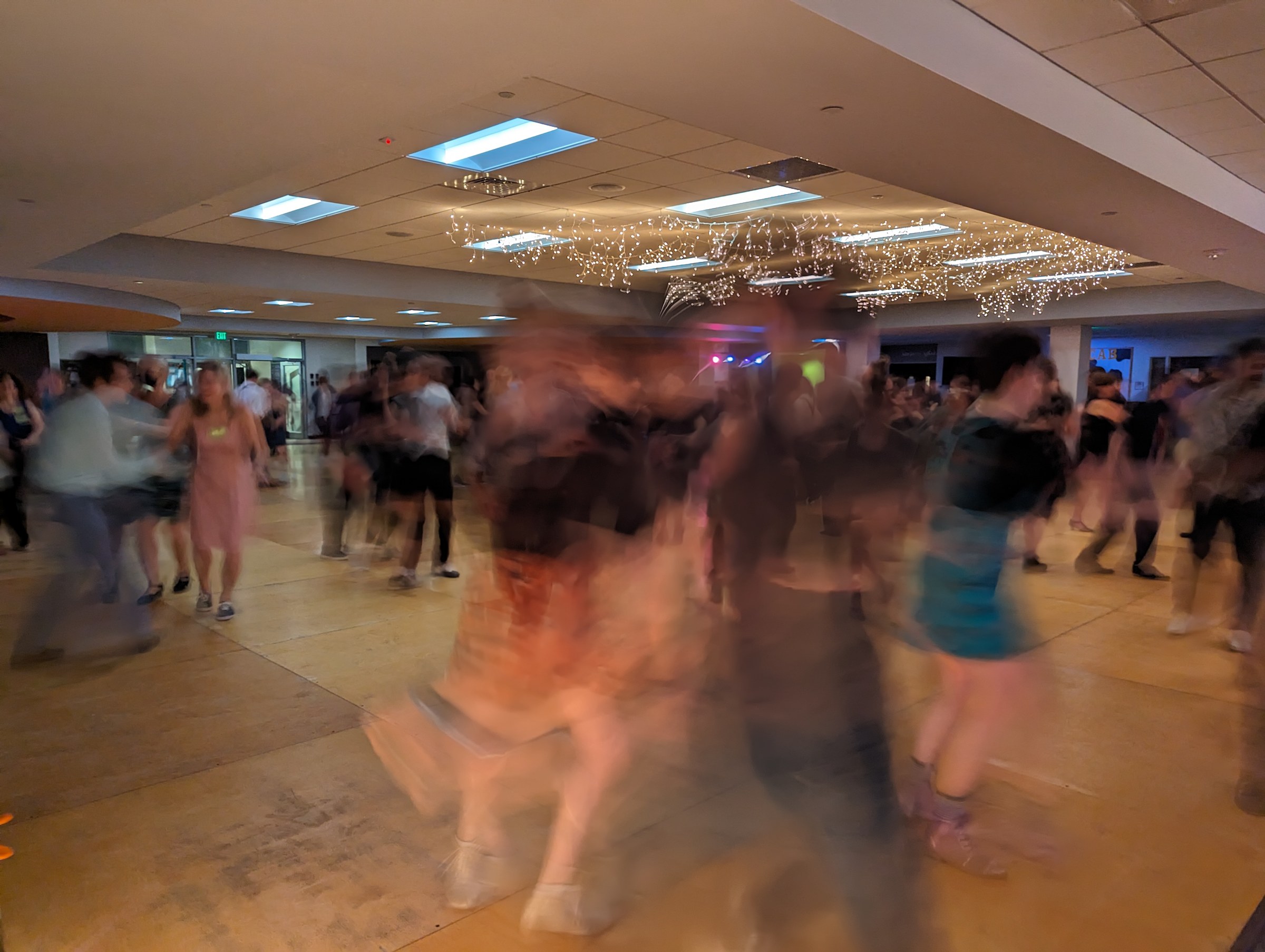
Beantown Lindy Hop Dance Camp 2023 long exposure 4
Sdkb
- Source:
- Wikimedia Commons
- Rights:
- Reusable with conditions: credit the creator; share any adaptation under the same licence. Source record ↗
- Recorded as:
- cc by-sa 4.0
Lindy Hop is a foundational American dance form with deep roots in African-American culture, yet most visual documentation shows either historical footage from the 1930s–1940s or staged performance. This photograph documents its living practice in the contemporary moment, showing that Lindy Hop remains active, participatory, and central to swing dance culture. The long-exposure technique itself is significant: it visualizes the temporal and collective nature of social dance in a way still photography cannot ordinarily achieve.
What you are looking at
A long-exposure photograph captures the main dance floor of Beantown Lindy Hop Camp in motion. The image shows dozens of dancers scattered across a wooden floor beneath a coffered ceiling with decorative crystal chandeliers and skylights. The motion blur created by the long exposure renders most figures as translucent, ghostly forms in mid-movement, their bodies streaked with color and light. Dancers wear casual contemporary clothing—t-shirts, shorts, summer dresses—typical of modern swing dance socials. The Callahan Center's institutional architecture frames the scene: plain walls, practical lighting, a space designed for function rather than spectacle. Despite the blur, the photograph captures the essential character of a swing social: constant motion, multiple couples dancing simultaneously across the floor, energy distributed rather than concentrated.
The dancing
The motion blur prevents precise analysis of individual holds and frames, but the photograph documents multiple simultaneous partnerships distributed across the floor. Visible through the blur are paired figures in close proximity typical of partner dance, with bodies angled toward one another. The blur suggests vigorous, energetic movement consistent with Lindy Hop's characteristic bounce and rotational motion. The density of figures—two dozen or more visible—indicates a crowded social dance floor where couples navigate shared space, a defining feature of swing socials.
The dance depicted
This is unambiguously Lindy Hop, as stated in the catalogue record and confirmed by the setting (a named Lindy Hop camp) and the contemporary casual dress of a 21st-century swing dance social. Lindy Hop is a partner swing dance developed in African-American communities in Harlem in the 1920s–1930s, characterized by improvisation, partner connection, and energetic footwork. The long exposure technique paradoxically serves the subject matter: it visualizes the constant motion and temporal extension of social dancing, where the point is not a single moment but the sustained exchange of movement between partners over time. The photograph documents not performance but vernacular social dance—the form as it lives in weekly socials and camps.
How it was made
This is a long-exposure digital photograph, a technique that accumulates light over an extended shutter duration (typically one to several seconds), rendering moving subjects as blurred traces. The technique transforms individual dancers into streaks of color and light, making individual technique impossible to assess but making visible the overall energy and pattern of group motion. Long exposure is particularly suited to documenting social dance, where the appeal lies in continuous partnered movement rather than discrete moments. The photographer, credited as Sdkb, uses the blur not as a technical limitation but as an aesthetic choice that prioritizes the temporal and collective character of swing dancing.
About this work
This is documentary photography of contemporary Lindy Hop practice at a major swing dance camp in 2023. It captures not the polished, choreographed Lindy Hop of performance or competition, but the social form—dancers in motion in an institutional space, learning and socializing through improvised partner dance. The long-exposure technique makes visible something invisible in still photographs: the sustained, continuous motion that defines social dancing as a temporal and embodied experience. The image belongs in a dance gallery because it documents how Lindy Hop actually lives in the 21st century—not as theatrical spectacle but as a social practice with its own venues, calendars, and communities.
How to look at it
Attend to the overall composition rather than individual couples. The blur should be read not as a limitation but as an index of motion—the photograph shows the floor filled with constant, overlapping movement. Notice how the light from the chandeliers and skylights passes through the translucent forms of the dancers, making their motion visible as streaks of color. The institutional, ordinary setting (a college recreation center) is essential to the meaning: this is not theatrical performance but vernacular practice.
The artist
Sdkb is a photographer and Wikimedian documented in the Wikimedia Commons. The photograph was contributed to Commons, making it part of the open-access documentation of contemporary culture. No further biographical information is available in the catalogue record.
The period
This photograph dates to 2023, a period of revival and flourishing for Lindy Hop and swing dance in the United States. Multi-day camps like Beantown have become the primary venues for teaching, competition, and social connection in swing dance communities since the 1990s. These camps serve dancers from beginner to advanced levels and function as both educational and social events. The casual dress and mixed-gender mixed-level participation reflect contemporary swing dance culture, which has moved significantly toward inclusivity compared to the male-dominated and gender-rigid norms of the 1940s.
Where it lives
The photograph is held in Wikimedia Commons, a public repository of freely licensed media. It was contributed by the photographer Sdkb in 2023 and is available for reuse under its stated licence.
Dance in this work
Questions about this work
What is Lindy Hop?
Lindy Hop is an improvised partner swing dance developed in Harlem in the late 1920s and 1930s, characterized by a circular figure-eight footwork pattern, energetic bounce, and partner connection. It emerged in African-American communities and spread through ballrooms, jazz clubs, and eventually the broader dance world. The dance was nearly lost after the 1950s but has been extensively revived since the 1980s through camps, competitions, and social dances like the one shown here.
Why use long exposure for dance photography?
Long exposure photography accumulates light over time, rendering moving subjects as blurred traces rather than frozen moments. For social dance, this technique visualizes the sustained, continuous motion that defines the experience—it shows flow and temporality rather than a single gesture. The technique is particularly suited to group social dancing, where the subject is not individual virtuosity but collective, partnered, improvised movement.
What is Beantown Lindy Hop Camp?
Beantown is a week-long annual swing dance camp held in the Boston area, typically at Endicott College's Callahan Center (the venue in this photograph). The camp offers classes in Lindy Hop and related swing dances at multiple levels, social dances each evening, and competitions. It is one of dozens of similar camps held annually across North America, serving the contemporary Lindy Hop community.
How is contemporary Lindy Hop different from the 1940s version?
Contemporary swing dance communities are far more gender-inclusive and mixed-level than the male-dominated, highly gendered social dances of the 1930s–1940s. Modern camps welcome all genders and sexual orientations, and dancers at all levels dance together. The dance itself has evolved to incorporate more flexibility in lead and follow roles, and contemporary dancers study historical footage while also innovating new variations and styling.
More dance artwork





