49 works in this view — arrow keys or swipe to move between them.
Dance in Art
Beantown Lindy Hop Dance Camp 2023 long exposure 2
Sdkb
- Source:
- Wikimedia Commons
- Rights:
- Reusable with conditions: credit the creator; share any adaptation under the same licence. Source record ↗
- Recorded as:
- cc by-sa 4.0
This image documents the contemporary social swing dance scene—a thriving global community of dancers who have sustained and evolved a 1920s African American vernacular form into a living social practice. The choice of long exposure over documentary photography suggests how swing dancers and swing dance culture value the experience of motion and partner connection as central to the form, not merely the technical appearance of steps. For historians and practitioners, this image shows the modern swing camp context as a site of transmission, community, and pleasure.
What you are looking at
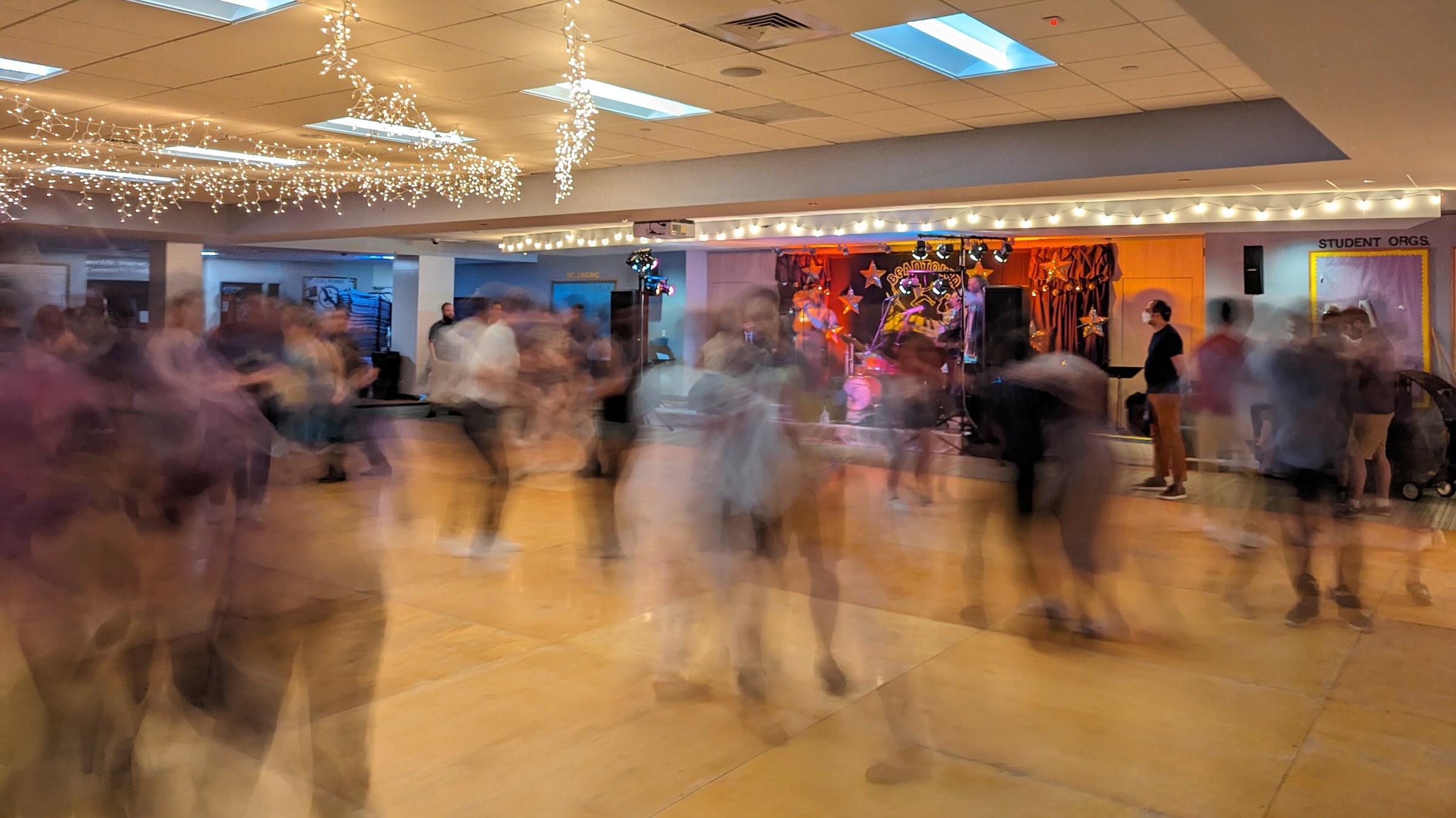
A long-exposure photograph captures the crowded dance floor of the Beantown Lindy Hop Dance Camp's main hall, rendered as a blur of overlapping figures in motion. The venue is a modern institutional space with a suspended ceiling of warm-toned drop panels interrupted by rectangular skylights and decorated with hanging strands of small white lights, creating pools of warm illumination across the wooden dance floor. The walls are painted in pastel tones—visible on the right are sections in pale blue and vivid orange. The motion blur is pronounced, with dozens of dancers appearing as translucent, ghosting figures moving through the space; only a few stationary figures remain sharp enough to be read clearly. One person stands relatively still on the right side of the frame. The long exposure has transformed individual movements into streaks and halos of color, conveying energy and continuous motion rather than any single frozen moment. A stage or performance area is visible in the background with orange curtaining and hanging decorations.
The dancing
The motion blur obscures most dance-specific details of frame and hold, but what remains visible suggests couples in closed or semi-closed position moving across the floor in multiple directions simultaneously. The translucent overlapping of figures indicates multiple dancers rotating, swinging, and traveling through the space—consistent with the rapid weight transfers and directional changes characteristic of swing dancing. A few figures are sharp enough to show torsos and arm positions, suggesting both the leader and follower roles typical of partnered swing dance. The sheer density of overlapping forms conveys the packed social dance floor typical of a camp social or competition venue.
The dance depicted
This is a Lindy Hop social dance event, as confirmed by the caption and the Beantown Camp's explicit focus on that style. Lindy Hop is a swing dance that emerged in Harlem in the 1920s and remains a thriving social and competitive dance form in the 21st century. The motion blur—a deliberate photographic choice—emphasizes the hallmark speed, rotational energy, and continuous flow of swing dancing rather than freezing individual steps. The multiple overlapping figures suggest the call-and-response social environment of a camp social, where many couples dance simultaneously on a shared floor. The packed venue and the choice of long exposure to show motion rather than stillness captures the genre's defining quality: ceaseless rhythmic movement and partner connection at speed.
How it was made
This is a long-exposure photograph, a technique that requires an extended shutter speed to record movement as blur and light trails. Long exposure renders the fleeting and kinetic—normally invisible or frozen by conventional photography—as continuous streaks of form and color. The technique was likely chosen deliberately to convey the sensation and energy of swing dancing rather than to document individual dancers' technique. Long exposure demands a stationary camera, so this image is not a candid moment but a composed recording of activity over several seconds. For a dance event, this technique is unusual and aesthetically motivated: it prioritizes the feeling of dance as motion and collective energy over the documentary capture of individual bodies and technique.
About this work
This is a long-exposure photograph of a contemporary Lindy Hop social dance event held at Beantown Camp, an annual week-long swing dance camp in the United States. Lindy Hop is a partner swing dance rooted in African American vernacular dance of the 1920s Harlem jazz scene, and it has experienced sustained revival and growth as an international social dance practice since the 1980s. The photograph is not a document of individual dancers but an artistic rendering of the collective and kinetic energy of the event—dozens of couples dancing simultaneously in a modern institutional space. The motion blur technique transforms the recognizable structure of swing dancing (partner positions, directional changes, speed) into an abstract visual field of movement. This work belongs in a gallery of dance imagery both as a record of how swing dance is practiced and community-built today and as an example of how photography can aestheticize motion itself rather than freezing it.
How to look at it
Attend to the density and rhythm of the overlapping forms: the long exposure creates a visual rhythm that echoes the musical beat underlying the dance. Notice which figures remain sharpest—usually stationary bystanders—and which dissolve into blur, allowing you to read the geography of the floor and the intensity of movement in different areas. The composition is not centered on a single couple or moment but distributed across the entire frame, showing how swing dancing is a group social practice. The warm lighting and institutional ceiling frame this as a contemporary, accessible, indoor-venue version of the dance, far from the nightclub or ballroom contexts where swing dancing historically developed.
The artist
Sdkb appears to be a photographer active on Wikimedia Commons. No other verified information about their artistic practice, specialization, or institutional affiliation is available from the catalogue record or the image itself.
The period
Lindy Hop experienced a worldwide revival beginning in the 1980s, driven initially by preservationists, jazz historians, and dance enthusiasts who studied archival footage and oral histories to reconstruct the form. By the 2020s, swing dance camps, competitions, and social scenes exist on multiple continents, attracting dancers across age ranges and ethnic backgrounds. These camps are now standard institutional sites for transmission of the form. The photograph dates to 2023, during a period when swing dancing was recovering from pandemic-related disruptions to in-person social dance. The Beantown Camp's emphasis on "classes, socials, competitions, and related activities" reflects the modern swing camp model: a multi-day event structured to serve beginners, competitors, and experienced social dancers simultaneously.
Where it lives
The photograph is held on Wikimedia Commons, a free media repository. It is presented as a documentary record of a specific event (Beantown Lindy Hop Dance Camp 2023) and is labeled as long-exposure photography by the photographer Sdkb.
Dance in this work
Questions about this work
Why is the image so blurry?
This is a long-exposure photograph, a technique that holds the camera's shutter open for several seconds. All movement during that time is recorded as blur and light trails. The photographer chose this technique deliberately to capture the continuous energy and motion of swing dancing rather than freezing a single moment. It conveys the sensation of the dance—rapid, sustained, collective—better than a conventional action photograph would.
Is Lindy Hop the same as other swing dances?
Lindy Hop is one form of swing dance, originating in Harlem in the 1920s and characterized by partnership, aerials, and rapid footwork over jazz music. Other swing dances include Charleston, Balboa, and various regional styles. Lindy Hop is the most widely danced form today and the focus of most contemporary swing dance camps and communities.
What is a dance camp?
A dance camp is a multi-day or week-long residential or day-based event where dancers gather for instruction, social dancing, and competition. Swing dance camps like Beantown typically offer classes for multiple levels, organized social dances (where people dance for pleasure rather than competition), and competitions. Camps serve as sites of transmission, community building, and celebration of a dance form.
Can you identify specific dancers or steps in this image?
The long-exposure technique makes it impossible to identify individual dancers or to read specific footwork or styling. This is a limitation of the medium the photographer chose, but it is also intentional: the image prioritizes collective energy and group experience over individual technique or identity.
More dance artwork





