49 works in this view — arrow keys or swipe to move between them.
Dance in Art
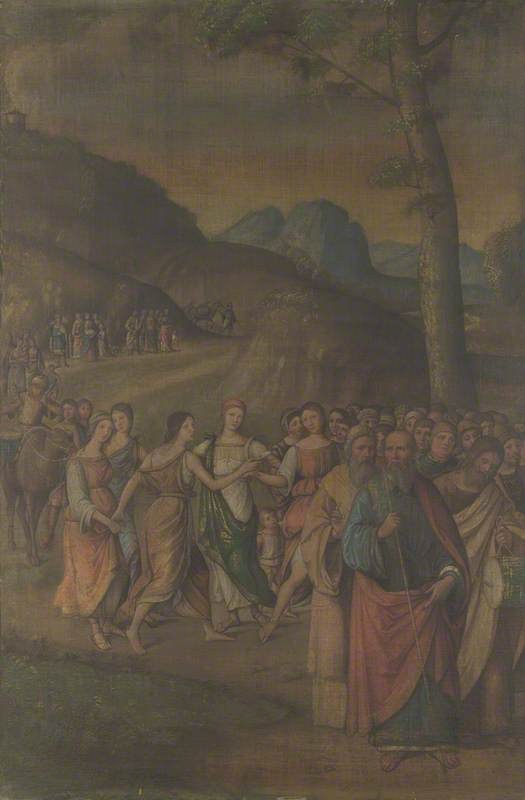
The Story of Moses (The Dance of Miriam) title QS:P1476,en:"The Story of Moses (The Dance of Miriam) "label QS:Len,"The Story of Moses (The Dance of Miriam) "label QS:Lde,"Geschichte von Moses (Miriams Tanz)"
Niccolò Pisano
- Source:
- Wikimedia Commons
- Rights:
- Public domain — free to use, share and adapt.
- Recorded as:
- public_domain
This work is significant as a visual interpretation of a biblical passage that has historically been central to Jewish and Christian liturgy and celebration. For dancers and historians, it offers evidence of how Renaissance artists understood and visually translated communal, non-choreographed movement—collective rejoicing rather than structured dance—providing a window into how dance was conceptualized in religious narrative of the period.
What you are looking at
A large crowd of figures in classical drapery gathers in a rocky, mountainous landscape under a warm, hazy sky. The composition is divided between a densely packed group in the foreground—where figures in ochre, pink, green, and white garments cluster together—and a more dispersed procession visible in the middle distance ascending into the hills. The lighting is golden and diffuse, suggesting either dawn or the dust of movement. The setting evokes biblical wilderness, with rough outcrops and sparse vegetation. The foreground group appears animated, with arms raised and bodies in varied postures suggesting active participation in a collective moment rather than static gathering.
The dancing
The figures in the foreground display raised arms, turned shoulders, and engaged torsos characteristic of celebratory or processional movement. Several women in the immediate group have their arms lifted or extended, some with heads tilted back. The grouping is not in a formal line or set pattern, but rather a loose, organic cluster with figures overlapping and turning toward one another. The density and variety of poses—some standing upright, others seemingly moving or swaying—suggests spontaneous, joyful motion rather than choreographed formation. The drapery of their garments is rendered with attention to how cloth moves with the body.
The dance depicted
The title identifies this as the Dance of Miriam, the biblical celebration following the crossing of the Red Sea (Exodus 15:20–21). Miriam, Moses' sister, led the Hebrew women in song and dance as an act of thanksgiving and rejoicing. This appears to depict that moment of collective women's celebration, though the inclusion of male figures and the mixed group suggests the artist may have depicted the broader festivities rather than Miriam's specific leadership role. The absence of rigid formation, musical instruments, or a clear focal point indicates an interpretation of dance as communal rejoicing rather than formal choreography—consistent with biblical accounts of spontaneous celebration.
How it was made
The work appears to be a painting, likely oil on panel or canvas, executed in a Renaissance or early Renaissance style. The handling of light—diffuse and atmospheric—and the composition's depth suggest familiarity with Early Netherlandish or Italian painting traditions. The soft modeling of forms and the warm, unified tonality indicate a 16th-century approach to landscape and figure grouping. This technique allowed the artist to render the landscape as an integral part of the narrative and to create atmospheric unity across a complex multi-figure scene, suggesting the work was intended for a patron of considerable means.
About this work
This painting depicts the biblical Dance of Miriam, a moment of thanksgiving and communal celebration. The work situates a biblical narrative within a naturalistic landscape and renders the dance not as formal choreography but as spontaneous, joyful collective movement. The composition—with its crowded foreground and receding procession—treats dance as a social and religious act rather than a performance art, reflecting Renaissance engagement with classical and biblical narrative through contemporary visual language.
The painting belongs to a tradition of biblical illustration in Renaissance art, where narrative moments are given visual weight through landscape, light, and the careful disposition of figures. The emphasis on women's participation and the rendering of varied, energetic poses mark this as a thoughtful interpretation of Exodus rather than a generic celebration scene.
How to look at it
Attend to the variety and informality of the poses: these are not dancers in synchrony or formation, but individuals in different moments of response—arms raised, bodies turning, heads tilted. Note how the artist has distinguished individuals within the crowd through their colored garments and varied gestures, creating a sense of simultaneous, non-coordinated movement. The landscape is not incidental but integral to the narrative—the wilderness setting grounds the celebration in biblical geography and scale. The golden light unifies the scene and suggests a moment suspended in time, neither fully still nor clearly progressing.
The artist
Niccolò Pisano (or Niccolo Pisano) was a 16th-century Italian painter active in the late Renaissance. Little is documented of his biography or the extent of his output, but the stylistic sophistication of works attributed to him places him within the tradition of narrative and religious painting. The work's composition and handling suggest training in or familiarity with Tuscany or Northern Italy, where Renaissance fresco and panel painting traditions were strong.
The period
In the early 16th century, Renaissance artists were increasingly engaged with biblical narrative as a vehicle for exploring human emotion, landscape, and social dynamics. The rendering of spontaneous, collective movement—as opposed to courtly or formal dance—reflects a broader humanist interest in authentic human response and emotion. Simultaneously, the study of classical texts meant renewed attention to biblical accounts and their visual interpretation. The mountainous, atmospheric landscape places this work within the tradition of landscape as setting for human drama, a development in Italian Renaissance painting of this period.
Where it lives
The work is housed in an unspecified collection and is known through Wikimedia Commons. The catalogue record provides minimal detail, suggesting the painting may be in a museum collection with limited online documentation or may be identified primarily through reproduction.
Dance in this work
Questions about this work
Who was Miriam and why is her dance important?
Miriam was Moses' sister and a prophet in biblical tradition. According to Exodus 15:20–21, after the Hebrew people crossed the Red Sea, Miriam led the women in song and dance as an act of thanksgiving. This moment is significant in Jewish and Christian tradition as an instance of collective celebration, prophetic leadership by a woman, and the integration of music and dance in religious practice.
What is the artist showing us about how people danced in this period's imagination?
The painting depicts dance as spontaneous, communal, and emotionally expressive rather than as formal choreography or court entertainment. The figures are not in synchronized formation but in varied poses suggesting individual joy and movement—arms raised, bodies turning, oriented toward one another. This reflects both biblical narrative (which describes singing and dancing but not formal steps) and Renaissance understandings of authentic human response.
Why include a landscape in a dance scene?
The rocky wilderness setting roots the biblical narrative in a specific place—the approach to Mount Sinai—and lends the event scale and gravity. In Renaissance painting, landscape was used not merely as backdrop but as commentary on the human action: the vast, dramatic terrain emphasizes both the significance of the people's deliverance and the vastness of divine providence they are celebrating.
Is this painting well-known?
The work is not widely documented in standard art historical references, and its attribution to Niccolò Pisano rests on limited information. Its accessibility primarily through Wikimedia Commons suggests it may be held in a museum collection with smaller public visibility, or its attribution and dating may be open to scholarly revision.
More dance artwork





