49 works in this view — arrow keys or swipe to move between them.
Dance in Art
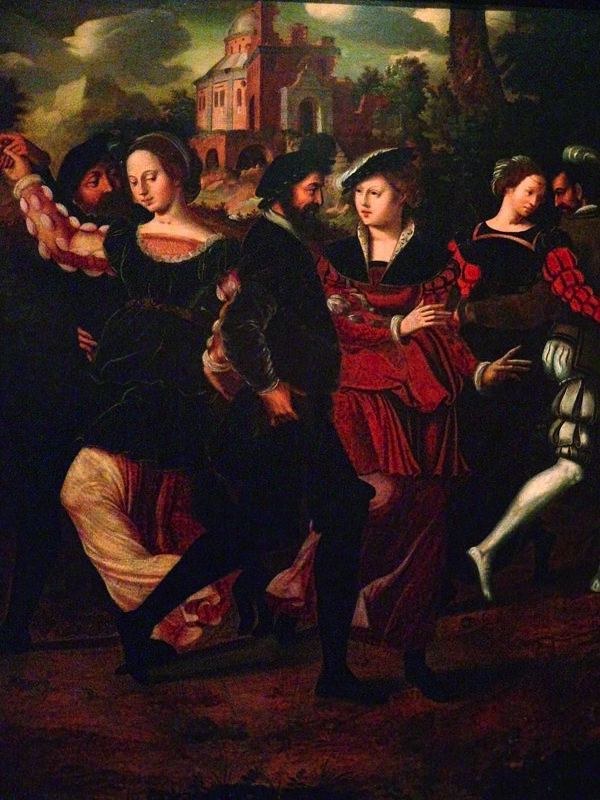
Ambrosius Benson - Elegant couples dancing in a landscape leo sobre tabla museo de bellas artes de la universidad de utah utah usa
Ambrosius Benson
- Source:
- Wikimedia Commons
- Rights:
- Public domain — free to use, share and adapt.
- Recorded as:
- public_domain
This painting provides rare visual evidence of Renaissance court dance as it was practiced—not as a theoretical system described in manuals, but as an actual social event among the nobility. The artist has observed the formal posture, the measured spacing, and the control of the body that distinguished Renaissance court dance from both folk practice and later ballroom styles. For a historian of dance, this work is more valuable than many treatises because it shows what the dancers looked like to a contemporary observer.
What you are looking at
A group of elegantly dressed figures gather in a moonlit landscape dominated by a fortified tower or castle in the middle distance. The composition is divided between the shadowed foreground where the figures stand and a luminous background where architecture and vegetation are rendered in warm golden tones against a greenish sky. Six or seven figures occupy the foreground, arranged in loose clusters: at left, two figures in dark garments appear to be dancing or in close embrace; to their right, a woman in a shimmering gold-yellow gown faces toward the left in profile; further right, a man in dark clothing with a feathered hat stands near a woman in a striking red dress with dark sleeves. At the far right, another pair in dark clothing looks toward the dancers. The palette is predominantly dark—blacks, deep reds, forest greens—which throws the luminous yellows and flesh tones into sharp relief. The lighting is theatrical and suggests either twilight or torchlight, creating a scene of courtly leisure or celebration in a Renaissance garden or parkland.
The dancing
The figures display the upright posture and formal positioning characteristic of Renaissance court dance. The pair at left appear to be in a closed or semi-closed position typical of Renaissance couple dances, with the man's arm extended and the woman leaning slightly away in a graceful arc. The woman in the gold gown stands in a three-quarter pose with her body angled and arms held at approximately shoulder height, a position suggesting either a pause in movement or a moment of social presentation. The man in the feathered hat stands at attention near the woman in red, neither pair locked in obvious dance contact but positioned as though awaiting or transitioning between figures. All figures maintain the vertical alignment and controlled arm carriage expected in sixteenth-century ballroom practice.
The dance depicted
This image most likely depicts a Renaissance court dance, probably a pavane or basse danse given the formal dress, outdoor garden setting, and the paired positioning of the dancers. The image captures a moment of social dancing among nobility or courtiers—neither a theatrical performance nor a folk celebration but the kind of leisure activity documented in Renaissance dance manuals. The composition suggests multiple couples moving through figures, possibly a galliard or branle, with some dancers in mid-figure while others wait. The nighttime parkland setting and the presence of both dancing pairs and observing figures is consistent with Renaissance depictions of courtly entertainment, where dance was part of a broader social ritual.
How it was made
This is an oil painting on wood panel (tabla), a medium favored by Northern European Renaissance painters for its luminosity and capacity for fine detail. Oil allowed Benson to achieve the delicate modeling of flesh tones, the subtle gradations in the dark fabrics, and the jewel-like quality of the woman's gold gown and red dress. The technique permitted the creation of atmospheric depth through the warm, glowing landscape background and the careful management of light across the foreground figures. Works of this scale and medium on panel were portable, valuable objects made for private patronage—not public display—which shaped both their subject matter and their preservation.
About this work
This is a Northern European Renaissance painting depicting six or seven elegantly dressed figures engaged in or about to engage in courtly dance in a moonlit landscape. The work captures a moment of social choreography among nobility, showing the formal posture and paired positioning characteristic of sixteenth-century court dance. The painting belongs to a tradition of Renaissance panel paintings that document courtly leisure and the rituals of aristocratic sociability, where dance was a core practice. The work demonstrates the artist's understanding of both the formal conventions of Renaissance dress and the bodily discipline required of court dancers, combining these with a sophisticated handling of nocturnal light and landscape to create a scene of elegance and restraint.
For historians and dancers, the painting is valuable as a record of Renaissance social dance in practice rather than in diagrammatic form. It shows the actual spacing of dancers, the approximate positioning of arms and torso, and the kind of landscape setting where such dances took place, making it a document of how this dance was experienced as courtly ritual rather than technique.
How to look at it
Attend to the formal uprightness of all the figures, even those in apparent motion, and the carefully controlled arm positions—this is the visible discipline of Renaissance court dance as opposed to the wild energy of later social dances. Notice the role of costume: the woman's shimmering gold and brilliant red dresses are not just beautiful but functional, as the weight and sweep of such fabrics would have been part of the kinetic experience of dancing. Observe how the artist has positioned some dancers mid-figure while others stand apart, creating a narrative of social interaction—this is not a moment frozen in a single step but a complex social moment captured as it unfolds. The nocturnal garden setting is neither accidental nor merely romantic; outdoor evening dancing was part of Renaissance courtly practice, and the subtle light allows the artist to emphasize the luminosity of the dancers' dress against the darker landscape.
The artist
Ambrosius Benson (c. 1495–1550) was a Flemish painter active in Bruges during the Renaissance, known for his panel paintings of religious subjects, mythological scenes, and courtly leisure. He was trained in the tradition of Early Netherlandish painting and worked with the careful attention to detail, rich color, and atmospheric effects characteristic of that school. Benson was patronized by the nobility and wealthy merchants, which explains both his subject matter—courtly and elite—and his technical sophistication. His works were highly portable and widely circulated among collectors, giving them significant cultural influence despite his relatively small surviving oeuvre.
The period
This painting dates to the early to mid-sixteenth century, a period when Renaissance court dance—particularly the pavane, galliard, and branle—was at the height of its cultural prestige in Northern Europe. Dance manuals by practitioners like Thoinot Arbeau were beginning to systematize and document these practices, though such manuals remained rare and expensive. Court dance was a central social practice among the nobility, a visible marker of rank, education, and refinement, performed at celebrations, diplomatic occasions, and leisure. In the visual arts, depictions of courtly dance were part of a broader interest in scenes of aristocratic life and leisure, particularly in Flemish and German painting, where such works functioned as documents of social aspiration and courtly ideals.
Where it lives
The work is recorded as held by the Utah Museum of Fine Arts (accession 1976.016). It came to the museum via institutional collecting rather than a documented aristocratic or merchant provenance, which is typical for Renaissance panel paintings that have passed through multiple hands since their creation.
Dance in this work
Questions about this work
What dance is being shown?
The painting most likely depicts a pavane, galliard, or branle—the formal couple and group dances that dominated Renaissance court life. The exact dance cannot be determined from a single frozen moment, but the paired positioning and formal dress are consistent with these practices. Renaissance dancers would have recognized the moment as part of a known choreographic sequence.
Why are they dancing outside at night?
Evening outdoor dancing in gardens was a documented practice among Renaissance nobility, particularly in summer. Such occasions combined dance with other courtly pleasures—conversation, music, viewing the garden by torchlight. The painting records this as a real social practice rather than an imagined scene.
How does this compare to later ballroom dance?
Renaissance court dance maintained a much more upright, formal posture and greater distance between partners than eighteenth-century ballroom styles. There is no body contact or closed embrace; partners move in proximity but with controlled separation. The arm positions and the overall frame are also distinctly different from later ballroom conventions.
Who would have owned a painting like this?
Panel paintings by Benson were expensive objects owned by wealthy merchants, nobility, or clergy. This work's subject—aristocratic leisure and courtly accomplishment—suggests it was made for someone who participated in or aspired to court life. The portability of panel paintings meant they could circulate as valuable gifts or trade goods.
More dance artwork





