49 works in this view — arrow keys or swipe to move between them.
Dance in Art
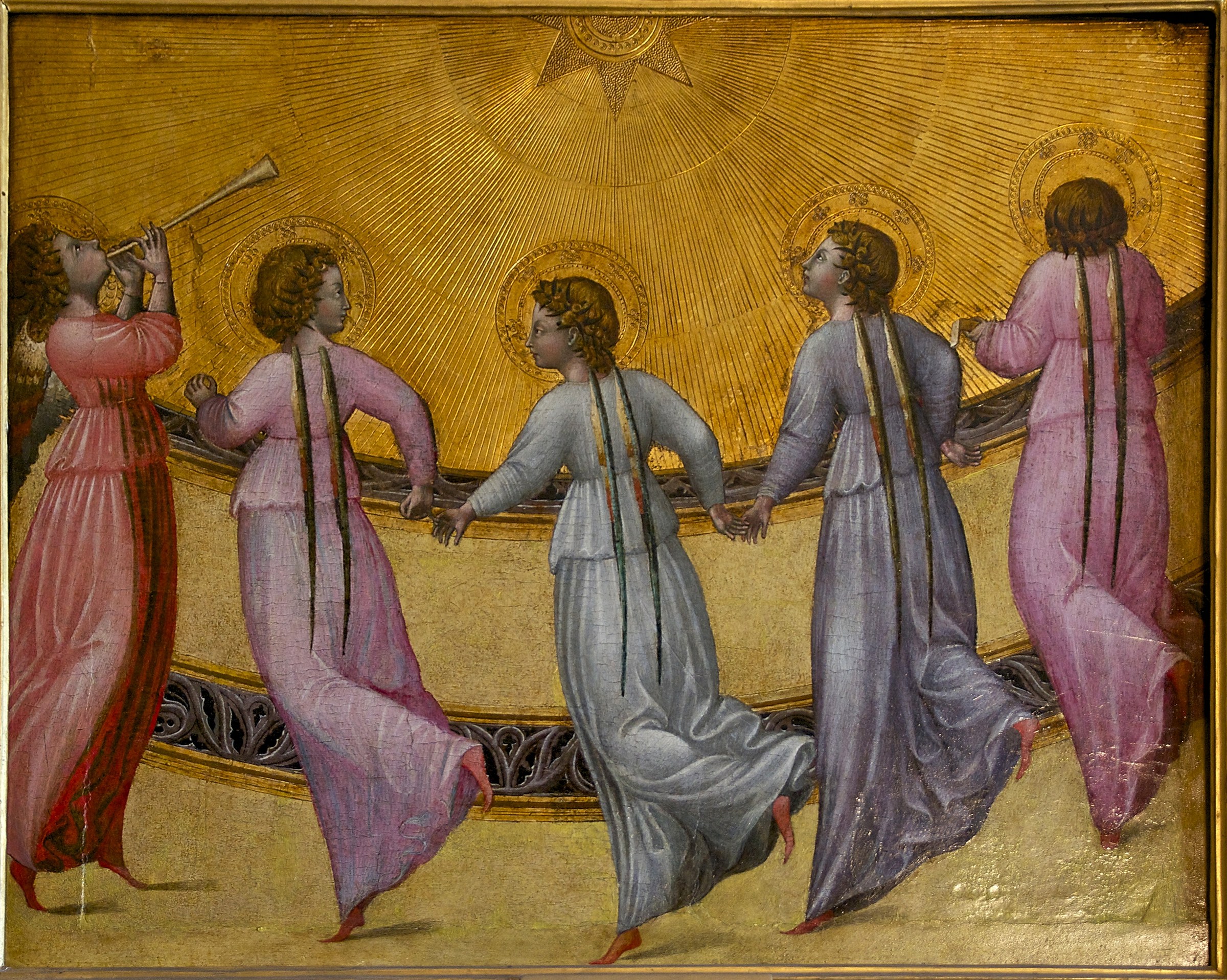
French: Cinq anges dansant au pied d'un trône Five dancing angelstitle QS:P1476,fr:"Cinq anges dansant au pied d'un trône "label QS:Lfr,"Cinq anges dansant au pied d'un trône "label QS:Lpt,"Cinco anjos dançantes"label QS:Len,"Five dancing angels"
Giovanni di Paolo
- Source:
- Wikimedia Commons
- Rights:
- Public domain — free to use, share and adapt.
- Recorded as:
- public_domain
This image documents how Renaissance artists visualized sacred dance and celestial movement, revealing assumptions about grace, coordination, and the body's capacity to express spiritual elevation. For scholars of liturgical dance and costume, the precision of the robes—their cut, their binding, their flow—provides visual evidence of how such garments moved during actual processions and choral dances in churches. The work also illustrates a fundamental theme: that dance, in the Renaissance imagination, was an activity fit for divine beings, not merely earthly entertainment.
What you are looking at
Five young angels with golden halos dance in a celestial setting beneath radiating divine light. They stand in a shallow line against a gold background, their bodies arranged in a fluid, processional chain. Each figure wears a long, flowing robe in shades of pink, mauve, and pale blue, with dark binding or ribbon running vertically down the center front. The angel on the far left sounds a long trumpet toward the heavens. The others hold hands in a gentle linked formation, their bodies angled gracefully, their postures suggesting forward movement and rhythmic coordination. The composition is symmetrical and hieratic: the light rays emanating from above establish a vertical axis, while the figures create a horizontal frieze across the lower register. The painting employs the gold-leaf ground and tempera-on-panel technique characteristic of Northern Italian Renaissance devotional art.
The dancing
Five figures of similar height stand in profile or three-quarter view, their bodies gracefully curved. Each wears a long, flowing robe that extends to the ground, and each has a pronounced halo rendered as an ornamental gold disk. The leftmost angel raises a trumpet to her lips, her body twisted slightly upward. The remaining four angels link hands consecutively, creating a connected chain; their joined hands sit at waist height, and their free arms fall naturally or gesture subtly outward. The bodies are elongated and gently swaying, with weight distributed evenly as if moving together in a measured, coordinated procession. The postures suggest lightness and buoyancy—feet barely seem to touch the ground.
The dance depicted
This depicts a liturgical or devotional dance of angels in Christian celestial imagery, not a human social or theatrical dance. The linked-hand formation and processional movement suggest a sacred roundel or choral dance—a formalized, ceremonial arrangement of divine beings in praise or worship. The presence of the trumpet (an instrument of proclamation and judgment in Christian iconography) combined with the synchronized, graceful movement indicates this is a moment of heavenly celebration or announcement. Such angel dances were common in Northern Renaissance art and reflected both theological imagery and the actual choreography of liturgical processions and carol dances performed by humans on feast days.
How it was made
This is a tempera painting on gold-leaf panel, a technique established from the image by the characteristic flat gold background with incised radiating lines (a pattern tooled into the gold leaf itself), the luminous but non-naturalistic color, and the precise linear definition of forms. The artist has used tempera—pigment bound in egg yolk—which allowed for fine detail and translucent glazes. The gold leaf, which would have been carefully laid before painting began, establishes the work as devotional and precious, intended for chapel or private domestic devotion among the affluent. The technique was standard in Italian panel painting of the early 15th century and implies an audience of clergy and noble patrons familiar with religious iconography.
About this work
Giovanni di Paolo's *Five Dancing Angels* is a devotional image from early 15th-century Siena depicting a moment of celestial celebration. The five figures link hands in a coordinated procession beneath radiating divine light, their flowing robes and synchronized postures conveying both grace and spiritual purpose. This is not a representation of human dancing but rather a theological vision—a visualization of the heavenly praise sung in liturgies and imagined in religious poetry. Yet the care with which the artist has rendered the linked formation and the flowing movement of robes shows genuine attention to choreographic gesture. The work sits within a long tradition of angel choirs in Christian art, a tradition that intersected with actual liturgical dance performed on feast days in churches and cathedrals.
How to look at it
Observe the moment Giovanni di Paolo has chosen: the instant when the five angels are perfectly synchronized in their processional movement, their robes flowing in unison. The linked hands are key—they indicate coordination and shared purpose. The radiating lines of light above compress the space and draw the eye upward, inviting the viewer to share in the celestial focus. Notice how the artist has differentiated the robes by color (pink, mauve, pale blue) while maintaining their formal similarity; this allows the viewer to follow each figure as a distinct being while understanding them as a unified choir. The trumpet, sounded by the leftmost angel, is the moment's pivot: it announces or celebrates what the others, through their coordinated movement, affirm.
The artist
Giovanni di Paolo (c. 1403–1482) was a Sienese painter known for his narrative religious panels, altarpieces, and devotional images. He worked in the International Gothic tradition, which emphasized elegant line, bright color, gold grounds, and spiritual content over naturalistic representation. His works were commissioned by churches, confraternities, and wealthy families in and around Siena. He was admired for his ability to render flowing drapery and graceful figures, qualities evident in this image of the dancing angels.
The period
In the early 15th century, when Giovanni di Paolo was active, Renaissance art in Northern Italy was transitioning from the International Gothic toward early humanism, yet still deeply rooted in religious imagery. Liturgical dance was a living practice in this period: choral dances, processional dances (especially laude processions associated with confraternities), and feast-day celebrations with choreographed movement were regular features of religious life. Angel choirs appeared frequently in art as a way to visualize the heavenly host described in scripture and in popular theology. The figure of dancing angels also resonated with mystical theology and with the poetic tradition of the *laude*—vernacular hymns often associated with singing and dancing confraternities.
Where it lives
The work is recorded in Wikimedia Commons, a digital repository of artworks in public collections. No specific holding institution is recorded in the catalogue entry provided, and further provenance details cannot be established from the image alone.
Dance in this work
Questions about this work
Is this showing a real dance that people performed?
Not directly. Giovanni di Paolo is depicting a theological vision of heavenly beings, not a human dance. However, the linked-hand formation and processional movement reflect actual liturgical dances that were performed in churches during this period—particularly the choral processions and feast-day celebrations of confraternities. The artist's choice to render the angels in synchronized, graceful movement shows knowledge of how such processions looked and moved.
What do the gold halos and radiating light mean?
The halos mark the figures as divine—as blessed beings or saints. The radiating lines of light represent divine illumination or the presence of God (often depicted as light in Christian theology). Together, they establish that this is a sacred, not secular, scene. The light also draws the viewer's eye upward, emphasizing the spiritual direction of the dance.
Why are they holding hands?
The linked-hand formation is a choreographic choice that emphasizes unity, harmony, and coordinated movement. It appears in many depictions of sacred processions and choral dances of the period. In the context of a celestial choir, it suggests that the angels are singing, moving, and praising in perfect synchrony—a visual expression of heavenly accord.
What is the trumpet for?
In Christian iconography, the trumpet is an instrument of divine proclamation—used by archangels to announce God's will or judgment. Here, it may represent the announcement of a feast day, a divine message, or simply the voice of heaven. It distinguishes this angel from the others and gives the scene a moment of particular intensity or declaration.
More dance artwork





