49 works in this view — arrow keys or swipe to move between them.
Dance in Art
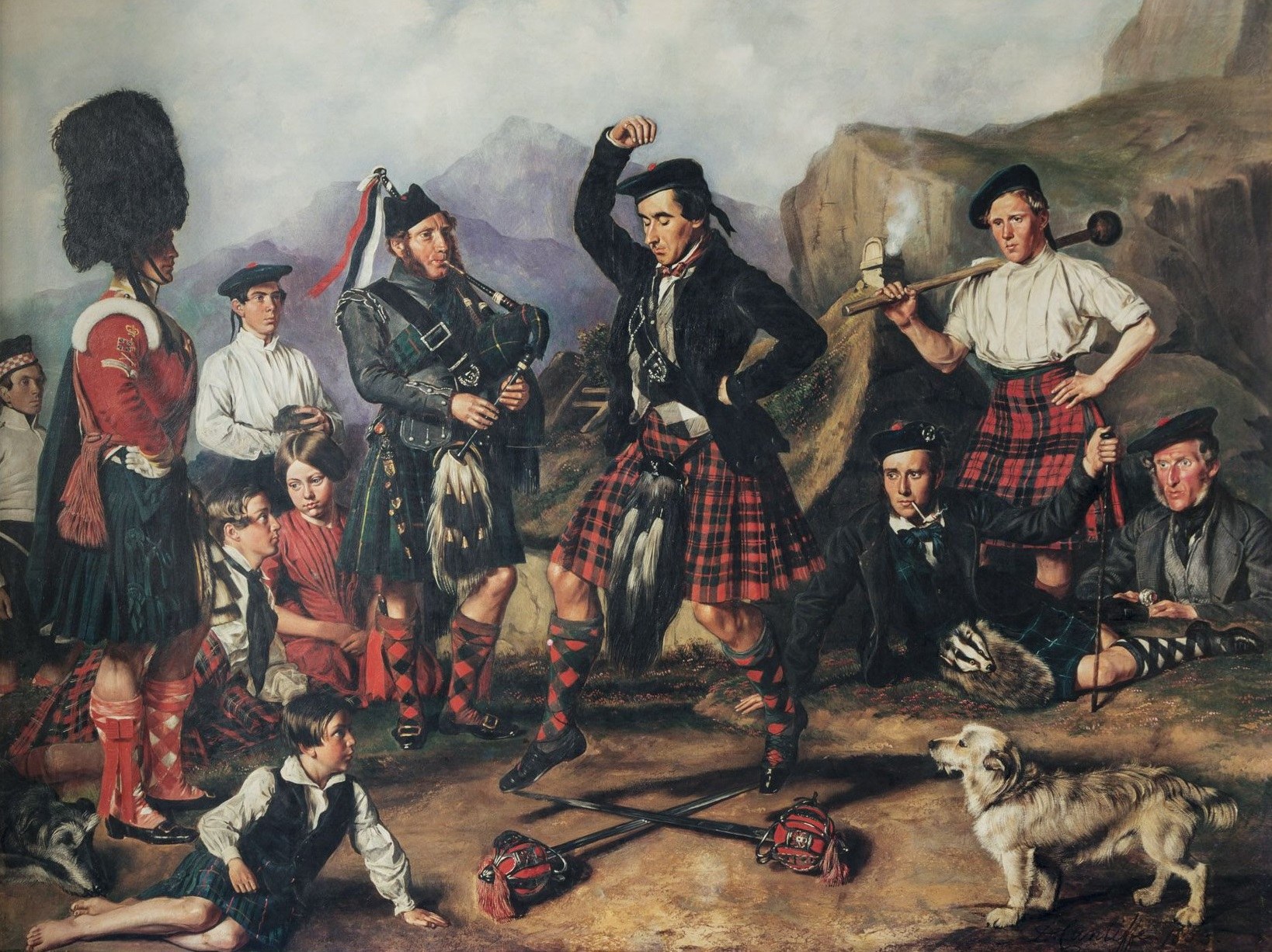
The Sword Dance by David Cunliffe, 1853
David Cunliffe
- Source:
- Wikimedia Commons
- Rights:
- Public domain — free to use, share and adapt.
- Recorded as:
- public_domain
The sword dance shown here is one of the oldest documented solo dances in Britain, and this image captures its performance in a crucial historical moment: when Highland culture, long suppressed, was being reabsorbed into British military and imperial identity. For dancers and historians, it offers visual evidence of how the dance was executed in the 19th century—the posture, the footwork, the scale, the speed—before film. For social historians, it documents the role of dance in military culture and the complex relationship between conquest and cultural revival.
What you are looking at
A military gathering in a mountainous landscape depicts a Highland sword dance in progress. A young boy in civilian dress dances over crossed swords laid on bare ground, his body upright and contained, arms at his sides or raised with palms inward. He wears a dark jacket and light breeches. Around him stand soldiers in full dress uniform—tall bearskin-capped figures in red coats with white facings (the 93rd Regiment) and kilted Highlanders in dark tartan (the 42nd Regiment). Two musicians with bagpipes and drum stand ready; other soldiers and civilians watch from the periphery, including women in tartan skirts and a small white dog in the foreground. The setting is rocky and austere, with mountains rising in mist behind. The composition creates a circle of witnesses around the dancer, emphasizing the formal, contained nature of the performance even as it occupies a wild landscape.
The dancing
The dancer maintains a rigidly upright posture throughout the step, with the trunk still and legs performing rapid, precise footwork confined to a small area over the crossed blades. The arms are held low and controlled, never above shoulder height, in marked contrast to the expansive gestures of social or theatrical dance. The stance is military in its discipline—weight centered, body economical. The surrounding soldiers form a static frame, their formal dress and rigid bearing in sharp contrast to the bounded energy of the dancer's feet.
The dance depicted
This is a Highland sword dance (also called the Gillie Callum or Sword Dance), a Scottish solo dance traditionally performed over two crossed swords or dirks. The image captures the essential character: tight, precise footwork performed without traveling, the dancer's body held still above while the feet execute rapid, intricate steps. The dance was a staple of Scottish regimental culture and Highland gatherings, often performed at military functions and celebrations. The participation of both the 93rd (Sutherland Highlanders) and 42nd (Royal Highland) Regiments here suggests this was a formal military occasion, and the presence of the young boy indicates the dance was taught and performed across all ages within Highland military tradition.
How it was made
This appears to be an oil painting on canvas, executed with careful attention to uniform detail and the rocky landscape. The technique is academic realism with a narrative focus—the composition balances the spectacle of Highland dress against the dramatic natural setting. The layered depth (foreground figures, middle-ground dancer and musicians, background mountains) and the controlled light suggest a work intended for exhibition and reproduction, designed to commemorate a specific military moment while celebrating Highland culture.
About this work
This 1853 painting documents the Highland sword dance as practiced within the British Army during the mid-19th century. It captures a moment of regimental tradition and cultural identity during a period when Highland dress and dance had become integral to military ceremony and imperial spectacle. The work preserves both the technical form of the dance—the precise, ground-bound footwork—and its social context: a performance by a child, framed by military witnesses, set in the romantic landscape of the Scottish Highlands. The painting sits at the intersection of military history, cultural documentation, and the long process by which Highland traditions were formalized, institutionalized, and romanticized within British culture.
How to look at it
Watch the dancer's feet, not his face: the artist has captured the economy and precision that defines the sword dance, the way all movement is concentrated in the lower leg while the torso remains almost statue-like. Note the scale of the swords and the confined area of the dance—this is not a traveling dance or one that covers ground. Observe how the painter has used the ring of uniformed witnesses to frame the performance, making the dance simultaneously intimate (a small, precise action) and formal (a military ceremony). The landscape is deliberately spare and elemental, focusing attention on the human figures and their ritual.
The artist
David Cunliffe (1820–1887) was a Scottish painter known for historical and narrative scenes, particularly those depicting Scottish military and Highland life. He exhibited at the Royal Academy and the Scottish Academy during the height of the Victorian enthusiasm for Romantic portrayals of Scottish identity. His work often combined military precision with picturesque landscape, appealing to audiences interested in both regimental history and Highland heritage.
The period
The 1850s saw the full integration of Highland regiments into the British Army and the establishment of Highland dress as official military uniform—a dramatic reversal from the post-1746 ban on Highland clothing. Dance and music had become key symbols of this cultural rehabilitation. The sword dance, in particular, was being actively performed and preserved within military contexts, especially as regimental traditions became increasingly formalized and celebrated. This was also the period of intense Victorian interest in folk culture, medievalism, and the picturesque—reflected in the romantic treatment of landscape here.
Where it lives
The work is held in Wikimedia Commons and appears to be in a public or institutional collection, though the specific holding institution and accession details are not recorded. It was painted as a documentary historical work celebrating British military life and Highland culture in the mid-Victorian period.
Dance in this work
Questions about this work
What is a Highland sword dance?
A solo dance performed over crossed swords or dirks, traditionally danced in Scotland and among Highland regiments. The dancer executes rapid, precise footwork without traveling, keeping the body upright and still above the waist. It is one of Britain's oldest documented dances and remains a central form in Scottish dance competitions and ceremonies.
Why are British soldiers dancing in a Scottish style?
The 42nd and 93rd regiments shown here were Highland regiments of the British Army. By the 1850s, Highland dress and dance had become integral to military identity and ceremony, celebrated as part of British imperial culture. The sword dance was performed at regimental gatherings, celebrations, and public events as both a martial and cultural tradition.
Is this a competitive or social dance?
This appears to be a formal regimental performance rather than a competitive context (those competitions had not yet formalized in 1853 as they would later in the 20th century). However, the dance itself—the form, precision, and footwork—is identical to the competitive solo dance still performed today in Highland Games and championships.
How historically accurate is the depiction?
The artist has captured the essential technical features correctly: the upright posture, low arm carriage, ground-bound footwork, and confined dancing space. The costume details (military uniform, tartan, sporran placement) appear carefully researched. The painting is a reliable visual document of how the dance was performed and presented in mid-19th-century British military culture.
More dance artwork





