49 works in this view — arrow keys or swipe to move between them.
Dance in Art
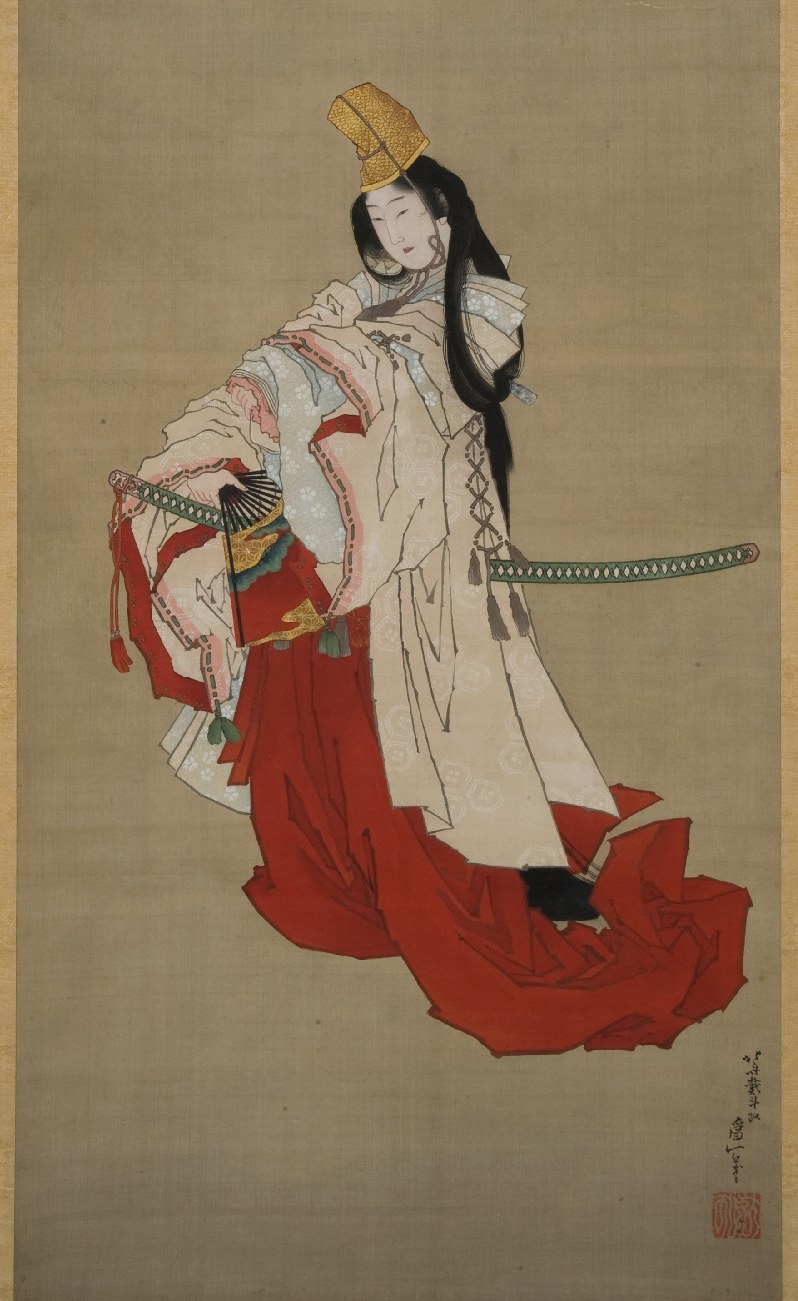
Shizuka-gozen in her farewell dance to Yoshitsune
Katsushika Hokusai
- Source:
- Wikimedia Commons
- Rights:
- Public domain — free to use, share and adapt.
- Recorded as:
- public_domain
Shizuka-gozen is a foundational figure in Japanese dance history and legend; this image is one of the few surviving visual records of how a shirabyoshi was understood and portrayed in the early 19th century. For dance historians, the work documents the formal costume, bearing, and social status of this elite performance tradition at a moment when it was already becoming historical. Hokusai's treatment reveals how a master painter of the period visualized a dancer not in motion but in the emotional and ceremonial gravity of character.
What you are looking at
A single figure in an elegant contrapposto stance dominates the composition against a plain tan background. The dancer wears a layered white outer robe (uwagi) over a brilliant red undergarment, with the white fabric swept dramatically across the body and trailing behind in a long train. The costume is decorated with delicate painted or embroidered details including a red fan motif. A tall gold brocaded hat (eboshi) with a distinctive peaked forward tilt frames the figure's face. The dancer's long black hair falls straight down the back. In the left hand, the figure holds a small decorative fan; a long sword (tachi) hangs at the right hip. The pose suggests a moment of contemplative stillness rather than active motion—the body is upright, weight settled, one arm extended slightly forward in a gesture that could be greeting, blessing, or farewell. The composition is intimate and frontal, drawing the viewer into direct engagement with the solitary performer.
The dancing
A single standing figure with controlled, formal posture. The left arm extends with a soft gesture, hand holding a fan; the right arm rests at the side. The weight appears evenly distributed, the spine vertical, the head tilted slightly downward in a pose of dignity or sorrow. The crossed legs and the sweep of fabric suggest a moment of pause rather than active stepping or turning. The proportions and delicate rendering of the hands and face indicate a trained performer of high status.
The dance depicted
This is a shirabyoshi, the celebrated courtesan-dancer tradition of medieval and early modern Japan. Shirabyoshi were highly educated female entertainers who performed ritual dances, often in the service of nobles and at temples. The formal, stationary pose and the ceremonial costume—particularly the gold hat and white robe—suggest this is not an active choreographic moment but rather a formal portrait capturing the dancer in character. The catalogue identifies this as Shizuka-gozen, the most famous shirabyoshi in Japanese legend, known for her beauty, her skill, and her tragic love affair with the warrior Yoshitsune. The image captures her not in mid-dance but in a moment of emotional weight, consistent with narratives of farewell or parting.
How it was made
This is a colored ink drawing on silk, executed with the refined technique characteristic of Katsushika Hokusai's later years. The artist has used careful brushwork for the structural lines of the costume and face, with washes of color—particularly the brilliant red of the inner robe and the gold of the hat—laid in with precision. The technique allows for both detailed pattern work (visible in the fan and textile designs) and the subtle tonal modulations in the white robe. The paper or silk support and the quality of execution indicate this was a work of considerable care, likely created for a patron familiar with both Japanese courtly aesthetics and the legendary history of shirabyoshi performance.
About this work
This is a portrait of Shizuka-gozen, the legendary shirabyoshi dancer, rendered by Katsushika Hokusai around 1825. Rather than depicting active choreography, it presents the dancer in formal, stationary repose—a moment of emotional stillness captured through costume and gesture. The work belongs to a tradition of theatrical portraiture that celebrated famous performers by fixing them in memorable poses. Hokusai's rendering emphasizes both the visual splendor of shirabyoshi costume and the inward composure of a celebrated artist, making this work both a portrait of an individual and a document of a vanished performance tradition. The image survives from an era when Hokusai was nearing eighty and continued to produce works of remarkable refinement; it shows his continued engagement with Japanese theatrical and courtly subjects even as he remained famous internationally for his landscape prints.
How to look at it
Attend to the pose: this is a moment of stillness, not motion. The slight forward tilt of the head, the extended left arm, and the trailing robe suggest an inward emotional state—contemplation, resignation, or ritual formality—rather than active choreography. The costume details (the gold hat, the layered robes, the sword, the fan) are the visual vocabulary of shirabyoshi status and education. Notice how Hokusai has used the contrast between the brilliant red of the inner garment and the white and gold outer layers to create visual richness while maintaining the figure's commanding vertical presence. The pose is characteristic of Japanese formal aesthetics: economical in gesture, weighted with meaning, dependent on the viewer's knowledge of theatrical and courtly convention.
The artist
Katsushika Hokusai (1760–1849) was one of Japan's most prolific and innovative artists, celebrated for his landscape prints (including the series *Thirty-six Views of Mount Fuji*) but also deeply engaged with theatrical subjects, portraiture, and narrative illustration throughout his career. He worked across media and scales, from woodblock prints to paintings and drawings. His late work, including this piece, demonstrates undiminished technical control and a continued interest in Japanese cultural subjects, even as his international reputation was built primarily on his landscapes.
The period
By 1825, the shirabyoshi tradition was already several centuries old; the most celebrated practitioners had flourished in the 12th and 13th centuries, and the form had become both a historical subject and a living (if increasingly specialized) performance practice. Early 19th-century Japan saw a flourishing of theatrical and performance documentation in visual arts—woodblock prints, paintings, and drawings of kabuki actors, musicians, and other performers became widely circulated. This work sits at the intersection of that theatrical portraiture tradition and the cultural nostalgia for elite medieval and courtly practices that characterized Edo and early Meiji intellectual life.
Where it lives
The work is recorded in Wikimedia Commons and appears to be part of a public collection, though the specific holding institution and accession information are not provided in the available catalogue record.
Dance in this work
Questions about this work
Who was Shizuka-gozen?
Shizuka-gozen (early 12th century) is a legendary and historical figure in Japanese culture, celebrated as the most famous shirabyoshi dancer of her era. She is best known from the *Tale of the Heike*, a foundational medieval narrative, for her love affair with the warrior Yoshitsune and her fate after his fall from power. She became a symbol of beauty, talent, loyalty, and tragic loss in Japanese literature and performance.
What is a shirabyoshi?
Shirabyoshi were female entertainers and dancers of medieval Japan, trained in music, dance, poetry, and courtly accomplishment. They often performed at temples, at court, and for the nobility. The term literally means 'white-rhythm.' They were highly educated and held a complex social position—respected for their artistry but also sexually available to patrons. The tradition declined over centuries but remained culturally significant into the modern period.
Why is she holding a sword?
The sword (tachi) is part of the formal regalia of a shirabyoshi and signifies both status and martial cultural context. Shirabyoshi dancers were often associated with the warrior class and performed at military and noble households. The sword, along with the formal robe and hat, marks this as a figure of high rank and education within medieval Japanese society.
Is this work depicting a dance, or is it a portrait?
It is both. This is a portrait of a famous dancer rendered in a pose that suggests performance character and emotional depth rather than active choreography. It belongs to a tradition of theatrical portraiture in which celebrated performers are shown in costume in a memorable moment, fixed and timeless, rather than captured mid-movement. For shirabyoshi, the formal pose and costume were themselves central to the performance aesthetic.
More dance artwork





