49 works in this view — arrow keys or swipe to move between them.
Dance in Art
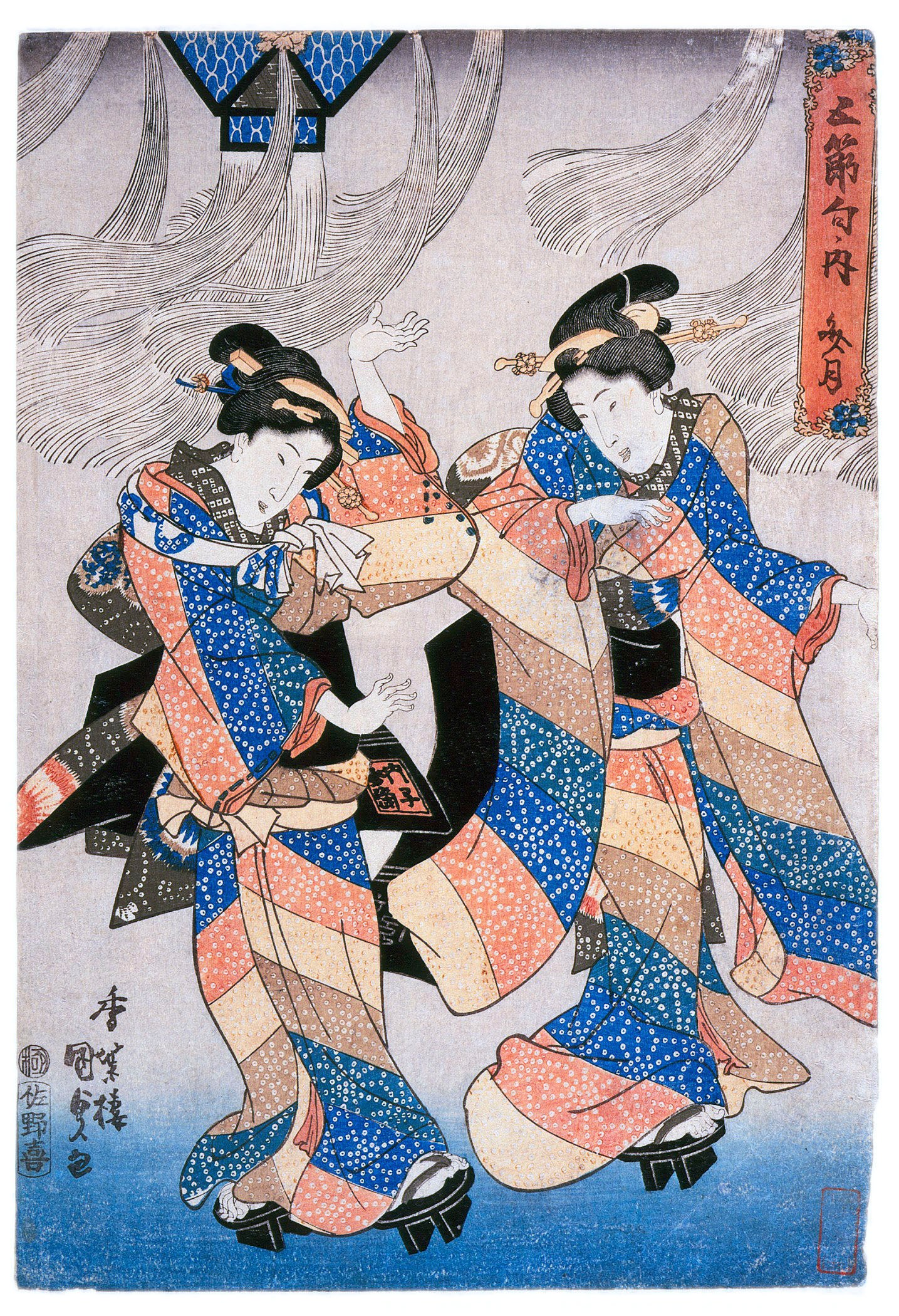
Tanabata Festival Dance
Utagawa Kunisada
- Source:
- Wikimedia Commons
- Rights:
- Public domain — free to use, share and adapt.
- Recorded as:
- public_domain
The image preserves a rare visual record of Tanabata Festival dance practice in the early nineteenth century, showing the coordination, dress codes, and formal movement qualities valued in this seasonal celebration. For woodblock print collectors and historians, it demonstrates the technical sophistication of color registration and the commercial viability of dance and festival imagery in this period. For choreographers and performers interested in historical Japanese movement practice, it offers evidence of how parallel, mirrored, and synchronized gestures structured festival performance.
What you are looking at
Two women in elaborate kimonos perform a dance together against a background of stylized, sweeping brushstrokes suggesting fabric or water in motion. Both wear richly patterned garments in blue, coral, and cream with intricate geometric and floral designs; their black hair is arranged in traditional updos adorned with ornamental pins. They lean toward each other in a connected pose, their bodies angled and intertwined, with arms raised and extended in parallel gestures. The composition is intimate and dynamic, capturing a moment of synchronized movement. At the top of the print, a decorative banner in blue with white pattern work hangs above them. The background's sweeping linear patterns—rendered in delicate parallel lines—create a sense of motion or possibly represent the flowing silk of their garments magnified. The color palette is restrained but jewel-like: deep indigo, coral-red, pale cream, and black, printed with the precision characteristic of woodblock technique.
The dancing
The two dancers are positioned side by side and slightly overlapping, their bodies creating a unified composition. Their arms are raised and extended outward in a parallel, mirrored gesture—a hallmark of formal, ceremonial movement. Their knees are bent and their posture leans inward toward each other, suggesting a partnered coordination rather than independent solo movement. The weight appears to be on the balls of the feet, and their silhouettes suggest a restrained, deliberate quality rather than dynamic leap or turn. The matching pose and synchronized gesture indicate this is a duet built on mirror or parallel form.
The dance depicted
This print depicts a Tanabata Festival dance, as confirmed by the catalogue title and the Japanese seasonal context. The Tanabata Festival (Star Festival, celebrated on the seventh day of the seventh month) is associated with the romantic story of celestial lovers and traditionally features communal celebrations with dance, music, and elaborate dress. The pose and costume suggest this is a formal, ritualized dance performance rather than casual celebration movement. The parallel arm gestures and synchronized positioning are typical of Japanese festival and theatrical dance traditions, which often emphasize geometric symmetry and controlled, intentional movement. The elaborate formal dress and the paired configuration suggest this may represent a specific festival dance or tableau, though without additional inscription details the precise choreographic form cannot be determined with certainty.
How it was made
This is a color woodblock print (ukiyo-e), executed with the multi-block registration technique that allowed precise layering of distinct colors and patterns. The parallel line work visible in the background is characteristic of woodblock printing, where linear patterns are an economical way to suggest movement, fabric texture, or atmospheric effect. The precision of the geometric patterns on the kimonos—the repeating blue and white motifs on the garments—demonstrates the capability of woodblock to render intricate textile design. The technique allowed for serial production and wide circulation, making this the kind of image that would have been accessible to a substantial audience in Edo and Meiji Japan, informing public knowledge of festival practices and formal dress codes.
About this work
This is a woodblock print from Utagawa Kunisada's series *Five Seasonal Festivals*, depicting two women performing a coordinated dance in celebration of Tanabata, the seventh-month Star Festival. Kunisada was one of the most prolific and commercially successful artists of his era, and his images of beautiful women (*bijin-ga*) and theatrical subjects reached a wide urban audience. The print sits at the intersection of documentary record—showing actual festival dress and movement conventions of early-nineteenth-century Japan—and artistic idealization, rendering the dancers' faces and forms according to contemporary aesthetics of beauty. For dance historians, it provides evidence of how festival dances were understood visually and marketed to the public, and how formalized, geometric movement aesthetics were valued in this cultural context.
How to look at it
Observe the precise parallel of the dancers' raised arms and their angled body positions—the artist has chosen a moment of synchronized stillness or slow coordination rather than a peak of dynamic movement, emphasizing the geometric and rhythmic aspects of the dance over virtuosity or speed. Note the extreme care taken with the kimonos' pattern work: the blue geometric designs and coral-red color blocks are rendered as precisely as the dancers' faces, suggesting that costume was as important to the viewer's experience as the bodies moving within it. The background's sweeping linear patterns operate at multiple registers simultaneously—they may represent fabric in motion, atmospheric suggestion, or pure compositional rhythm—and draw the eye outward from the intimate pairing of the dancers.
The artist
Utagawa Kunisada (1786–1864) was one of the most commercially dominant artists of the Edo and Meiji periods, renowned for his *bijin-ga* (pictures of beautiful women), *kabuki* scenes, and historical subjects. He succeeded Utagawa Toyokuni as head of the Utagawa school workshop, which operated on a large scale with many apprentices and assistants, allowing for prolific output and rapid response to market demand. His prints were created for a broad urban middle-class audience and circulated widely; the compositional clarity, color sophistication, and narrative legibility of his work made it highly accessible. The *Five Seasonal Festivals* series exemplifies his approach: pairing beautiful women with recognizable cultural moments that audiences would immediately understand and value.
The period
In the 1830s, Japan's urban merchant and artisan classes were the primary consumers of color woodblock prints, which documented both kabuki theater and idealized versions of social life, seasonal celebrations, and beautiful women. Festival culture was a significant part of urban leisure and social identity; the Tanabata Festival in particular had both literary prestige (celebrated in classical poetry) and popular participation. Visually, the early nineteenth century saw the consolidation of *ukiyo-e* technique—particularly the perfection of Prussian blue pigment and the refined registration system that allowed complex multi-color printing—which meant that artists could render elaborate textile patterns and coordinated compositions with unprecedented precision. Dance in this period was not yet a separate categorical concern; it appeared in prints as part of theater scenes, festival documentation, and courtship imagery, usually through the representation of women's bodies and dress rather than through abstract movement notation.
Where it lives
This work is held in the Los Angeles County Museum of Art and was part of a broader acquisition of Japanese prints in the mid-twentieth century. The print's serial number (16.14.68) and its identification as the left panel of a triptych indicate it was collected and catalogued as part of a larger effort to document *ukiyo-e* material in American institutions.
Dance in this work
Questions about this work
What is the Tanabata Festival and why are these women dancing?
Tanabata (Star Festival) occurs on the seventh day of the seventh lunar month and celebrates the mythological union of two celestial lovers, Orihime and Hikoboshi. The festival combined literary tradition with popular celebration and included music, dance, decoration, and communal feasting. The women in this print are likely performing a formal dance as part of the public celebration, wearing their finest kimonos to honor the occasion. The paired configuration may reference the romantic narrative at the festival's heart.
How can you tell this is a woodblock print?
The image shows the characteristic features of color woodblock printing: flat, distinct color areas with crisp edges; the use of repetitive linear patterns (visible in the background) as an economical way to suggest texture and movement; and the extreme precision of the geometric textile patterns on the kimonos, which would have been carved as separate blocks for each color. The color palette—indigo, coral, cream, and black—reflects the pigments available to woodblock printers in this era.
Is this a documentary image or an idealization?
Both. The clothing, festival context, and movement forms are based on actual practice and would have been recognizable to contemporary viewers as authentic to Tanabata celebration. However, the women's faces follow contemporary standards of beauty in ukiyo-e, their skin tone is idealized, and the composition is carefully arranged for visual harmony rather than candid observation. It is a stylized record rather than reportage.
Why are the dancers leaning toward each other?
The inward lean and parallel arm gestures create a visual and kinetic unity between the two dancers, suggesting coordinated movement and mutual focus. This compositional choice emphasizes partnership and synchronization, which may reflect the actual structure of the Tanabata Festival dance or may be an artistic convention used to create visual harmony and romantic association (given the festival's connection to lovers).
More dance artwork





