49 works in this view — arrow keys or swipe to move between them.
Dance in Art
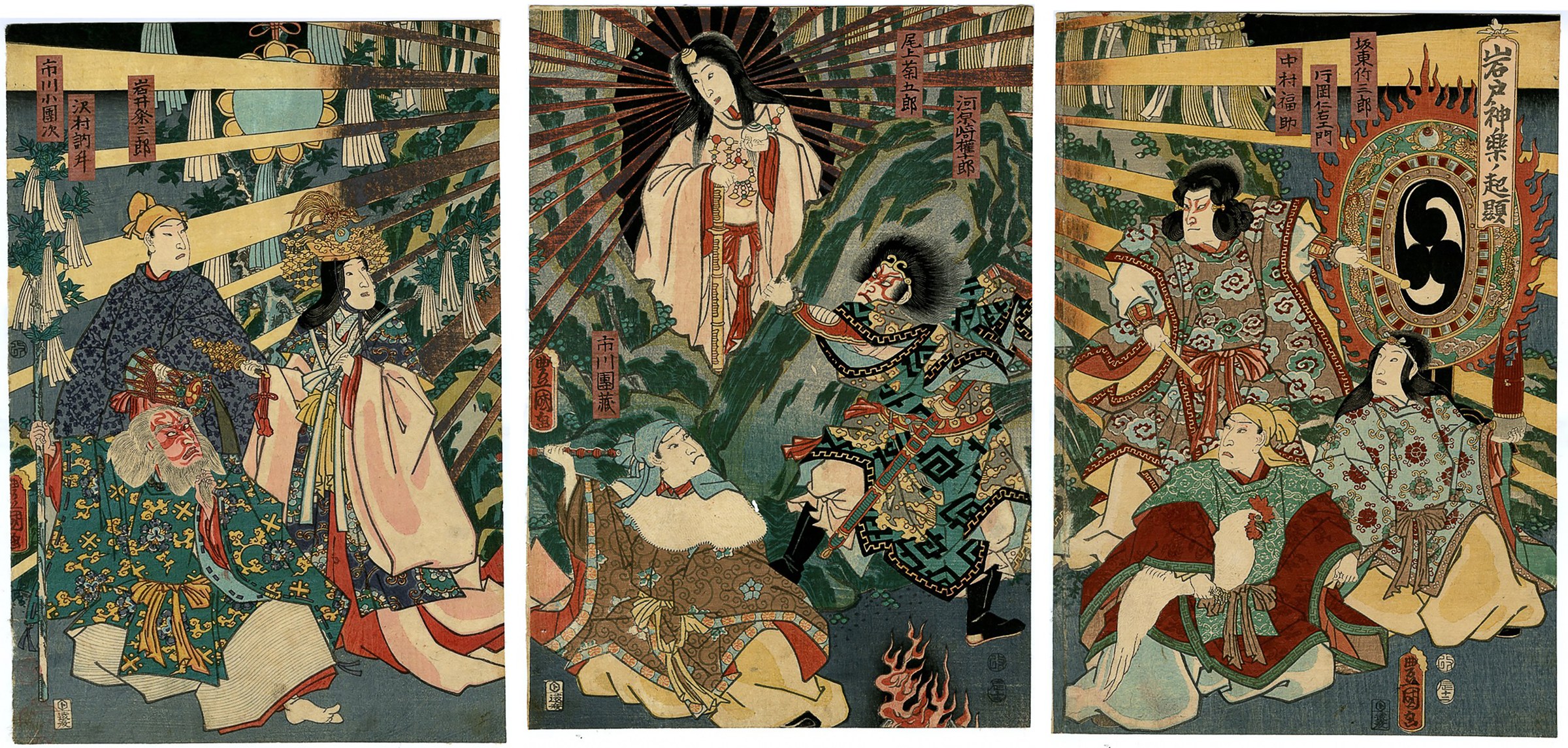
Origin of Iwato Kagura Dance Amaterasu by Toyokuni III (Kunisada) 1856
Toyokuni III (Kunisada)
- Source:
- Wikimedia Commons
- Rights:
- Public domain — free to use, share and adapt.
- Recorded as:
- public_domain
Iwato Kagura is designated as an Important Intangible Cultural Property of Japan and remains actively performed in Shinto shrines. This print documents the mythological narrative at the heart of the tradition and shows how sacred dance was understood and visualized by a leading artist of the period. The work demonstrates that kagura was not merely popular entertainment but a subject worthy of sophisticated artistic treatment by the era's most celebrated print master.
What you are looking at
This triptych depicts the mythological moment when the sun goddess Amaterasu emerges from the Iwato cave, the origin story of Iwato Kagura dance. The composition is divided across three panels showing the divine assembly and the central act of revelation. In the center panel, Amaterasu appears in pale robes with a massive radiating black fan-shaped halo, floating above a scene of chaos and firelight. Below her, several deities in elaborate court dress—gold patterned robes, red undergarments, and formal headdresses—gaze upward or gesture in celebration. The left panel shows attendant figures, while the right panel displays additional courtiers and divine beings arranged in a crowd, their bodies oriented toward the center. The background throughout features green rocky peaks suggesting the sacred cave landscape, with decorative gold and blue patterned areas representing architectural or cosmic space. The scene is rendered in the ukiyo-e style with bold outlines, mineral pigments, and gold leaf accents typical of mid-19th-century Japanese woodblock printing. The overall effect is one of divine emergence witnessed by a celestial court.
The dancing
The bodies throughout are arranged in attitudes of wonder and reverence, with arms raised, bodies leaning forward, and faces tilted upward toward Amaterasu. The figures are densely packed, creating a sense of collective witness rather than organized formation dancing. Most stand or kneel in poses of supplication or astonishment, their garments spread around them in the formal pleated skirts and layered robes of Heian court dress. The goddess herself is centrally positioned and elevated, her body vertical and formal, her presence marked by the enormous radiating fan that dominates the composition. The positioning suggests ceremonial observation rather than active dance movement in the Western sense, though the gathering itself constitutes a sacred assembly.
The dance depicted
Iwato Kagura is a sacred Shinto ceremonial dance originating from the mythological narrative depicted here: the sun goddess Amaterasu's emergence from the sacred cave (Iwato) where she had hidden, plunging the world into darkness. According to Shinto tradition, the other deities lured her out through music, dancing, and the appearance of a reflection (in a mirror, shown in the original myth). Iwato Kagura remains one of Japan's oldest and most sacred kagura traditions, performed as ritual dance rather than entertainment. The image captures not the dance itself but the mythological moment it commemorates and ritually re-enacts—the gathering of deities celebrating the restoration of light. This is a representation of sacred origin narrative rather than a depiction of the dance in performance.
How it was made
This is a woodblock triptych in the ukiyo-e tradition, likely a color woodblock print (nishiki-e or full-color print). The technique is evident from the bold outlines in black, the flat areas of pure color (reds, greens, blues, golds), and the precise registration of multiple blocks. Gold pigment—either gold leaf or brass dust—enriches the composition throughout, particularly in the halo and decorative background elements. The medium allowed for wide circulation among educated and merchant-class audiences and permitted the reproduction of this narrative in quantities that made it accessible beyond the imperial court. The style and palette suggest this is a deluxe production, with gold application indicating a higher-end print intended for collectors.
About this work
This triptych by Utagawa Kunisada (Toyokuni III) illustrates the Shinto mythological origin of Iwato Kagura, one of Japan's most sacred ceremonial dances. Rather than showing the dance in performance, it depicts the legendary moment when the assembled deities celebrate the sun goddess Amaterasu's emergence from the cave where she had hidden the world in darkness. The work sits at the intersection of myth illustration and cultural documentation, recording in visual form a narrative that is itself danced and re-enacted in ritual performance. It represents a major ukiyo-e artist's engagement with sacred subject matter during the late Edo/early Meiji period.
How to look at it
Observe the formal symmetry and the centering of Amaterasu within the triptych format—the composition emphasizes revelation and emergence through spatial hierarchy rather than dynamic action. The radiating black fan halo, a purely pictorial invention not part of historical Shinto practice, creates a visual analogue to the sun itself and marks the moment of sacred presence. Note how the surrounding figures are arranged as witnesses rather than participants in a choreographed formation; their varied poses and orientations create a sense of spontaneous response to the divine appearance. The rich decoration of their garments and the gold accents throughout elevate this to a scene of cosmic significance rather than earthly ritual.
The artist
Utagawa Kunisada (1786–1864), known professionally as Toyokuni III after succeeding to the name, was the most commercially successful and prolific ukiyo-e artist of his era. He dominated the woodblock print market in Edo/Tokyo for over five decades, producing designs for kabuki actors, beauties, historical narratives, and mythological subjects. His studio was the largest in Japan, and his works circulated widely among urban audiences. He was equally skilled in single sheets and multi-sheet compositions (diptychs and triptychs). By the 1850s, when this print was made, Kunisada was in his seventies but remained the preeminent figure in the medium.
The period
This print dates to 1856, during the late Edo period when Japan was under increasing pressure from Western powers and traditional culture was being codified and recorded with new urgency. Kabuki was the dominant performing art, but sacred Shinto practices including kagura were experiencing renewed interest and documentation. The ukiyo-e print industry was at its technical and commercial peak before photography began to displace woodblock prints in the 1870s. Gold-enriched prints like this represented the luxury end of the market, made for wealthy collectors and commissioned patrons.
Where it lives
The work is held in Wikimedia Commons and is accessible as a public digital resource. It is a color woodblock print triptych from 1856, a medium-to-high production print aimed at educated urban collectors and available through commercial print shops of the Edo period.
Dance in this work
Questions about this work
Is this showing an actual dance performance?
No. This depicts the mythological narrative from which Iwato Kagura originates—the moment when the sun goddess emerges from the cave. The dance itself is a ritual re-enactment of this story performed in Shinto shrines. The image shows the gathered deities witnessing the revelation, not a choreographed dance in progress.
Who was Amaterasu and why did she hide?
Amaterasu-Ōmikami is the supreme sun goddess in Shinto mythology. According to tradition, she withdrew into a sacred cave in anger, plunging the world into darkness. The other deities lured her out through music, dancing, and by showing her a mirror, restoring light to the world. This event is the mythological foundation of kagura performance.
What is Iwato Kagura and is it still performed?
Iwato Kagura is a sacred ceremonial dance tradition originating from the Iwate Prefecture region of Japan, though the name references the mythological Iwato cave. It is performed in Shinto ritual contexts and is designated as an Important Intangible Cultural Property. The tradition remains active in shrine performances and cultural preservation efforts.
Why did Kunisada choose this subject?
By the 1850s, sacred and historical subjects were popular in ukiyo-e alongside kabuki scenes and beauties. Shinto narratives in particular were gaining cultural attention as Japan modernized. A major artist creating a deluxe gold-enriched print on this subject was likely responding to demand from educated collectors interested in Japanese mythology and cultural heritage.
More dance artwork





