49 works in this view — arrow keys or swipe to move between them.
Dance in Art
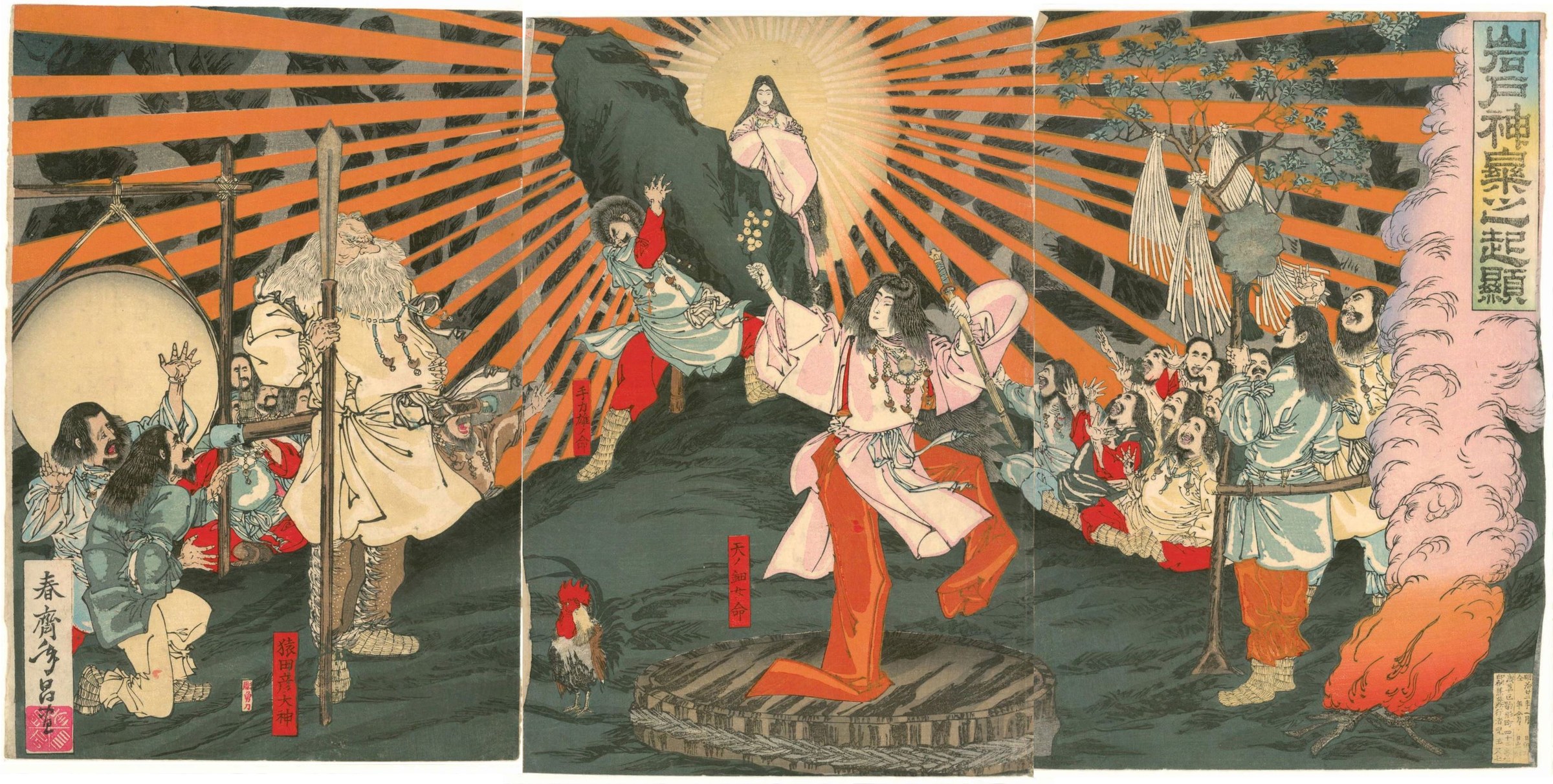
Origin of the Cave Door Dance (Amaterasu) by Shunsai Toshimasa 1889
Shunsai Toshimasa
- Source:
- Wikimedia Commons
- Rights:
- Public domain — free to use, share and adapt.
- Recorded as:
- public_domain
This work preserves visual testimony to one of the world's oldest documented sacred dances, one still performed in Shinto practice today. It shows how a foundational myth about dance—about a woman's body as the instrument of cosmic restoration—was still being celebrated and visualized in nineteenth-century Japan, and how woodblock printmaking could render the otherworldly intensity of ritual performance.
What you are looking at
This is a triptych woodblock print depicting a pivotal moment from Japanese mythology: the emergence of the sun goddess Amaterasu from her cave. The composition is dominated by dramatic radial lines in orange and black that surge outward from a luminous center, creating an intense visual effect of divine light and energy. The goddess herself appears in the upper center, surrounded by a golden aureole, her figure ethereal and remote. Below and around her swarms a dense crowd of divine beings—some in elaborate court dress with layered robes in cream, red, and pale green, others rendered as smaller, almost demonic figures in darker tones. The principal dancer, the goddess Ame no Uzume, appears in the lower center wearing a brilliant red skirt and jacket, captured mid-performance with her body angled dynamically. The setting is a sacred cave mouth rendered in dark charcoal tones, with the celebratory gathering spilling across all three panels. Musicians hold drums and other instruments. The mood is one of frenzied celebration and supernatural presence—the other gods coaxing their sun goddess back to the world through music, dance, and laughter.
The dancing
Ame no Uzume, the central dancer, is depicted in a low, weight-forward stance with her torso tilted and legs bent, suggesting vigorous, grounded movement. Her arms gesture outward and upward in an open, inviting pose. The surrounding figures cluster densely, many in profile or three-quarter view, watching intently. The crowd is arranged in no formal pattern but radiates outward from the dancer and the cave opening, creating visual energy. No closed holds or ballroom frame; the movement is expressive, ecstatic, and directed toward a purpose—not social dancing but ritual performance designed to achieve an outcome.
The dance depicted
This depicts the Iwato Kagura (岩戸神楽), the legendary 'cave door dance' from the Kojiki, Japan's oldest written record of mythology. Ame no Uzume performs a fertility dance and striptease to lure Amaterasu from her hiding place; her performance succeeds when the assembled gods laugh, arousing the sun goddess's curiosity. This is not a social or competitive dance form but a sacred-ceremonial performance embedded in a foundational creation myth. The image captures the moment of divine intervention through dance—the instant when the dancer's body becomes a tool of cosmic restoration. The visual language suggests energetic, uninhibited movement quite unlike the restrained court dances of later periods.
How it was made
This is a three-panel woodblock print (triptych) in the ukiyo-e tradition, created from separated blocks for each color—orange, black, cream, pale green, and touches of pink. The artist is identified as Shunsai Toshimasa, with execution by Wada Yūjirō and publication by Kodama Matashichi in 1889. The bold radial line work and the flattened, outlined approach to figures are characteristic of woodblock printing technique; the dramatic orange rays would have required skillful registration across three separate blocks. The medium allowed wide circulation through prints, making this imagery accessible beyond the imperial court or temple audiences. The date of 1889 places this in the Meiji period, when Western influences on Japanese art were increasing, yet this work remains firmly rooted in traditional subject matter and printing method.
About this work
This triptych depicts a scene from Japan's foundational mythology—the moment when the goddess Ame no Uzume dances to coax the sun goddess Amaterasu from a cave, restoring light to the world. It is simultaneously a historical record of a sacred dance tradition and a masterwork of woodblock printmaking that captures the supernatural intensity of ritual performance through compositional rhythm and color. The Iwato Kagura remains a living tradition in Shinto practice, and prints like this one document how the myth was imagined and transmitted in the late nineteenth century, at a moment when Japanese cultural identity was being negotiated in relation to Western modernity.
The work belongs in a gallery of dance in art because it treats dance as a transformative force—not as entertainment or social ritual, but as a means of moving the cosmos. The dancer's body is the pivot on which the narrative turns. The composition emphasizes her presence while surrounding her with witnesses and supernatural consequence. For artists and historians, it demonstrates how non-Western traditions have long understood dance as sacred labor.
How to look at it
Attend first to the radial composition: the artist uses the lines not as mere decoration but as a visual expression of the divine power at stake. Notice how Ame no Uzume's body is captured at a moment of maximum openness and energy—weight forward, arms spread—a posture of invitation and exposure. The crowding and density of the surrounding figures, their varied scales and expressions, convey the urgency and chaos of the scene: gods pressing in, the moment of cosmic intervention. The orange rays overwhelm the dark cave, a visual metaphor for the return of light. The print demonstrates how woodblock technique—with its bold outlines and separated color blocks—is perfectly suited to rendering both the mythological grandeur of the scene and the kinetic intensity of the dancer's body.
The artist
Shunsai Toshimasa (春斎年昌) was a Japanese woodblock print artist active in the Meiji period (1868–1912). Little is documented about his individual biography, but his work falls within the late ukiyo-e tradition and the broader shift in Japanese printmaking toward historical and mythological subjects during a period of rapid modernization. The collaboration with Wada Yūjirō (execution) and publisher Kodama Matashichi suggests a structured workshop practice typical of the period's commercial print production.
The period
The late Meiji period (1889) was a time of intense cultural negotiation in Japan. While Western artistic influence was reshaping Japanese visual culture, mythological and historical subjects—especially those connected to Shinto, imperial ideology, and national identity—remained potent. Sacred dances like the Iwato Kagura were increasingly documented and valorized as expressions of authentic Japanese tradition. Woodblock printing, though ancient, was still the dominant mode for reproducing images at scale and was experiencing a revival of interest in historical and legendary subjects. This print sits at the intersection of traditional subject matter, traditional technique, and nineteenth-century print culture.
Where it lives
This is a triptych woodblock print from a numbered series (Wikimedia Commons indicates component parts KI 10404-1, KI 10404-2, KI 10404-3), suggesting it was part of a documented collection, likely in a museum or archive in Japan or Europe. The three-panel format indicates it was a significant production, not a minor work.
Dance in this work
Questions about this work
Is the Iwato Kagura a real dance that still exists?
Yes. The Iwato Kagura (cave door kagura) is documented in Shinto practice and is still performed in shrines today, often as part of New Year ceremonies or regular worship. The myth itself is recorded in the Kojiki (712 CE) and Nihon Shoki (720 CE), Japan's oldest written texts. This print documents how the legend was visualized in the nineteenth century, centuries after the foundational myth was written down.
What was Ame no Uzume actually doing in the dance?
According to the mythological accounts, she performed a striptease—removing her clothing and dancing ecstatically on an overturned tub or wooden platform. Her performance was explicitly sexual and uninhibited, designed to provoke laughter and arousal among the watching gods. This made Amaterasu curious enough to peek out of the cave, at which point the gods pulled her out and sealed the cave entrance, restoring light to the world.
Why is this mythological moment important to Japanese culture?
The myth explains the cosmological power of female sexuality and dance, establishes the sun goddess Amaterasu as the supreme deity from whom the imperial line descends, and provides a narrative origin for Shinto ritual and celebration. It also explains why the world has cycles of light and darkness. The myth has remained central to Japanese religious practice and identity for over a thousand years.
What is woodblock printing and why was it used for this image?
Woodblock printing is a relief printing technique in which an image is carved into separate wooden blocks—one for each color—and then inked and printed in sequence. By 1889, it was the primary technology for reproducing and circulating images in Japan before photography became dominant. It allowed artists and publishers to create multiple copies of complex, multi-colored images for a broad audience, making mythology, history, and current events visually accessible.
More dance artwork





