49 works in this view — arrow keys or swipe to move between them.
Dance in Art
絵兄弟
Kitagawa Utamaro
- Source:
- Wikimedia Commons
- Rights:
- Public domain — free to use, share and adapt.
- Recorded as:
- cc0
For historians of kabuki and Japanese dance, this print is primary source documentation of how major roles were prepared and what their visual and material codes were in the 1790s. For art historians, it exemplifies Utamaro's innovative approach to theater subjects—depicting not the actor on stage but the person and the work behind the curtain.
What you are looking at
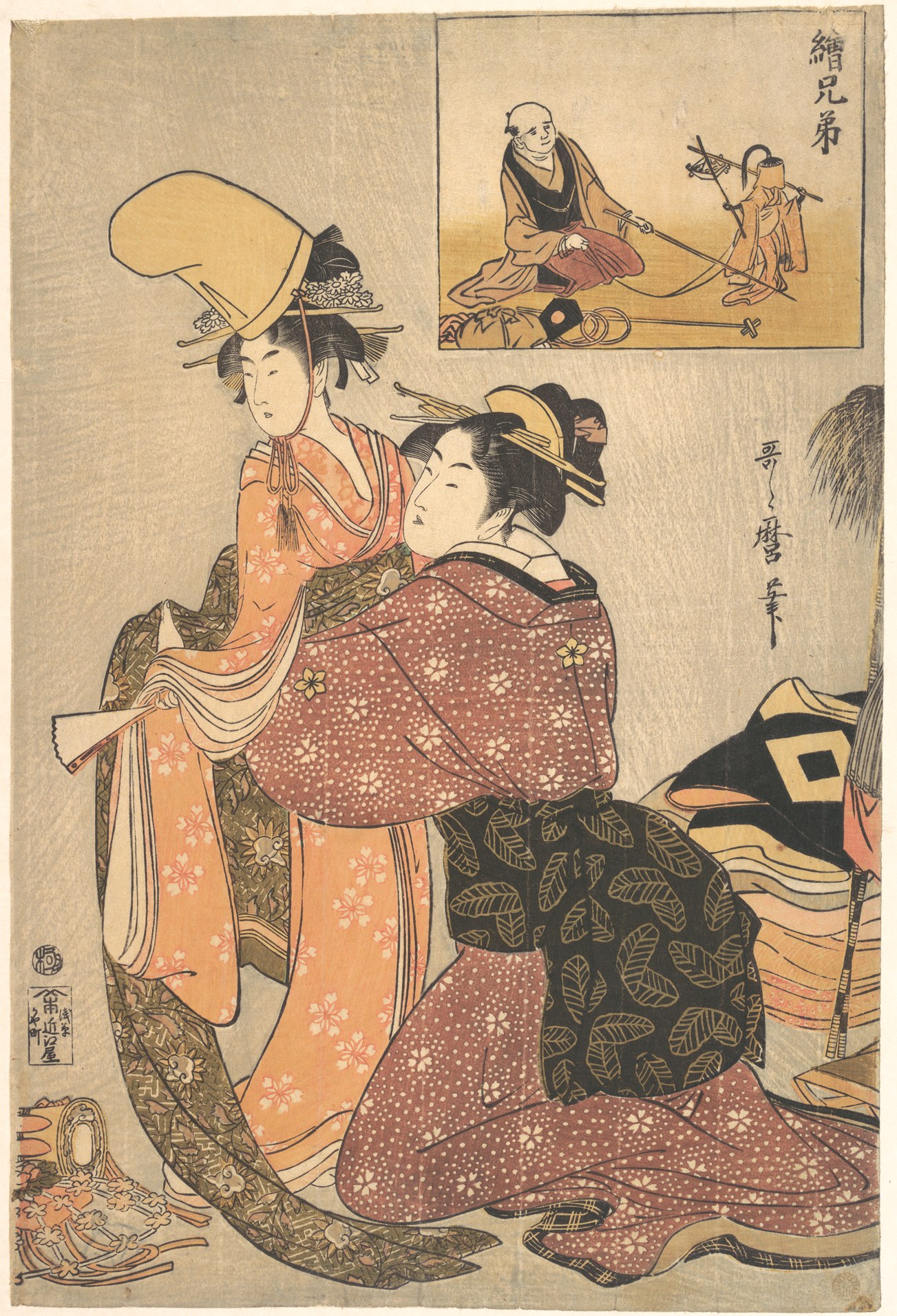
This woodblock print depicts two women in an interior space, kneeling and seated on a tatami floor. The standing woman on the left wears an elaborate orange kimono decorated with floral patterns and a dramatically tall ornamental headdress (takashimada) adorned with gold leaf and decorative elements. She looks downward with serene composure. The seated woman in front, wearing a deep red robe with white polka dots and a black sleeveless jacket, gazes upward toward the standing woman. Between and around them lie costume and stage properties—a folded garment, what appear to be theatrical props, and implements. A small inset scene in the upper right shows an adult and child, presumably connected thematically to the main scene. The composition is typical of Utamaro's intimate domestic or backstage scenes, with careful attention to textile pattern, the fall of fabric, and the psychological relationship between the figures.
The dancing
Both figures are static and posed rather than actively dancing. The standing woman's body is nearly vertical, her weight settled, her gaze downward in a moment of stillness or presentation. The seated woman looks upward with apparent admiration or attention. There is no visible footwork, no dynamic weight shift, and no active dancing posture—the moment is one of dressing, preparation, or possibly instruction, with the standing figure presented as an object of regard rather than as a dancer in motion.
The dance depicted
The catalogue record identifies this as a woman dressing a girl for the Kabuki dance Musume Dōjōji (The Maiden at the Dōjōji Temple), one of the most celebrated roles in the kabuki repertoire. Musume Dōjōji is a solo dance (buyo) dramatizing a maiden's infatuation and the magical appearance of a bell. The print captures the theatrical preparation rather than performance itself—the elaborate costume, headdress, and the evident attention and care of the moment before the dancer takes the stage. The inset scene may reference the narrative content of the dance or show the performer's transformation. The image preserves documentation of kabuki's material world and the embodied knowledge involved in preparing for a major role.
How it was made
This is a hand-colored woodblock print (ukiyo-e), a medium that allowed Utamaro to combine the precision of carved line with carefully applied pigments—here predominantly orange, red, and gold. The technique is readable in the strong black outlines defining form, the fine cross-hatching indicating texture and shadow on fabric, and the gold highlights on the headdress that suggest luxury and prestige. Woodblock prints were popular, affordable, and widely circulated among urban audiences in Edo-period Japan, making this a work accessible to theatergoers and art patrons alike. The hand-coloring varies slightly across impressions, making each print unique.
About this work
This is a kabuki-related print by Kitagawa Utamaro documenting the preparation for performance of Musume Dōjōji, a virtuosic solo dance in the female role tradition. Rather than depicting the dance itself, Utamaro captures the moment of dressing—the costume, the headdress, the concentration and care involved—creating a backstage view of the theatrical apparatus. The work belongs in a dance gallery because it records not the movement itself but the material, social, and aesthetic conditions of a major dance form, showing how kabuki dance existed as a composite of costume, person, narrative, and staged presence.
Utamaro was the dominant portraitist of kabuki actors and theater culture in his era, and this print is characteristic of his practice of revealing the labor and intimacy behind performance. By focusing on preparation rather than action, the print invites the viewer to understand kabuki dance as an art of transformation and material craft.
How to look at it
Attend first to the headdress and costume: the extreme verticality of the takashimada (tall-standing coiffure), the architectural formality of the woman's silhouette, and the richness of the textile patterns convey the grandeur and artificiality of the role. Notice the direction of gaze: the standing woman's downward look and the seated woman's upward gaze create a moment of asymmetrical attention and intimacy. Look at the properties scattered on the floor—tokens of the theatrical world. The inset scene, smaller and more narrative, may offer a clue to the story or the character's journey. Utamaro's line is always precise, but here it conveys not motion but poise, patience, and the weight of costume.
The artist
Kitagawa Utamaro (1753–1806) was the most celebrated ukiyo-e artist of his generation and the dominant portraitist of kabuki actors and the pleasures of Edo urban culture. His practice focused on the female figure—whether kabuki actors in female roles (onnagata), courtesans, or women in domestic scenes—rendered with psychological subtlety and decorative sophistication. Utamaro worked with multiple publishers and was prolific across formats: single sheets, series, and illustrated books. His influence on Japanese printmaking and European art was profound. He was known for intimate, close-up compositions that emphasized gesture, costume detail, and the textures of silk and skin.
The period
The print dates to 1790, during the mature Edo period in Japan and the height of kabuki's popularity and formal development. Kabuki theater had been established for nearly two centuries; the female role (onnagata) tradition was mature and highly codified, with specific dances and costume systems. Musume Dōjōji was one of the canonical dance pieces, performed regularly and celebrated in visual culture. In this period, ukiyo-e printmaking was at its aesthetic and technical peak, with artists like Utamaro pushing the boundaries of portraiture and intimate observation. The theater was a central focus of urban Edo culture, and kabuki actors were celebrities; prints served both as souvenirs and as portable art objects.
Where it lives
The print is sourced from Wikimedia Commons. The catalogue record provides only the title, artist, date, and an existing descriptive note; no collection holding or accession information is recorded.
Dance in this work
Questions about this work
Is this a scene from a kabuki performance?
No—this is a backstage scene showing preparation for performance. The woman is being dressed for the role of the Maiden in Musume Dōjōji, one of kabuki's most celebrated dances. Utamaro often depicted this theater world behind the scenes rather than the action on stage itself.
What is the tall headdress?
It is a takashimada, an ornamental formal coiffure worn by high-status female characters in kabuki. The tall, sculptural shape and the gold-leaf decoration mark this as a role of beauty, wealth, or supernatural status. It is part of the kabuki costume system, not everyday dress.
Who is dressing whom?
The standing woman is likely an actor (onnagata, or female-role specialist) being prepared by an attendant or dresser (the seated figure). The act of dressing was labor-intensive and required skill, and Utamaro captures it as a moment of concentration and care.
What is Musume Dōjōji?
Musume Dōjōji (The Maiden at the Dōjōji Temple) is a kabuki dance derived from classical Noh theater. It tells of a maiden who falls in love with a bell-maker and becomes obsessed; the dance showcases virtuosity, transformation, and the onnagata's art. It remains a signature piece in kabuki.
More dance artwork





