49 works in this view — arrow keys or swipe to move between them.
Dance in Art
Imayō Dance Performed at the Kimpeirō House in the Yoshiwara District
Tsukioka Yoshitoshi (Japan, 1839-1892)
- Source:
- Wikimedia Commons
- Rights:
- Public domain — free to use, share and adapt.
- Recorded as:
- public_domain
The *Imayō* is an under-documented form in English-language dance history, and this contemporary visual source is rare evidence of how performers were costumed, presented, and circulated in popular culture. Yoshitoshi was a master of the medium during the early Meiji period, and this print shows how woodblock printing was used to document and popularize entertainment forms in real time.
What you are looking at
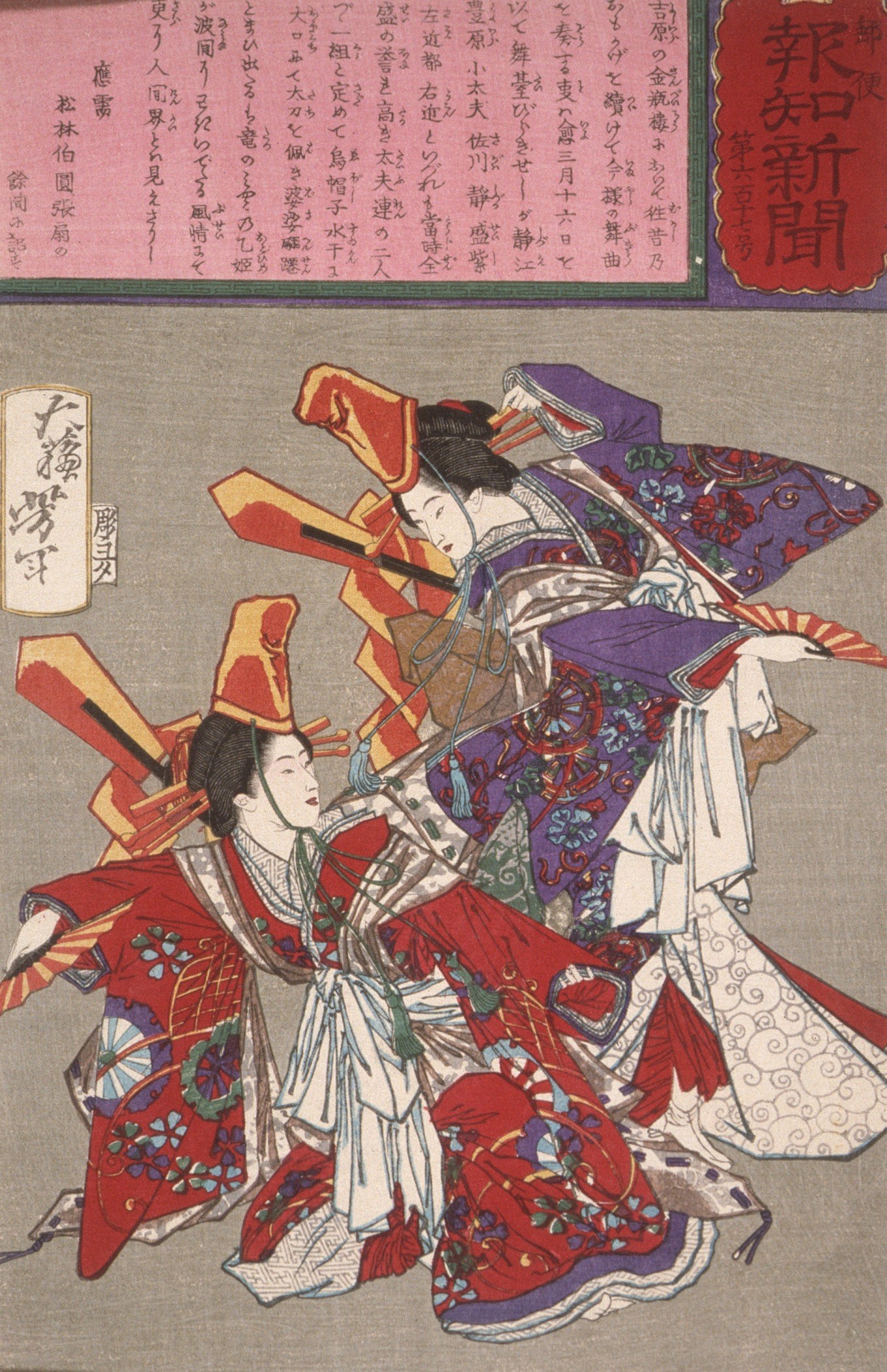
Two female figures in elaborate costume dominate a composition set against a neutral tan ground. The standing figure at rear wears a purple outer robe with dense floral patterning and a tall, ornate headdress in red and gold; her posture is upright and commanding. The seated or lower figure in front wears a red robe with similar decorative patterning and a matching headdress. Both figures are rendered with careful attention to textile detail—the robes show embroidered or painted designs of flowers, geometric patterns, and auspicious motifs in blue, green, red, and gold. The seated figure holds what appears to be a fan or similar prop. The composition suggests a moment of performance or entertainment in an interior setting, likely a pleasure quarter or high-status venue. Japanese text in the upper portion and a cartouche labeling the work in red complete the print.
The dancing
Both figures are posed in stillness rather than dynamic movement, their bodies oriented toward the viewer in a frontal or slightly angled plane. The standing figure's frame is upright with arms positioned at the sides or near the body in a formal stance. The seated figure's posture is elegant but static, with the body settled and the prop (possibly a fan) held at rest. There is no evidence of the sharp articulation, weight shifts, or limb extension that would indicate active dance movement. The figures read as statues or performers in costume waiting or posed for display rather than mid-gesture.
The dance depicted
This work is titled as depicting the *Imayō* dance, a historical form of entertainment that emerged in the Edo period and was performed in the Yoshiwara pleasure quarters. The *Imayō* was a song-and-dance form, often performed by courtesans, that combined vocal performance with stylized movement. However, what is shown here appears to be a costume or character portrait rather than a moment of active dance. The elaborate dress, the prop, and the formal pose suggest that the image captures the performer in full regalia—the visual identity and status markers of an *Imayō* entertainer—rather than freezing a moment of actual choreographic movement. The work documents the aesthetic and cultural context of the form more than its kinetic reality.
How it was made
This is a color woodblock print (*ukiyo-e*), identifiable from the layered flat color fields, the precise black outlines, and the registration of multiple carved blocks. The technique allowed for fine linear detail in the textile patterns, which are rendered with decorative precision suggesting embroidery or elaborate dyeing. The muted ground color and the careful color separation indicate skillful carving and printing. As a color woodblock, this work was designed for circulation as a serial print—likely one page in a newspaper or illustrated periodical (*Postal News*, no. 617)—making it accessible to a broad urban audience interested in entertainment culture and current events.
About this work
This color woodblock print documents the *Imayō* entertainment form through a costume portrait of two female performers at the Kimpeirō House in the Yoshiwara District. Made by Tsukioka Yoshitoshi in 1875 and circulated as part of *Postal News*, a popular illustrated periodical, the work captures the visual splendor and status of Edo-period courtesans through meticulous depiction of dress and ornament. Rather than depicting active dance, it serves as a visual record of performance identity and the material culture of entertainment venues during the Meiji transition.
The work belongs in a gallery about dance because it documents a major historical performance tradition and its social context, even though the image itself is formal and static. *Imayō* was an important vector of entertainment and cultural practice in urban Japan, and this print preserves knowledge of how performers presented themselves—their costume, hierarchy, and the aesthetic codes of the profession.
How to look at it
View this print as a costume portrait rather than action imagery. Attend to the elaborate patterning of the robes—the density and variety of floral and geometric designs signal wealth, status, and artisanal skill. Notice the two figures' different poses and the hierarchical relationship suggested by the standing and seated arrangement. The ornate headdresses are key status markers. The formal frontality and stillness are intentional: the artist has chosen to display the performer as a visual icon of the form, making the costume and regalia themselves the subject rather than the movement. Compare this to any contemporary illustrations of other entertainment forms to see how *Imayō* performers were visually distinguished.
The artist
Tsukioka Yoshitoshi (1839–1892) was one of the most prolific and innovative Japanese woodblock artists of the mid to late 19th century. He worked across genres including historical scenes, portraits, supernatural subjects, and contemporary life, and was particularly known for his dramatic compositions, psychological intensity, and technical mastery of the color woodblock medium. His work often engaged with Meiji-era modernization and the tension between tradition and change. Yoshitoshi was a significant figure in the transition from ukiyo-e to modern Japanese printmaking.
The period
The *Imayō* emerged as a popular entertainment form in the late 16th century and flourished in the Edo period (1603–1868), particularly in the Yoshiwara pleasure quarters of Edo (Tokyo). It combined singing with stylized movement and was performed by high-ranking courtesans and entertainers. By the 1870s, when this print was made, the form was in transition: the Meiji government's modernization policies were reshaping urban entertainment, and older pleasure-quarter traditions were being documented, celebrated, and sometimes contested. Woodblock prints like this one served to preserve and publicize such forms even as they were changing. The medium itself—mass-produced color prints in popular periodicals—reflects how entertainment culture was increasingly mediated through print media and made available to a broad literate public.
Where it lives
This work is held in the Herbert R. Cole Collection (M.84.31.195) and is identified as part of *Postal News* (*Shinbun*), a Japanese illustrated periodical, issue no. 617, dated April 1875. As a print from a mass-circulation periodical, it was one of many such works and speaks to the integration of performance documentation into print media during the early Meiji period.
Dance in this work
Questions about this work
What is the Imayō, and why was it important?
The *Imayō* was an Edo-period entertainment form combining song and stylized dance, performed primarily by courtesans in pleasure quarters. It was a major vector of urban popular culture and cultural prestige. By the Meiji era, it was being documented and celebrated in print as part of a larger cultural record, even as modernization was transforming traditional performance worlds.
Why does this image show the performers standing and sitting rather than dancing?
This is a costume portrait, not an action scene. Woodblock artists often depicted performers in their full regalia as a way of documenting identity, status, and material culture. The elaborate dress—the robes, headdresses, and props—were as important to understanding the form as movement would have been, and perhaps more important to a print audience unfamiliar with live performance.
What does the patterning on the robes tell us?
The dense floral and geometric designs indicate expensive textiles—likely embroidered or specially dyed fabrics. These patterns signal the high cost and prestige of the performance world, where elaborate dress was a marker of a courtesan's rank and success. The craftsmanship visible in the print's rendering of these patterns reflects the visual sophistication of the design.
Why was this printed in a newspaper?
*Postal News* was an early illustrated periodical that circulated entertainment, current events, and cultural content to a broad urban readership. Printing performance documentation in such periodicals made entertainment culture visible and discussable in a modern public sphere, and helped preserve knowledge of forms like *Imayō* as they were changing.
More dance artwork





