49 works in this view — arrow keys or swipe to move between them.
Dance in Art
Weiditz Trachtenbuch 107-108
Christoph Weiditz the Elder
- Source:
- Wikimedia Commons
- Rights:
- Public domain — free to use, share and adapt.
- Recorded as:
- public_domain
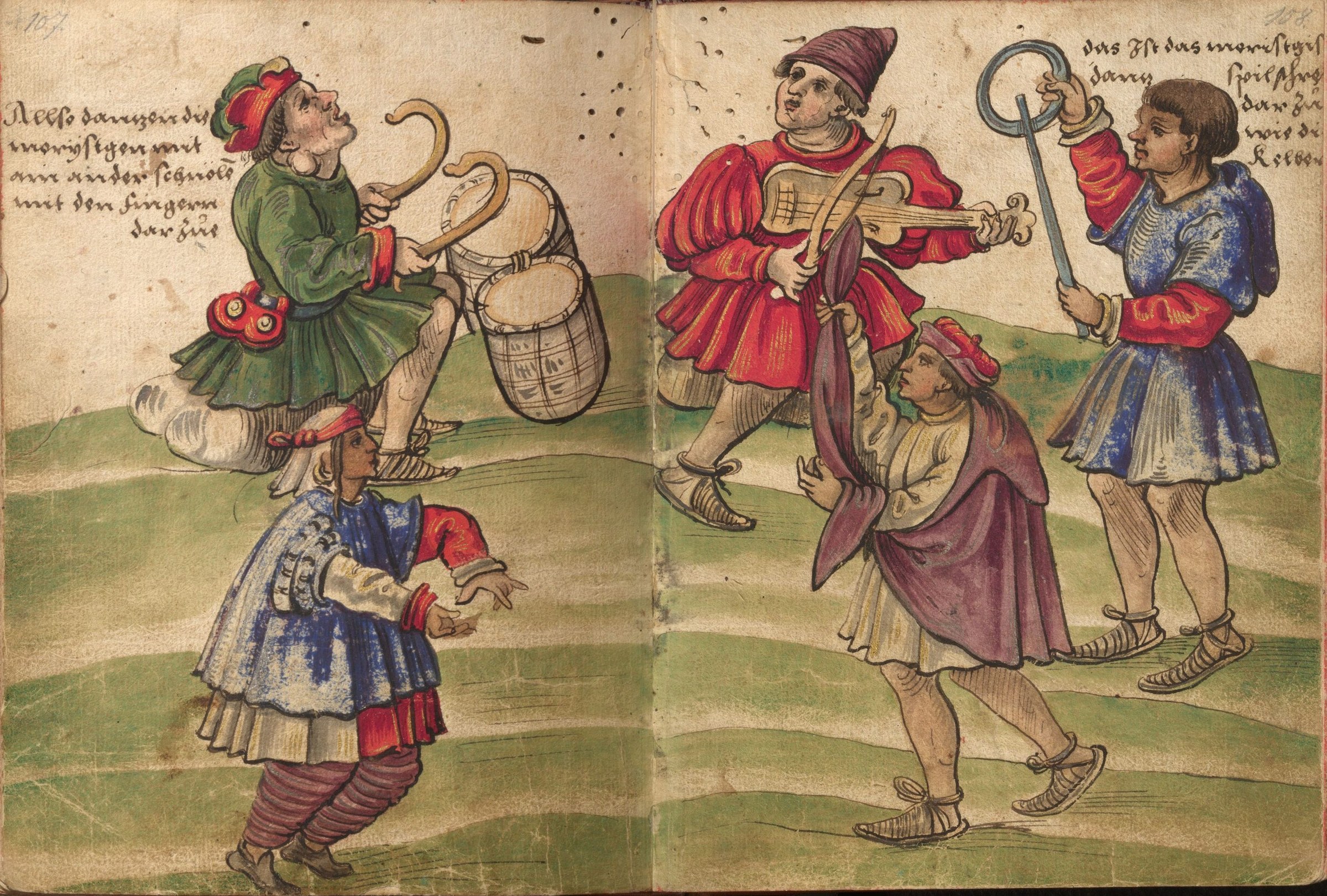
The Moresca is poorly documented; most of what we know comes from court records, dance treatises by other hands, and a handful of visual sources like this one. Weiditz's Trachtenbuch is the most systematic early-16th-century visual survey of European social dance and costume, and this sheet uniquely shows the Moresca in mid-action, capturing postures and group dynamics that written descriptions do not convey. For historians of Renaissance dance and performance, this print is primary evidence of how bodies moved and how the form was understood and valued in its own time.
What you are looking at
A hand-colored woodcut or engraving showing five figures in a lively outdoor scene, arranged across a grassy ground. On the left, a figure in a green tunic with red cap holds curved pipes or bagpipes aloft, while beside them a nearly nude male figure crouches or dances with exaggerated posture. Center stage stands a man in striking red and gold costume with a burgundy hat, wielding what appears to be a curved sword or scimitar in one hand and holding a curved pipe in the other, his body twisted in dynamic motion. Below him a kneeling figure in cream and burgundy looks upward. On the right stands a young figure in blue dress with red accents, holding a staff or pole aloft. The composition is crowded and theatrical, with the figures overlapping and gesturing expressively. German text in the upper left margin identifies the scene. The ground is rendered in horizontal bands of green, and the aged paper shows the browning typical of 16th-century prints.
The dancing
The bodies display exaggerated, theatrical postures rather than balletic alignment. Weight is often uncentered—the leftmost male figure is nearly prone or crouching, the central male figure twists sharply with one knee bent and torso rotated. Arm positions are high and emphatic, with curved weapons or pipes held aloft as active props rather than mere costume. The kneeling figure's upturned face and raised arms suggest supplication or amazement rather than dance posture. The rightmost figure stands more upright but still gestures actively. There is no closed hold; bodies remain separate, and the composition suggests rapid, gestural movement rather than the precise coordination of ballroom or court dance.
The dance depicted
The catalogue identifies this as the Moriskentanz (Moresca or Moorish dance), a key theatrical entertainment of Renaissance Europe. The Moresca was a mimetic, acrobatic dance-drama that typically involved mock combat, exotic or fantastical costumes, and asymmetrical, virtuosic individual display rather than symmetrical partnering. This image captures that character: the curved weapons (scimitars or similar), the eccentric costumes mixing colors and fabrics, the dynamic weight shifts and contorted postures, and the inclusion of near-nude figures all align with contemporary descriptions of the form. The pipes held by two figures suggest musical accompaniment. The Moresca was performed at courts and in streets by professional dancers and amateurs, often with a narrative of conquest or exoticism that this print's composition—with some figures dominant and others suppliant—may reflect.
How it was made
This is a hand-colored woodcut or engraving, identified in the catalogue as part of Weiditz's Trachtenbuch (Book of Costumes), a systematic record of European dress and social types created ca. 1530. The medium allowed cheap, reproducible circulation—multiple copies would have reached printers, merchants, scholars, and performers across German-speaking lands and beyond. The fine line-work and attention to costume detail suggest an engraving rather than a cruder woodcut, enabling the artist to record specific textile patterns and accessory details. Hand-coloring was applied after printing, making each copy unique in its palette and finish. The printing process privileged clear contours and readable composition over atmospheric effect, reinforcing the documentary rather than romantic character of the image.
About this work
This is a documentary record of the Moresca, one of the most widely performed dances of the Renaissance, captured in the systematic Trachtenbuch compiled by Christoph Weiditz the Elder around 1530. The Moresca was a virtuosic, mimetic dance-drama featuring exotic costumes, mock combat, and acrobatic display; it was staged at courts and street festivals from Italy to Germany, often with a narrative edge around conquest or cultural encounter. Weiditz's image preserves not the refined geometry of court dances but the raw physicality of the form—twisted spines, splayed limbs, exaggerated gesture, weapons held as active props. It is one of the earliest visual records of European stage dancing and a crucial document of how performers actually moved in an era from which almost no choreography survives in written notation.
How to look at it
Focus first on the bodies: notice how few of them stand upright, how many bend or twist or crouch. The central male figure is the most dynamic—his spine is sharply rotated, one knee bent, his weight displaced. This is the Moresca's signature: not the smooth flow of a processional dance or the geometric precision of a court basse danse, but jerky, mimetic movement, almost acrobatic. Attend to the weapons and pipes as active elements of the dance, not merely costume. The curve of the scimitars echoes the curved spine of the central figure—they are wielded, not merely worn. Notice also the hierarchy and asymmetry: some figures dominate the space, others kneel or crouch submissively, suggesting that the Moresca carried narrative content, not just virtuosity. Finally, observe Weiditz's visual clarity: every seam, every weapon, every fold is legible, making this less an artistic interpretation than a record of what he saw.
The artist
Christoph Weiditz the Elder (c. 1498–after 1559) was a Strasbourg-born printmaker and draftsman who served in the courts of Augsburg, Spain, and the German territories. He is best known for the Trachtenbuch, a systematic illustrated record of contemporary dress across social ranks and regions, compiled largely from his own observation during travels in Spain and elsewhere. The work exists in multiple manuscript copies and printed editions, establishing Weiditz as a documentarian of costume and social custom rather than an inventor of narrative allegory. His style is precise, economical in line, and attentive to textile patterning and ethnic or occupational markers. The Moresca sheet exemplifies his method: close observation of an actual performance, rendered with enough specificity that the dance's character, costume, and physical vocabulary are recoverable.
The period
The Moresca emerged in Italy in the late 15th century and spread rapidly through German courts and civic celebrations in the early 16th century, at the peak of the Renaissance. It was performed by professional dancers, courtiers, and actors, often in festive or ceremonial contexts—weddings, receptions, carnival. The form thrived in an era of intense visual spectacle and cross-cultural fantasy; Moorish, Turkish, and exotic themes were fashionable in European courts, and the Moresca allowed performers to enact narratives of conquest, conversion, or exotic otherness. In art, the early 16th century saw a surge in documentary and ethnographic prints—Dürer, Burgkmair, and Weiditz all created systematic visual records of dress, customs, and performance. Weiditz's Trachtenbuch sits in this tradition, capturing a moment when print culture was making visual knowledge shareable and when dance was increasingly documented by artists who valued specificity over allegory.
Where it lives
This sheet is identified as part of the Trachtenbuch (Book of Costumes) of Christoph Weiditz the Elder, held in the Germanisches Nationalmuseum, Nuremberg (Hs. 22474, sheets 107–108). The Trachtenbuch survives in several manuscript and printed versions. The work is an illustrated compendium of 16th-century dress and social types, created as a reference for artists, tailors, and scholars, and it circulated widely in the early modern period.
Dance in this work
Questions about this work
What is the Moresca?
The Moresca was a mimetic, acrobatic dance-drama that emerged in Italy in the late 15th century and spread through European courts and streets in the 16th and 17th centuries. It typically featured exotic or fantastical costumes, mock combat with swords or other weapons, and individual virtuosity rather than symmetric partnering. The form often carried narrative content around conquest, conversion, or cultural encounter, reflecting Renaissance fascination with the exotic. It was performed by professionals, courtiers, and amateurs at weddings, civic celebrations, carnival, and court festivals.
How do we know this is the Moresca and not another Renaissance dance?
The catalogue identifies the scene explicitly as 'Der Moriskentanz' in German text in the margin. The visual vocabulary also matches: the curved weapons, the exaggerated and acrobatic postures, the near-nude or exotic costumes, and the asymmetrical composition all align with contemporary descriptions and other visual sources. The Moresca was distinctive precisely for its theatrical exoticism and physical virtuosity, which this image captures vividly.
What is the Trachtenbuch?
The Trachtenbuch (Book of Costumes) compiled by Christoph Weiditz the Elder is a systematic visual record of 16th-century European dress and social types. Weiditz created it partly from his own travels and observations in Spain and the German territories, documenting occupational dress, regional costume, and court clothing with careful attention to textile patterns and accessories. It survives in multiple manuscript and printed copies and is one of the most valuable sources for early modern costume and social custom.
Is this a woodcut or an engraving?
The catalogue record does not specify the medium, but the fine line-work, precise detail, and careful rendering of textile patterns suggest this is an engraving rather than a cruder woodcut. Engravings allowed finer detail and were preferred by artists and printers interested in documentary accuracy. The work was then hand-colored, as was common practice, making each copy unique in its palette.
More dance artwork





