49 works in this view — arrow keys or swipe to move between them.
Dance in Art
Polka Mazurkas (Sheet music cover)
Winslow Homer / Oliver Ditson Company
- Source:
- Wikimedia Commons
- Rights:
- Public domain — free to use, share and adapt.
- Recorded as:
- cc0
Sheet music covers are primary sources for understanding which dances were popular, how they were taught and promoted, and how dancers and artists understood the social and physical conventions of the ballroom. This specific work documents the polka-mazurka at the moment of its greatest fashionability in America, and reveals the visual language by which the middle class learned and validated ballroom propriety.
What you are looking at
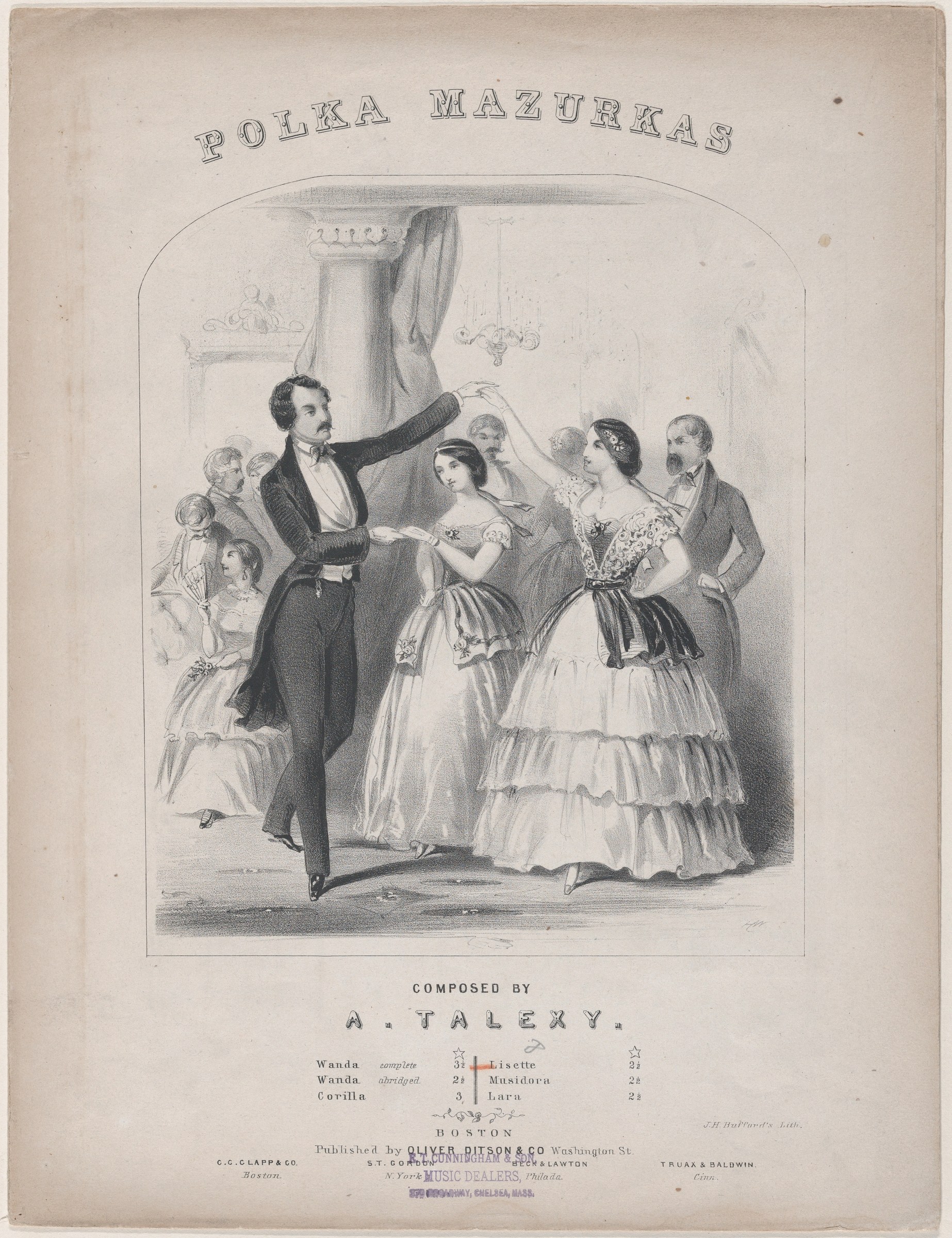
A lithographed sheet music cover presents a salon dance scene in a grand interior, likely a ballroom or drawing room. A formally dressed gentleman in black coat and trousers, with an extended arm and animated posture, leads the composition while a woman in an elaborate white ball gown with tiered skirts and dark ribbon accents responds to his gesture. A second woman in similar fashionable dress stands nearby, while additional figures—a child, another gentleman, and attendants—populate the background. The setting features classical architectural details: fluted columns, a window with draped curtains, and decorative ceiling ornaments. The figures are rendered in the precise, detailed style typical of mid-19th-century commercial lithography, with careful attention to the textures of fabrics, the play of light on surfaces, and the social dynamics of an upper-class gathering.
The dancing
The lead gentleman's right arm extends outward in an invitation or directive gesture, his torso twisted and his weight shifted dynamically forward. The primary woman faces him in a composed but engaged stance, her left hand raised in response. Both figures wear the formal silhouettes of the 1850s—her full skirt supported by crinolines suggests weight distributed over the legs rather than a partnered closed hold. The secondary woman stands in profile, her posture echoing the primary dancer's attentiveness. The spatial relationship and arm positions suggest a moment of social choreography rather than a physically close partnership, consistent with public ballroom conduct of the period.
The dance depicted
This depicts a polka or polka-mazurka in a fashionable ballroom setting—the title confirms the latter, and the sheet music likely documented one of the many hybrid salon dances that blended the sprightly rhythm of the polka with the three-beat structure of the mazurka. Both were extremely popular in American and European drawing rooms during the 1850s. The image captures the social dimension of the dance: the gentlemanly invitation, the responsive attention of the ladies, the presence of observers and chaperones. The postures are upright and restrained; this is ballroom propriety, not folk exuberance. The open positioning and extended gestures suggest the figures are at the beginning or a key moment of the dance sequence.
How it was made
This is a lithograph, a process that allowed economical mass production of sheet music covers and made illustrated dance instruction and promotion accessible to middle-class households. The medium's capacity for fine detail and subtle tonal gradation is evident in the careful rendering of fabric folds, facial expressions, and architectural setting. Such covers were commercial objects, designed to appeal to amateur musicians and dancers who would perform at home. The presence of the composer's name (A. Talexy) and publisher information (Oliver Ditson & Co., Boston) at the bottom confirms this as a printed commercial product distributed through music sellers and shops.
About this work
A mid-19th-century lithographed sheet music cover advertising a polka-mazurka composition, capturing a moment of ballroom dance as social performance. The image documents both the dance itself and its cultural context: the formal dress codes, the spatial and gestural conventions of parlor dancing, the presence of spectators, and the structured courtship dynamics of the period. The work belongs to the rich tradition of commercial dance imagery that shaped public understanding of fashionable movement during the Gilded Age.
How to look at it
Notice the gentleman's role as instructor or inviter—his extended arm and forward energy establish the social hierarchy of the ballroom moment. The women's postures convey attentiveness and trained reserve rather than spontaneous joy. The open space between the figures is deliberate: mid-19th-century ballroom dancers maintained visible distance, with hand contact limited to specific holds. The presence of observers in the background reminds us that ballroom dancing was always performance for an audience of peers, not private movement. The careful costume detail served both documentary and aspirational purposes—viewers could study what to wear.
The artist
This cover is credited to Winslow Homer, who in the mid-1850s worked as a commercial illustrator for music publishers and newspapers in Boston and New York before establishing himself as a painter. He contributed illustrations to sheet music covers and periodicals, producing work in the detailed, readable style required for mass-market commercial printing. The technical skill evident here—the composition, the attention to costume and setting, the clarity of gesture—reflects his training and his eye for the social detail that would define his later paintings.
The period
The polka arrived in America from Europe in the 1840s and by the 1850s had become the dominant fashionable dance of the ballroom, overtaking the waltz in popularity. The polka-mazurka hybrid represented an attempt to refresh the formula by blending the two styles' characteristic rhythms and figures. Oliver Ditson, the Boston publisher, was one of America's leading music houses and played a significant role in circulating both European compositions and American-authored pieces to domestic audiences. The year 1856 places this at the height of polka craze, when sheet music covers regularly featured dance scenes to promote both the music and the social dance itself.
Where it lives
This work appears in Wikimedia Commons, a repository of public-domain cultural heritage images. It is a commercial sheet music cover produced by Oliver Ditson & Co. of Boston, one of the major American music publishers of the 19th century. Such covers were widely distributed to sheet music buyers and remain abundant in institutional collections.
Dance in this work
Questions about this work
Was the polka-mazurka a real dance or just a marketing term?
Both. Composers and dance masters created hybrid forms that blended elements of the polka (with its characteristic two-beat and hopping action) and the mazurka (a three-beat Polish dance with accented second beat). These variants were performed in ballrooms and often appeared as separate pieces in dance cards. The sheet music title confirms this was marketed as a distinct form, though variations proliferated.
Who would have bought this sheet music?
Wealthy and upper-middle-class households with pianos and amateur musicians. The cover's elegant illustration appealed to aspirational buyers who wanted both the music and the social knowledge it conveyed. Publishing a dance on sheet music was a way to make it fashionable and teachable across a wide geography.
What does the open positioning tell us about how the dance was performed?
Mid-19th-century ballroom dancing maintained stricter spatial and physical boundaries than we might expect. Closed holds were restricted to specific dances like the waltz. The polka and mazurka often used open or semi-closed positions, allowing dancers to display footwork and to maintain the decorum required in public or semi-public settings. The gentleman's extended arm here is typical of an invitation or a specific figure in the dance sequence.
More dance artwork





