49 works in this view — arrow keys or swipe to move between them.
Dance in Art
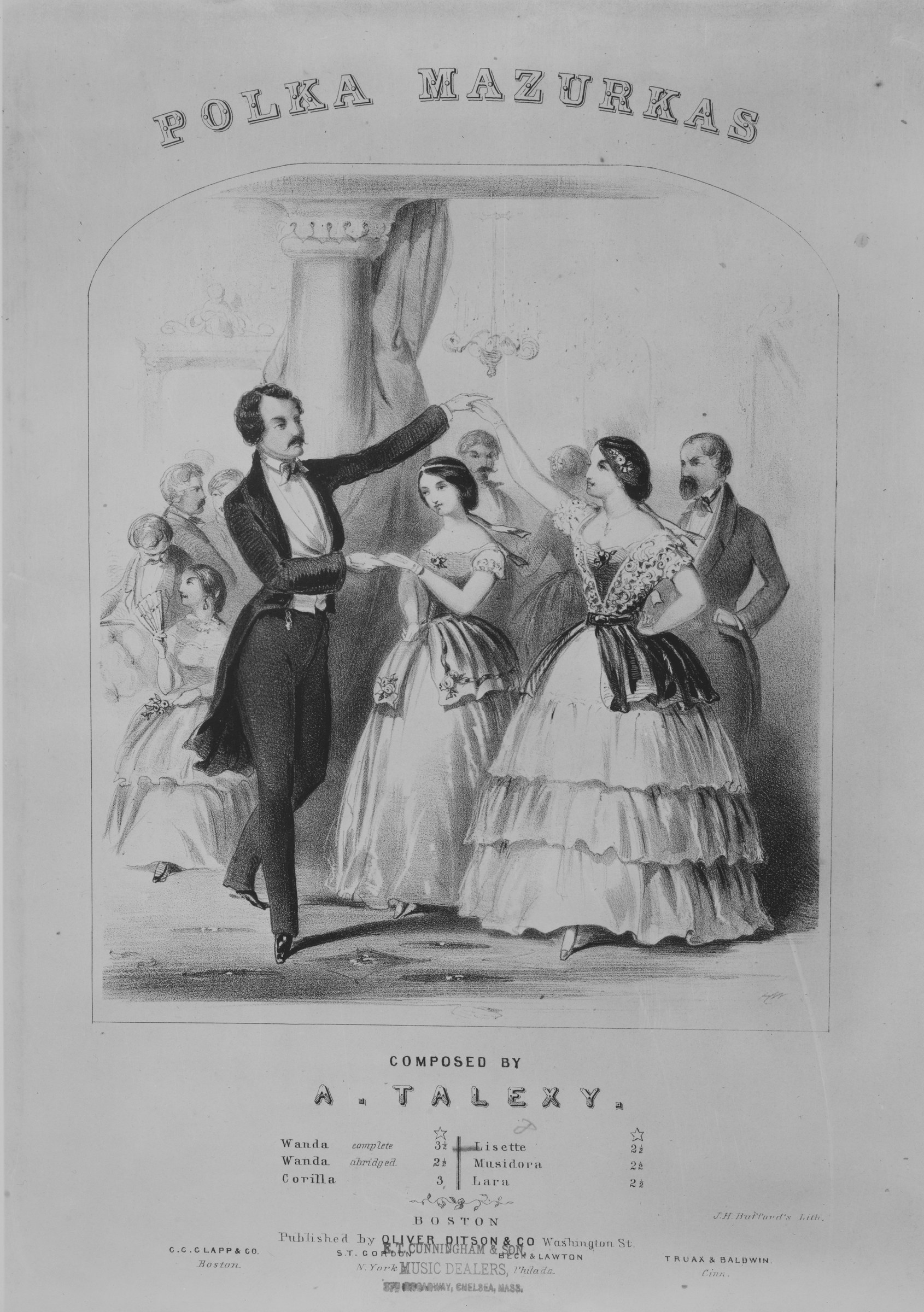
Polka Mazurkas (Sheet music cover)
Winslow Homer / Oliver Ditson Company
- Source:
- Wikimedia Commons
- Rights:
- Public domain — free to use, share and adapt.
- Recorded as:
- cc0
This image documents both a specific, hugely popular dance fad (the polka-mazurka combination) and the pedagogical and social structures through which fashionable dances circulated in mid-nineteenth-century American homes. The sheet music cover was a mass medium that shaped how ordinary people encountered and learned about dance, and this example shows what the commercial dance publishing industry considered an appealing, saleable image: domestic gentility, instruction by an accomplished master, and the participation of fashionable women.
What you are looking at
A parlor or ballroom scene set in the mid-nineteenth century, viewed as a sheet music cover illustration. A well-dressed man in black tailcoat and trousers stands at the center-left, gesturing expansively with his right arm raised toward the ceiling as if leading or demonstrating dance figures. To his right stand two women in full bell skirts typical of the 1850s, their bodies angled toward him in attitudes of attention or readiness. Behind them, partially obscured, are additional figures including what appears to be a child and other observers. The interior is suggested by drapery and an ornamental cornice visible at the top. The composition is crowded and convivial, with the male figure commanding attention as the presumed dance master or instructor. The women's skirts are richly detailed with multiple layers and decorated hems; their posture suggests they may be about to begin or are being taught a figure. The overall tone is one of genteel domestic entertainment.
The dancing
The male figure stands in an open, gestural pose with weight on both feet and his right arm extended high, a classic teaching or demonstrating posture. The nearest woman faces him with her body open and her hands low, in a receptive stance. A second woman stands to the right, also attending. The figures are positioned not in closed hold (as in formal ballroom dancing) but in separate, attentive positions suitable for instruction or for the kind of figure-based social dances of the period. No footwork is visible, but the upright carriage and posture suggest ballroom-trained deportment.
The dance depicted
The work depicts a polka or mazurka lesson or social dance performance, as indicated by the title. The polka was introduced to Western Europe in the 1830s and became a craze in the 1840s–1850s; the mazurka was a Polish origin dance also fashionable in the same period. The scene shows what appears to be the teaching or leading of such a dance in a domestic setting. The man's elevated gesture and command of the floor suggests he is either a professional dance master or an accomplished amateur leading the company. The women's separate, waiting positions and their dress suggest this is a moment of instruction or preparation rather than continuous dancing, which was typical of how these dances were learned and practiced in polite society.
How it was made
This is a lithographic print, recognizable from the characteristic crayon-like tonal rendering and the way light and shadow are modeled across the figures and drapery. Lithography allowed rapid, relatively inexpensive reproduction suitable for sheet music covers and popular prints. The fine detail in the women's dress and the careful modeling of the male figure's tailcoat demonstrate skilled draftsmanship. As a sheet music cover published by Oliver Ditson & Co. (a major American music publisher) in Boston and New York, this work was designed to circulate widely among amateur musicians and dancers in middle-class homes.
About this work
This is a lithographic sheet music cover for a polka-mazurka composition by A. Talexy, published by the major Boston and New York firm Oliver Ditson & Co. around 1856. It documents a moment of domestic dance instruction or performance, showing a male dance master or leader in a parlor surrounded by fashionably dressed women and other observers. The work belongs to the substantial tradition of sheet music cover art that used dance scenes to market music to the middle-class home market in mid-nineteenth-century America. Such images are primary evidence for how ballroom dances were taught, learned, and understood in their moment of greatest popularity. The image shows the social and gendered dynamics of dance instruction: the man as active instructor and authority, the women as attentive, receptive, and admiringly watching.
How to look at it
The artist has chosen a moment of pause and instruction rather than a continuous figure, which is typical of how sheet music covers represented dance—as teachable, repeatable units rather than flowing motion. Look at the man's gesture: his extended arm and open posture convey authority and teaching. Notice how the women's separate positions and their attentive faces suggest they are about to execute or are being corrected on a figure. The dress is the most vivid element: the women's skirts are full and layered, consistent with mid-1850s fashion, and their upper bodies are constrained by tight corseting. The formality of the setting (the drapery, the cornice) signals this is happening in a respectable, probably wealthy home. The crowding of figures in the background suggests this is a social event as much as a lesson.
The artist
The lithograph is credited to Winslow Homer as the artist, though it was published by Oliver Ditson & Co. Homer (1836–1910) was in the early phase of his career in 1856 and was known for commercial illustration and wood engraving before his later fame as a painter of American landscape and maritime subjects. Early in his career he provided illustrations and designs for popular publications, including sheet music covers and newspaper illustrations. This work is typical of mid-nineteenth-century commercial graphics by accomplished draftsmen working for publishers.
The period
The polka was introduced to Paris in 1840 and reached the United States by the mid-1840s, becoming a genuine craze among all classes through the 1850s. The mazurka, a Polish dance in triple meter, was also fashionable among the European and American upper and middle classes during the same period. Sheet music covers became an important vehicle for marketing both music and dancing to the home market; they were displayed on pianos and in music shops and circulated widely. The pedagogical framing—the dance master as central authority figure—reflects the way these dances were transmitted: through published instructions, through professional teachers in cities, and through imitation from published images. Lithographic printing technology made such images economical to produce and distribute, accelerating the standardization and commercialization of ballroom dance.
Where it lives
The work is a published sheet music cover, accessed via Wikimedia Commons. The original publisher was Oliver Ditson & Co., a major American music publisher based in Boston with offices in New York. Such covers were produced in quantity and distributed commercially, making them accessible historical documents of nineteenth-century popular taste and dance practice.
Dance in this work
Questions about this work
What is a polka-mazurka and why were they so popular?
The polka is a lively couple dance in duple meter that originated in Bohemia and became a European and American craze in the 1840s–1850s. The mazurka is a Polish triple-meter dance also fashionable during this period. The polka-mazurka pairing reflects the way fashionable dances of this era were often combined in a single piece or dance program. Both dances were considered modern, cosmopolitan, and accessible to the middle class, unlike the more formal quadrilles and cotillions. Sheet music publishers capitalized on the craze by issuing hundreds of polka and mazurka compositions.
How did people learn these dances?
Dances were learned through a combination of methods: private lessons from professional dance masters (as shown here), group instruction at dancing academies, published step descriptions and diagrams in dance manuals, and imitation from social dancing at balls and parlor gatherings. Sheet music covers like this one served as visual marketing but also as evidence of what the dances looked like. The presence of an instructor or accomplished dancer was essential because the notation and description in step manuals were often difficult to follow without demonstration.
Who was Winslow Homer?
Winslow Homer (1836–1910) was an American painter and illustrator who became famous for his landscape and maritime paintings, particularly his depictions of the American frontier and the sea. Early in his career, he worked as a commercial illustrator and wood engraver, producing designs for sheet music, newspapers, and magazines. This lithograph is from that commercial phase and is characteristic of the kind of popular graphic work he did before his later reputation as a fine artist.
Why is the man gesturing that way?
The man's raised arm and commanding posture indicate he is demonstrating or calling out a figure in the dance—a typical teaching moment. Dance instruction of this era relied heavily on the teacher's ability to show and direct the dancers through movements and counts. The elevated gesture suggests he is either about to lead the women into a figure or is emphasizing a particular step or direction. This is the standard iconography of the dance master in nineteenth-century imagery.
More dance artwork





