49 works in this view — arrow keys or swipe to move between them.
Dance in Art
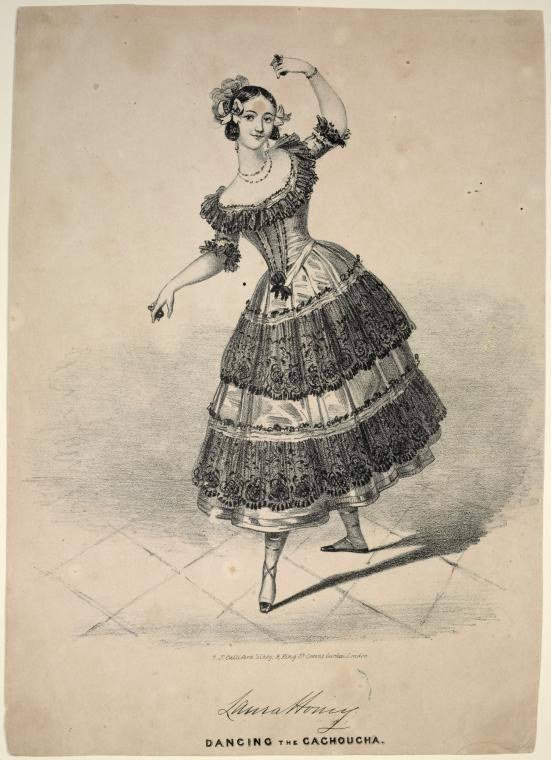
Laura Honey dancing the cachoucalabel QS:Len,"Laura Honey dancing the cachouca"
Artist unknown. Published by CJ Culliford, London.
- Source:
- Wikimedia Commons
- Rights:
- Public domain — free to use, share and adapt.
- Recorded as:
- public_domain
This is a rare contemporary visual record of the cachucha as an actual performed dance, not a written description. The engraving preserves information about costume, body position, and movement quality that would otherwise be lost—the voluminous tiered skirt, the specific arm gesture, the dynamic energy of the pose—and it documents that Laura Honey was skilled and celebrated enough to be marketed and sold as an image. For dance historians, this is evidence of what mid-19th-century audiences expected from character dances and how the body was positioned and adorned in what lay between folk dance and theatrical spectacle.
What you are looking at
A single female dancer is shown in a dynamic pose against a plain background, captured mid-movement in what appears to be a theatrical or concert performance setting. She wears a fashionable 1830s dress with a fitted bodice featuring horizontal ruching or gathering across the chest, and a voluminous skirt composed of multiple gathered tiers decorated with ornamental borders or trim. The skirt is lifted and caught up asymmetrically, revealing her lower legs and feet in what appears to be thin ballet or dancing slippers. Her left arm is raised expressively overhead with the hand curved, while her right arm extends outward at waist level. Her posture is animated and energetic, with her body angled and her weight distributed in a way that suggests active movement rather than a static pose. Her hair is styled in the fashionable ringlets of the period and adorned with ornamental combs or feathers. The composition emphasizes the dancer's form and the movement of her costume, with careful attention to the play of drapery and the articulation of her limbs.
The dancing
The dancer stands alone, balanced in a three-quarter pose that suggests continuous motion. Her upper body shows a slight twist, with her raised left arm curved gracefully overhead and her right arm bent at the elbow with palm facing outward—a posture that suggests Spanish or Latin folk gesture. Her weight appears shifted to one leg, with the other leg partially visible beneath the lifted skirt, suggesting either a pivot or a step in progress. The positioning of her feet and the lift of her skirt indicate active footwork rather than a stationary demonstration. Her frame is upright and contained rather than extended, which distinguishes this from the dramatically elongated line of Romantic ballet.
The dance depicted
The title identifies this as the cachucha, a lively Spanish or Spanish-colonial solo dance popular in European concert halls during the 1820s–1840s. The cachucha was typically performed by women and became fashionable entertainment at balls and theatres, often associated with Spanish exoticism and performed in increasingly elaborate theatrical dress. What the image shows is consistent with this: a vigorous solo female performance, the Spanish-inflected arm gesture (raised and curved rather than the rounded port de bras of ballet), and the energetic positioning of the body suggest a dance characterized by spirited footwork and flirtatiousness rather than the ethereal verticality of Romantic ballet. Laura Honey, to whom the print is attributed, was a professional dancer of this period known for performing character dances and national dances in London theatres.
How it was made
This is a steel engraving or line engraving, a reproductive print technique widely used in the 1820s–1830s to circulate images of popular performers and entertainment to a broad middle-class audience. The fine parallel hatching visible in the shading of the skirt and bodice, the crisp delineation of the fabric texture, and the clear definition of the ornamental trim are characteristic of engraving. This technique allowed for precise detail and relatively economical mass production, which explains why such prints were affordable souvenirs of theatre performances and could be sold individually or bound into illustrated periodicals. The publisher, C.J. Culliford of London, was a music and theatrical print publisher, which places this within the commercial theatrical print trade of the period.
About this work
This engraving documents the cachucha as it was danced in 1830s London, performed by Laura Honey, a professional dancer of the period. The work is a commercial theatrical print—a form of entertainment souvenir that allowed audiences to take home an image of a favourite performer. The cachucha itself was a fashionable Spanish or Spanish-colonial dance that became a staple of European concert halls and balls, performed as a virtuosic solo by women in increasingly ornate costume. This print captures both the dance and the performer's celebrity, preserving a moment of a style of dancing that has left few other visual records.
The work belongs in a dance gallery because it documents the actual appearance of a specific dance in performance, the costume conventions associated with it, and the body mechanics visible in the moment the engraver chose to freeze. It is evidence of how these dances looked to contemporary audiences, what mattered enough to print and sell, and how women's solo dancing was staged and celebrated in the commercial theatre of the Regency and early Victorian period.
How to look at it
Attend to the moment of the pose: the engraver has chosen a position of maximal energy and visual interest—the skirt lifted, the arms active, the body angled—rather than a moment of stillness or preparation. This convention of capturing the apex of movement is characteristic of 19th-century theatrical prints. Look also at the costume: the tiered, gathered skirt, the ornamental trim, and the way the fabric is shown mid-motion are not accidental details but evidence of what made this dance visually spectacular. The arm position—raised and curved—is Spanish in idiom, distinct from the rounded ports de bras of ballet, and the overall frame is more contained and earthbound than the verticality and extension of Romantic ballet. The engraver has prioritized clarity of the body and costume over atmospheric effect, a choice that tells us this was marketed to an audience that wanted to see the performer and the dress clearly.
The artist
The artist is unknown; the work was published by C.J. Culliford, a London music and theatrical print publisher active in the 1820s–1830s. Such prints were often unsigned engravings made by studio artisans working from descriptions, live observation, or earlier prints, rather than works by named artists. The convention was to credit the publisher and the subject (the dancer), not the engraver, reflecting the commercial and reproductive nature of the trade.
The period
The 1820s–1830s saw a flourishing trade in theatrical and celebrity prints in Britain, driven by urbanization, rising literacy, and the growth of commercial entertainment. This was also the period of High Romanticism in ballet—when Romantic ballet proper (with pointe work, gas lighting, and supernatural themes) was beginning to emerge—but popular entertainment still relied heavily on character dances, national dances, and solo virtuosic performances by women. The cachucha was part of a broader fashion for Spanish and exotic themes in European culture, driven partly by British involvement in the Peninsular Wars and partly by the Romantic fascination with folk culture and national identity. Dancing masters taught the cachucha in ballrooms, and it was performed on the concert and theatre stage with increasing theatrical elaboration. This print sits at the intersection of two worlds: the living practice of social dancing and its transformation into commercial theatrical spectacle.
Where it lives
The work is held in Wikimedia Commons, sourced from an institutional collection (specific holding not recorded). It is a published commercial theatrical print, one of many thousands produced in London during this period, sold individually or in series as souvenirs of popular performances.
Dance in this work
Questions about this work
What is the cachucha?
The cachucha is a lively, rhythmic solo dance of Spanish or Spanish-colonial origin that became fashionable in European concert halls and ballrooms during the 1820s–1840s. It was typically performed by women and was characterized by energetic footwork, arm gestures with Spanish idiom, and flirtatiousness. Dancing masters taught it to the middle classes as a fashionable accomplishment, while professional dancers performed it on stage in increasingly theatrical costume and with virtuosic precision.
Who was Laura Honey?
Laura Honey was a professional dancer active in London theatres during the 1820s–1830s, known for performing character dances and national dances. She was celebrated enough to be the subject of commercial theatrical prints, though detailed biographical information is limited. This print testifies to her career and popularity.
Why is the skirt lifted in the picture?
The lifted skirt serves multiple purposes: it reveals the footwork and legs, which were central to the visual spectacle and the virtuosity of the dance; it shows the movement and voluminousness of the costume in action; and it adds visual interest and energy to the image. For the contemporary audience, seeing the dancer's feet and the articulation of her legs was crucial evidence of her skill and the character of the dance.
How do I know this is an engraving?
The fine parallel hatching visible in the shading, the crisp lines and precise detail, the way fabric texture is rendered through cross-hatching and parallel strokes, and the absence of colour are all characteristic of steel or line engraving. This was the standard reproductive print technique of the period for distributing images of performers and entertainments to a mass audience.
More dance artwork





