49 works in this view — arrow keys or swipe to move between them.
Dance in Art
Il saltarello
Hortense Haudebourt-Lescot
- Source:
- Wikimedia Commons
- Rights:
- Public domain — free to use, share and adapt.
- Recorded as:
- public_domain
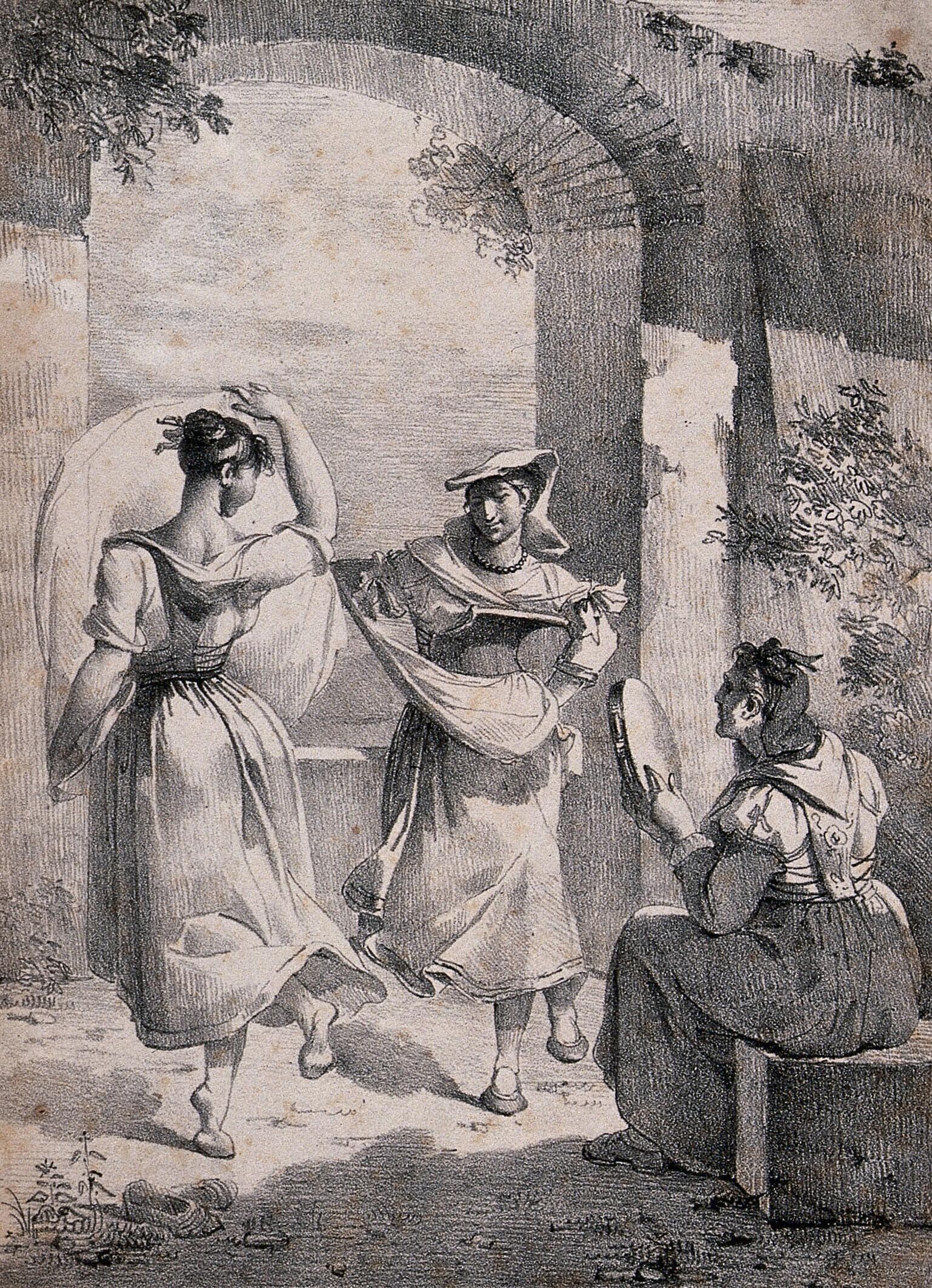
This image is evidence of how the saltarello—a dance of real social and historical importance in the Mediterranean—was seen and remembered by European artists in the early 19th century, before modern dance notation and film. It shows a choreographic understanding: the artist has grasped and rendered the jump as the dance's signature movement, and has placed it in a specific social and architectural context rather than inventing arbitrary poses.
What you are looking at
Three women in classical dress are positioned in a colonnaded setting with stone columns and climbing ivy. The leftmost figure stands in profile, lifting her arms above her head with palms inward, her body angled away from the viewer—a pose suggesting a moment of suspension or recoil. The central figure, facing toward the left, extends her right arm and appears to be in contact with or responding to the leftmost dancer. A third woman sits or crouches on the ground at right, watching the action unfold. The setting is rendered with classical architecture and natural elements, suggesting an idealized garden or portico. The medium is engraving or fine-line etching, with careful hatching creating depth and shadow; the figures' drapery is rendered in flowing, linear strokes typical of early 19th-century printmaking. The composition has a narrative quality—this is not a static pose but a captured moment of action and response.
The dancing
The dominant figure on the left executes an energetic vertical leap or jump with arms raised overhead, weight leaving the ground and body extended upward. The central figure leans forward dynamically with arm extended, engaging with or reacting to the jumping dancer—their proximity and gesture suggest direct interaction. The seated figure maintains visual attention on the action. All three wear classical or pseudo-classical draped garments; the standing dancers' legs are visible and unshod, and their posture suggests trained or practiced movement rather than social stepping. The composition emphasizes vertical extension and interpersonal spatial relationship.
The dance depicted
The catalogue identifies this as the Saltarello, an Italian dance. The image supports this identification: the saltarello is characterized by jumping motions (the name derives from Italian *saltare*, to jump), and the leftmost figure's upward leap with arms raised is consistent with historical descriptions of the dance. However, the scene depicts three figures in active, highly coordinated motion—not a simple couple dance. The sitting figure at right, possibly playing a percussion instrument, may represent musical accompaniment. The dance appears to be shown as a social or recreational performance rather than a theatrical presentation, fitting the saltarello's role as a social dance of the Renaissance and early modern Mediterranean.
How it was made
This is an engraving (possibly a copperplate engraving or steel engraving) executed in fine parallel lines and cross-hatching characteristic of early 19th-century reproductive printmaking. The technique allows precise linear definition of the figures and architectural setting while rendering texture through tonal variation. The print shows no color, relying entirely on the relationship between inked lines and paper ground. This technique suggests the work was designed for circulation as a reproductive print—likely in a book, portfolio, or periodical—making it accessible to a broad audience of dancers, artists, and educated amateurs interested in historical or ethnic dance.
About this work
This engraving documents the Saltarello, a jumping dance of Italian origin, as it was understood or imagined in the early 19th century. The artist has captured the defining motion of the saltarello—a dynamic upward leap—while setting it in a classical architectural frame that may reflect contemporary ideas about the dance's Mediterranean and possibly ancient heritage. The work sits at the intersection of antiquarian interest in historical dance and the romantic idealization of popular or 'national' dances that became fashionable in European art and literature in the decades after the Napoleonic Wars. Hortense Haudebourt-Lescot, a painter and engraver active in the 1810s–1820s, worked in this same register of historical and ethnographic imagery.
How to look at it
Attend first to the moment the artist has chosen: not a static tableau but a peak moment of action—the instant of the jump, when one dancer's body is most fully extended and the body weight has left the ground. Notice how the artist uses the architectural frame (the columns and vault) to emphasize the vertical trajectory of the leap. The classical drapery and setting are not incidental decoration but part of the work's argument: they claim classical pedigree for this folk dance. Observe the relationship between the three figures—the coordinated proximity of the two standing dancers and the attention of the seated figure suggest this is social or ensemble dancing, not an idealized solo.
The artist
Hortense Haudebourt-Lescot (1784–1869) was a French painter and printmaker known for historical and genre scenes, particularly works depicting Italian peasant life and folk customs. She trained as a painter and worked in oil as well as engraving. Her practice was rooted in the Neoclassical tradition but engaged closely with Romantic interests in regional identity, vernacular culture, and the picturesque. She exhibited at the Paris Salon and was commercially successful, with her prints circulating widely. Her work on Italian subjects and dances reflects the broader early 19th-century European fascination with folk culture and national character.
The period
In the 1810s–1820s, European artists and intellectuals were intensely interested in folk dances and regional customs as expressions of national character and historical depth. This interest was shaped by Romanticism, which valorized the authentic and the popular against perceived artificiality of court culture. Italy, in particular, held romantic appeal as a source of historical authenticity and picturesque rural life. At the same time, neoclassical aesthetics still dominated artistic training and composition; Haudebourt-Lescot frames her saltarello dancers in a classical architectural setting that lends historical legitimacy to the dance and connects it to ideas of Mediterranean civilization. The saltarello itself had an old and continuous history in Italian dance but had largely faded from courtly practice by the 18th century, making it available as a subject of historical and ethnographic interest.
Where it lives
The work is catalogued on Wikimedia Commons and is held in the public domain. No holding institution, accession number, or print edition is specified in the available record. The medium and date suggest it may be a reproductive engraving from a book, periodical, or artist's portfolio of the 1810s–1820s.
Dance in this work
Questions about this work
What is the Saltarello?
The Saltarello is a jumping dance with roots in medieval and Renaissance Italy. The name comes from the Italian *saltare* (to jump). It was performed socially and at court, and was documented in dance manuals and art. By the early 19th century, when this print was made, the saltarello had largely disappeared from living practice but remained a subject of antiquarian and romantic interest. It was revived and reimagined by later 19th- and 20th-century artists and historians.
Who was Hortense Haudebourt-Lescot?
Haudebourt-Lescot (1784–1869) was a French painter and engraver who specialized in historical scenes and Italian genre subjects. She was trained in the neoclassical tradition, exhibited regularly at the Paris Salon, and was successful in both painting and printmaking. Her work is characteristic of early 19th-century Romantic interest in folk culture, regional identity, and the picturesque.
Why is this dance shown in a classical setting?
The classical columns and architectural framing reflect the early 19th-century Romantic belief that folk dances—especially those from Italy—were survivals or descendants of ancient Mediterranean culture. By placing the saltarello in a neoclassical setting, the artist lends it historical depth and legitimacy, suggesting it was a dance of civilizational importance rather than merely rural entertainment.
What does this image tell us about how people danced the Saltarello?
The engraving shows that the defining characteristic of the saltarello is the upward jump or leap, executed with the body extended and the arms raised. The presence of three dancers in close spatial relationship suggests it was a social or ensemble dance, and the seated figure (possibly playing a drum or tambourine) indicates it required live percussion accompaniment.
More dance artwork





