49 works in this view — arrow keys or swipe to move between them.
Dance in Art
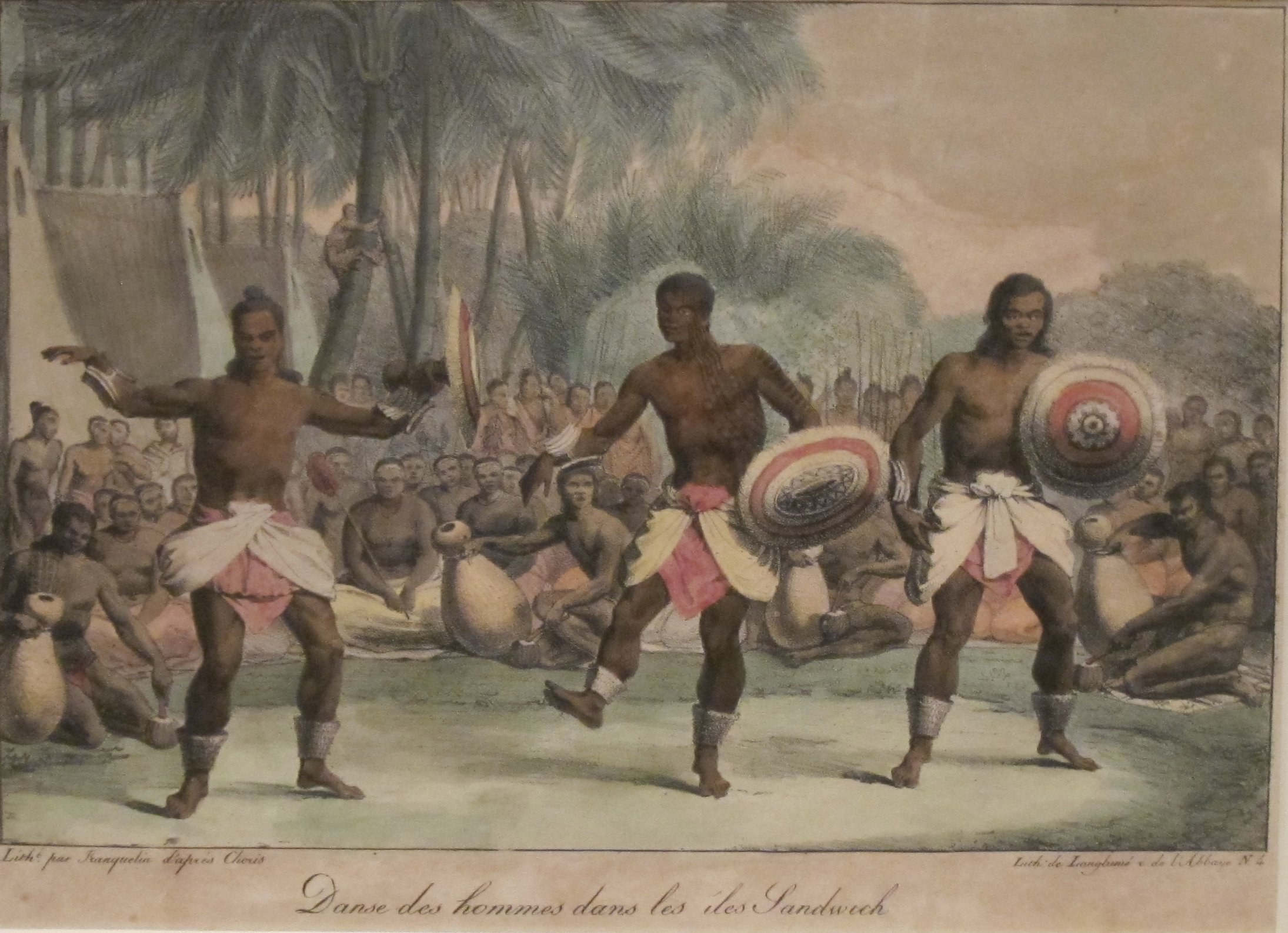
Men of the Sandwich Islands Dancing, lithograph by Jean-Augustin Franquelin, Honolulu Museum of Art
Hiart
- Source:
- Wikimedia Commons
- Rights:
- Public domain — free to use, share and adapt.
- Recorded as:
- cc0
This image is a rare early visual record of Hawaiian dance or movement practice as it was observed by European visitors, predating most other documented visual sources. It shows how Pacific dance was translated into European visual conventions and what elements (stance, gesture, community context) European observers considered worth emphasizing. For historians of Hawaiian culture and colonial representation, the image documents what outsiders chose to record and how they chose to record it—a dual text about both Hawaiian practice and European perception.
What you are looking at
A densely populated tropical scene depicts a gathering of Indigenous Hawaiian men in what appears to be a ceremonial or festive context. The composition centers on three standing male figures in the foreground, shirtless and wearing colored cloth wraps (pink and cream tones) around their hips and legs. They are positioned as if performing or being observed, with their bodies in active postures. The background is crowded with dozens of seated and standing figures arranged in loose clusters, suggesting an audience or community gathering. Tall palm trees frame the scene from above, and the atmospheric perspective uses hazily rendered background figures to suggest depth. The lithographic technique renders the scene in muted earth tones with selective hand-coloring in pink, cream, and ochre. The overall effect is of spontaneous, documentary observation—a moment of cultural practice being witnessed and recorded.
The dancing
The three central figures stand with legs bent in a dynamic, grounded posture; their arms are raised and extended in varied positions—one figure with arms spread wide, another with arms raised to shoulder height. Their bodies show weight distributed into the legs rather than lifted verticality. The figures closest to the viewer display the most detail: muscular torsos in natural proportions, bare-chested, with deliberate gesture that reads as emphatic and communicative rather than balletic. Surrounding them are dozens of other figures in less distinct poses, many seated cross-legged or in low squats, creating a tiered composition that emphasizes the standing performers' prominence.
The dance depicted
This appears to document Indigenous Hawaiian ceremonial or social movement practice, likely from the early contact period (early 19th century). The postures—grounded stance, bent knees, active arm gestures—are consistent with Hawaiian hula practices, though the documentary nature of the image and the apparent public gathering context suggest this may represent a broader category of community movement or ceremonial display rather than a codified dance form. The presence of an attentive audience and the formal arrangement of the performers indicate this was a recognized and valued cultural practice. Without identifying marks or cultural context visible in the image itself, the specific form and meaning cannot be determined solely from the visual record.
How it was made
This is a hand-colored lithograph, a technique that allowed mass reproduction with selective hand-tinting—relatively economical compared to oil or detailed engraving, but more refined than a simple print. The soft, atmospheric rendering typical of lithography is evident in the atmospheric perspective and the ability to suggest volume through tonal gradation rather than line. The hand-coloring adds specificity to dress and materials while remaining economical. This combination suggests the work was produced for a moderately broad European audience with interest in Pacific ethnography—neither the most expensive fine art production nor a cheap broadside, but rather a commercially viable document of exotic practice.
About this work
This hand-colored lithograph documents Indigenous Hawaiian male performers or ceremonial practitioners in what may be a hula or related form of movement practice. Created by the artist Jean-Augustin Franquelin after a painting by expedition artist Louis Choris (likely from Choris's voyage with Kotzebue, 1815–1818), the work sits at the intersection of travel documentation, ethnographic record, and artistic observation. It captures a moment of cultural practice being witnessed by outsiders at the moment of European contact and colonial expansion into the Pacific. The work belongs in a dance gallery as evidence of how European artists rendered Pacific movement practices and how those practices were circulated to European audiences as exotic spectacle and ethnographic fact.
How to look at it
Attend to the posture and the ground: these are not lifted, linear, or vertical bodies, but grounded, bent-kneed, dynamically weighted. The artist has chosen to freeze a moment of active gesture and expressive arm work, not a moment of stillness or formal alignment. Notice how the three central figures are positioned not as isolated dancers but as members of a densely populated community—the performance is embedded in collective witnessing, not separated from it. The hand-coloring in pink and cream on the cloth wraps suggests specific materials and status markers. Finally, observe how the lithographic technique allows atmospheric recession and suggestion of depth through tone rather than line—a European visual strategy applied to a non-European subject.
The artist
Jean-Augustin Franquelin (1780–1849) was a French lithographer and painter known for reproductive work and fine art printing. He worked extensively from drawings and paintings by travel artists, translating their field sketches into the more refined and reproducible medium of lithography. This work is based on paintings by Louis Choris, a German-Russian artist and naturalist who traveled as the official artist on Otto von Kotzebue's scientific expedition to the Pacific (1815–1818). Franquelin's role was to make Choris's observations available to European print audiences through a medium that was more economical and widely circulated than oil paintings.
The period
The image dates to the early 19th century, during a period of intense European and American exploration and documentation of the Pacific. The voyages of Kotzebue, Cook, and others generated vast collections of visual and written records that were rapidly published and circulated in Europe as both scientific documents and exotic entertainment. Hawaiian dance and movement were entirely outside European balletic or theatrical conventions, making them subjects of anthropological curiosity and aesthetic unfamiliarity. This period also marks the beginning of the end for many Indigenous Hawaiian practices, as contact brought disease, missionary activity, and colonial pressure. The image thus captures a moment of cultural practice on the eve of massive disruption.
Where it lives
The work is held in the Honolulu Museum of Art. As a lithograph after a painting by an expedition artist, it represents the type of reproduced travel document that circulated in early 19th-century European print culture, later to be collected and eventually housed in museums of the regions depicted. The work signals the colonial infrastructure of knowledge-making: observation in the field, translation into high art painting, conversion into reproducible print medium, and circulation and collection in institutional frameworks.
Dance in this work
Questions about this work
Is this actually Hawaiian hula?
The image almost certainly documents Hawaiian movement practice observed by Europeans in the 1810s, likely hula or a related form. However, the documentary context and the artist's European visual conventions mean we cannot know with certainty how Hawaiian practitioners themselves understood or named what was being performed. The image shows what outsiders chose to record about Hawaiian practice, not necessarily what the practice meant to those who performed it.
Who was Louis Choris?
Choris (1795–1828) was a German-Russian naturalist painter who traveled as the official artist on Otto von Kotzebue's scientific expedition around the world from 1815 to 1818. His paintings of Pacific peoples and landscapes became the basis for numerous lithographs and engravings that shaped European knowledge of the region. He was killed in Mexico at age 33 while pursuing further expeditions.
Why is this a lithograph rather than a painting?
Lithography was the dominant method for reproducing and circulating visual documents in the early 19th century. It allowed an artist's work to be translated into a medium that could be printed in multiple copies, colored by hand, and distributed relatively affordably across Europe. It was the equivalent of photography and photomechanical reproduction in later periods.
What does the audience arrangement tell us?
The densely packed, seated audience surrounding the performers suggests this was a valued community practice—something worth gathering to witness. It also tells us that the European observer (and by extension, Franquelin) understood this as a social or ceremonial form embedded in collective participation, not as an elite performance separated from audience by space and formality.
More dance artwork





