49 works in this view — arrow keys or swipe to move between them.
Dance in Art
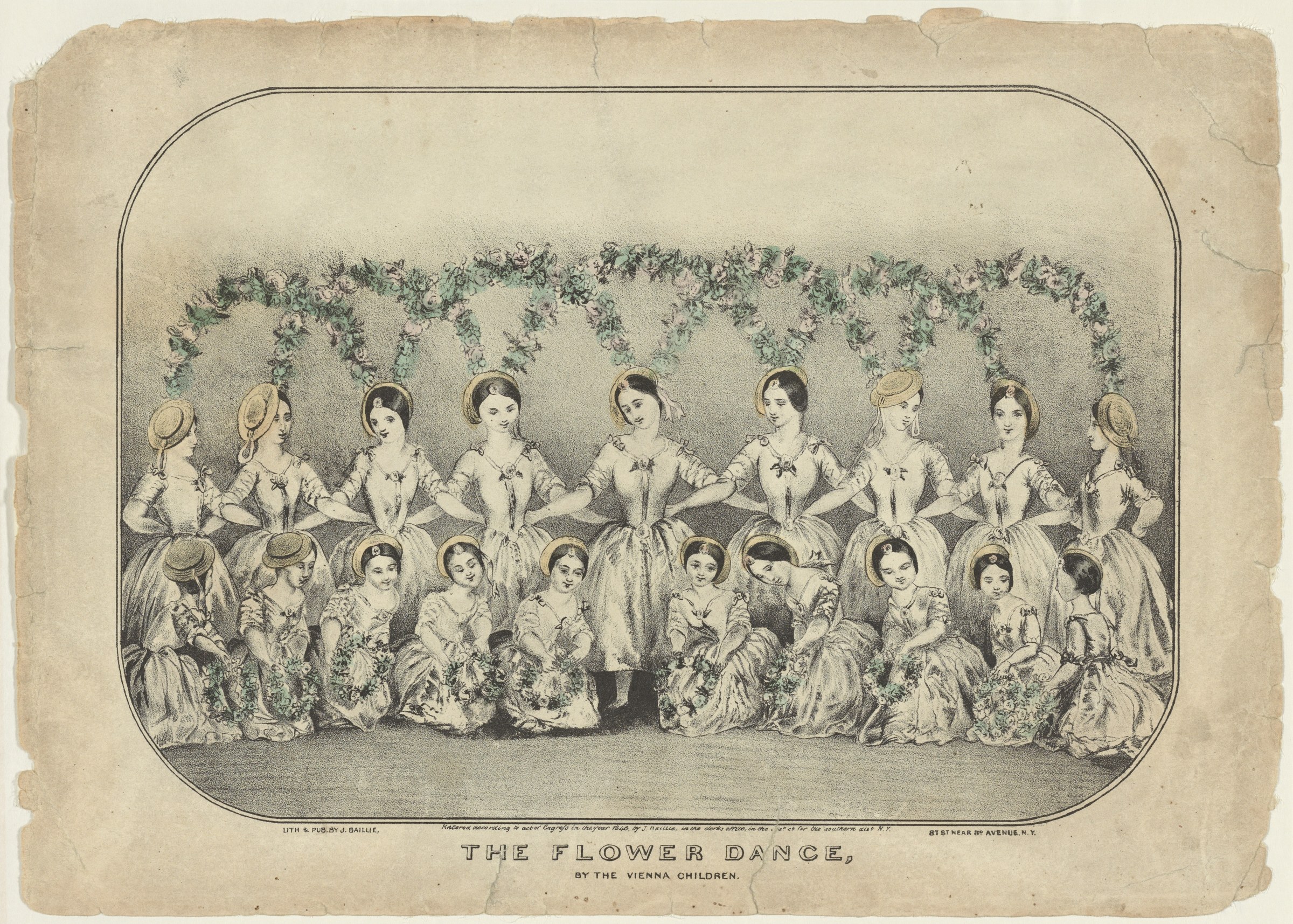
The Flower dance, by the Vienna children (NYPL b12164350-5047609)
Scan by NYPL
- Source:
- Wikimedia Commons
- Rights:
- Public domain — free to use, share and adapt.
- Recorded as:
- public_domain
This print is a rare document of children's theatrical performance in the mid-19th century, showing how young dancers were costumed, posed, and presented to audiences in Vienna at a moment when the Romantic ballet was at its height. It demonstrates the gap between actual dance technique and the static, decorative display that often framed ensemble and children's performance on the theatrical stage.
What you are looking at
Twenty young female dancers are arranged in two rows against a backdrop of trailing ivy or garland. The back row stands, the front row kneels or sits, all facing forward toward the viewer. Each dancer wears a white or cream-colored dress with puffed sleeves, a fitted bodice with a central bow or ribbon detail, and a full skirt. Most wear bonnets or headdresses. The dancers' poses are formal and composed rather than dynamic—they do not interact or form couples. The setting is austere, the background neutral, and the lighting flat and even. The overall effect is pageant-like: a display of individual figures arranged for presentation rather than a narrative scene of social dance.
The dancing
The dancers stand or kneel in static, frontal poses with arms held gracefully at the sides or gently raised. There is no contact between figures, no partnering, and no suggestion of weight transfer or locomotion. The bodies are upright and aligned, the arms decorative rather than functional. Posture is uniformly demure and refined. The stillness and formality of the arrangement suggests a rehearsed tableau or ceremonial presentation rather than the fluid, responsive qualities of actual social dancing.
The dance depicted
The work is titled *The Flower Dance*, and the floral garland overhead and the flower-like arrangement of the dancers themselves suggest an allegorical or theatrical spectacle rather than a recognizable ballroom or folk dance form. The composition and the date (1846) point toward a Romantic-era theatrical or pageant convention, possibly a children's performance or a feature in a larger theatrical production. The formal, static nature of the arrangement—with no visible footwork, partnering, or momentum—indicates this is a decorative ensemble piece or 'tableau vivant' rather than an active dance choreography. The identity of the choreographer or the specific theatrical context is not established by the image alone.
How it was made
This is a hand-colored lithograph or engraving, as evidenced by the tonal modeling, the fine linear detail in the dress fabrics and faces, and the characteristic half-tone shading of the background. The technique allowed for mass reproduction and wide circulation, making this a popular theatrical souvenir or broadside. The soft, diffused quality of the figures and the careful attention to costume detail suggest a commercial print designed to document or publicize a specific performance, likely sold to audience members or used as theatrical publicity.
About this work
This print documents a mid-19th-century theatrical spectacle featuring a chorus of twenty young dancers in formal Romantic-era dress, posed in a static allegorical tableau rather than in active dance. The work captures a moment of theatrical pageantry—specifically a children's or ensemble performance staged in Vienna during the 1840s. It belongs in a history of dance imagery because it records not the technique or form of a dance, but rather the theatrical framing and public presentation of young dancers in the Romantic era, when ensemble spectacle and visual display were central to theatrical entertainment.
How to look at it
Observe the complete absence of dynamic pose or weight shift: no dancer leans, pivots, or extends into space. The arrangement is symmetrical and frontal, designed to be viewed from a single vantage point, much like a portrait gallery or a sculptural frieze. Notice how the artist has rendered each face distinctly, suggesting that this may document an actual performance by identifiable local dancers. The floral frame overhead and the flower-like radiating arrangement of the figures transform the dancers themselves into botanical ornaments—a visual pun that explains the title.
The artist
The work is credited to 'LITH & PUBL'D BY J. BAILLIE' and printed 'BY NAGEL NEAR BY AVENUE N.Y.' according to the inscription visible at the base of the print. This indicates a commercial lithographic firm based in New York producing theatrical prints for the American market. The artists and producers are not further identified in the available record.
The period
In the 1840s, the Romantic ballet was in full flourish—characterized by tutus, pointe work, sylphs, and ethereal femininity. However, children's performances and ensemble or chorus work often remained formal and decorative rather than mimicking the virtuosity of principal dancers. This print captures that distinction: while professional prima ballerinas were executing complex technique, children's theatrical performances were still often organized as static visual tableaux, emphasizing costume, symmetry, and ornamental display over dynamic movement. The print's format and distribution suggest it was a commercial product aimed at documenting a notable performance for a broad theatrical public.
Where it lives
The work is held by the New York Public Library (NYPL b12164350-5047609) and is available through Wikimedia Commons. It is a commercial lithographic print from the mid-19th century, likely a souvenir or promotional item for a theatrical performance.
Dance in this work
Questions about this work
Is this actual ballet or a children's pageant?
The composition and pose suggest a theatrical tableau or pageant rather than a documented ballet performance. The static, frontal arrangement and absence of partnering, footwork, or dynamic gesture indicate this is a decorative ensemble piece, possibly part of a larger theatrical production featuring child performers.
What does 'Vienna children' mean in the title?
The title indicates the dancers were young performers, likely from Vienna, who performed this spectacle publicly. The inscription attributes the print to a New York lithographic firm, suggesting the performance took place in Vienna but the print was produced and sold in the American market.
Why are all the dancers in identical or near-identical dress?
Uniform costuming was standard for ensemble and chorus work in 19th-century theater. It emphasized symmetry, unity, and formal spectacle rather than individual character or virtuosity, and made the troupe visually cohesive for audiences.
How was this print made and distributed?
This is a hand-colored lithograph, a commercial reproductive technique that allowed multiple copies to be produced relatively quickly and inexpensively. Such prints were sold as theatrical souvenirs to audience members and used as promotional materials for forthcoming performances.
More dance artwork





