49 works in this view — arrow keys or swipe to move between them.
Dance in Art
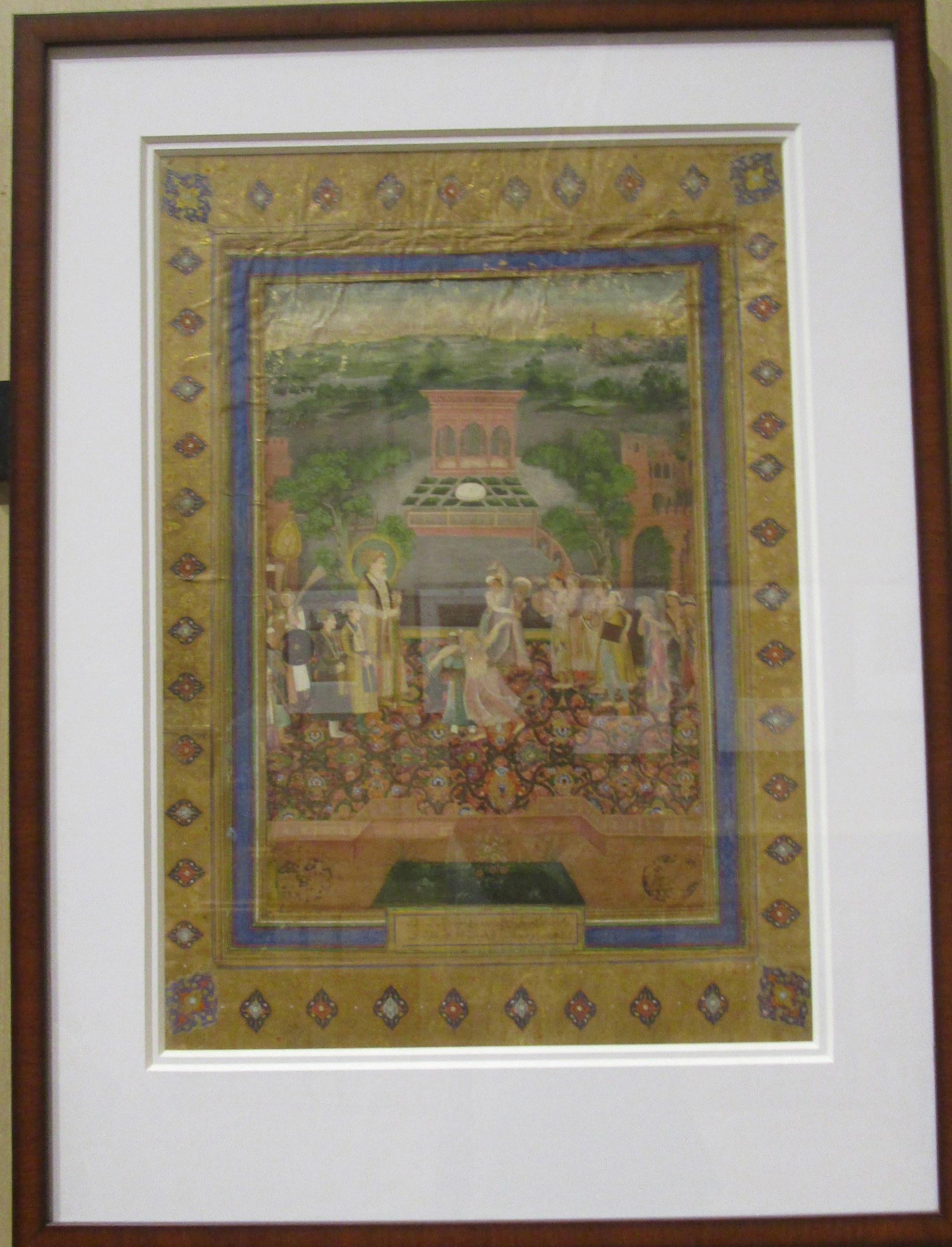
Emperor Shahjahan enjoying Sufi dance (2)
Unknown artist
- Source:
- Wikimedia Commons
- Rights:
- Reusable with conditions: credit the creator; share any adaptation under the same license. Source record ↗
- Recorded as:
- cc by-sa 4.0
This painting documents the integration of Sufi musical and dance practices into the Mughal imperial court, showing how devotional and ecstatic traditions were incorporated into state ceremony and elite entertainment. For historians of dance in South Asia, it provides visual evidence of performance contexts and court patronage that would otherwise depend entirely on textual sources. It also illustrates how Mughal court artists represented movement and spectacle—as architectural and sartorial splendor rather than as captured motion.
What you are looking at
A Mughal court scene depicting Emperor Shah Jahan seated on an elevated platform within an ornate architectural setting. The emperor occupies the center-left of the composition, wearing formal court dress with a jeweled turban and attended by courtiers. A large crowd of musicians, courtiers, and attendants fills the foreground, arranged in tiered formation across the lower portion of the image. The setting is an elaborate garden or courtyard framed by red-brick structures with Mughal architectural features—arched openings, crenellated walls, and ornamental detailing. The palette is dominated by warm terracottas and greens, with careful attention to the patterning of textiles and the individualization of turbans and robes. The perspective is flattened in the characteristic Mughal miniature style, with the horizon line high and figures distributed vertically across the plane rather than receding into depth.
The dancing
The figures are arranged in a formal hierarchical composition typical of Mughal court art. The emperor remains relatively still and elevated, while the assembled courtiers and musicians occupy lower ground. Dancers would be among the assembled figures, though they are not sharply differentiated in costume or isolated in a performance pose. The density of the crowd, the variety of turbans and robes, and the frontal orientation of multiple figures suggest formal presentation rather than the dynamic physical engagement visible in European dance paintings of the same period. This reflects the conventions of court spectacle in Mughal visual culture, where the choreography of social position matters more than the spectacle of physical virtuosity.
The dance depicted
The catalogue identifies this as depicting Sufi dance in the Mughal court. Sufi devotional practices, including ecstatic movement and music, were patronized by Shah Jahan and integrated into court entertainment. However, the image itself does not isolate dancers or show distinctively Sufi physical practices—whirling, trance states, or the characteristic circular formations of Mevlevi or other dervish orders. What we see is a formal court gathering where music and dance are elements of imperial ceremony rather than the primary subject. The presence of musicians (identifiable by instruments) suggests that music and movement are happening, but the visual emphasis falls on the emperor's presence and the assembled court's attention to him rather than on the dance itself.
How it was made
This is a Mughal miniature painting—a delicate work on paper or vellum executed in opaque watercolor with gold leaf, characteristic of the Indo-Persian artistic tradition. The framing with decorative borders (rendered in the photograph) is typical of how such works were mounted and displayed in albums. The miniature format and intimate scale suggest circulation within elite court circles or among collectors of Mughal manuscripts and portfolios. The technique allowed for extraordinary detail in costume, pattern, and architectural setting while maintaining the flattened, non-illusionistic perspective that structured Mughal court representation. The precision of individual heads and the systematic rendering of crowd and architecture required specialized workshop practice.
About this work
This is a Mughal court painting documenting an imperial gathering at which Sufi music and dance were performed as court entertainment during the reign of Shah Jahan (1627–1658). The work belongs to a rich tradition of Mughal miniature painting that recorded court ceremonies, hunts, and spectacles, preserving visual evidence of how music, dance, and imperial ritual intersected in seventeenth-century India. While not a dance-focused composition in the way European court paintings isolate and celebrate dancers, it is historically significant as a record of how dance functioned within Mughal imperial culture—as one element in a complex performance of power and cosmopolitanism rather than as a virtuosic display in itself.
How to look at it
Attend first to the architecture and framing, which establish the formal space of imperial reception. Then follow the eye to the emperor at the focal point—elevated, calm, attended. The assembled crowd is not presented as individual performers but as a unified body of courtiers, musicians, and attendants. The real subject is the structure of imperial ceremony: who stands where, what they wear, how attention flows. This reflects a fundamentally different visual and social conception of dance than European court painting, where dancers are often isolated and their bodies center the composition. Here, the emperor's stillness and the crowd's formal arrangement are the choreography.
The artist
The catalogue records no artist. Mughal miniatures of this type were produced by specialized court workshops in which multiple artists collaborated—master painters, gold-leaf specialists, and detail workers. Attribution in the modern sense is often impossible. The style, composition, and level of finish suggest a work from the imperial atelier (likely at Agra or Delhi) rather than a provincial workshop, implying direct service to the court.
The period
Shah Jahan's reign (1627–1658) was the apogee of Mughal artistic and architectural patronage. The emperor was celebrated for his connoisseurship and for projects like the Taj Mahal and the Red Fort (Lal Qila), both completed during this period. Sufi Islam had deep roots in the court, and mystical music (qawwali) and movement were well-established court entertainments. European travelers and Mughal court historians documented the emperor's interest in music, poetry, and spectacle. The miniature painting tradition was at its height, and the imperial albums (muraqqa) assembled under Shah Jahan represent some of the finest achievements of the medium. This work fits squarely within that moment of refined court documentation.
Where it lives
The work is recorded as from Wikimedia Commons. The framing photograph shows it in a Western mat and frame, suggesting it resides in a collection that has subjected it to European conservation and display conventions. Original Mughal miniatures were kept in albums and folios; the individual mounting shown here is a later intervention.
Dance in this work
Questions about this work
What is Sufi dance and why would it be performed at court?
Sufi is a mystical tradition within Islam emphasizing ecstatic devotion, often expressed through music and movement. Though rooted in religious practice, Sufi music and dance were appreciated by Mughal courts as sophisticated art forms. Shah Jahan patronized musicians and qawwals, and court painters documented these performances as markers of imperial refinement and cultural breadth.
Can you identify the dancers in this painting?
Not with certainty. In Mughal court paintings, dancers are often not visually distinguished from musicians or courtiers through pose or costume. The dense crowd contains figures who were likely dancers, but the miniature's focus on architectural space and imperial presence rather than on individual performers makes isolation difficult. Musicians are more identifiable by their instruments.
Why does this look so different from European dance paintings of the same period?
Mughal court art follows Indo-Persian conventions: flattened perspective, hierarchical composition, decorative patterning, and emphasis on the patron's stillness and centrality rather than performers' virtuosity. European court paintings (contemporary with Shah Jahan) often isolate dancers in dynamic poses to celebrate their skill. The two traditions reflect different values and different purposes for commissioning art.
Is there any way to date this painting more precisely?
The style and format are consistent with Mughal court painting of the mid-17th century, but without a signature, seal, or inscription visible in the photograph, precise dating is difficult. The architectural setting and costume suggest it depicts court under Shah Jahan, but it may have been painted in his time or later as a historical record.
More dance artwork





