49 works in this view — arrow keys or swipe to move between them.
Dance in Art
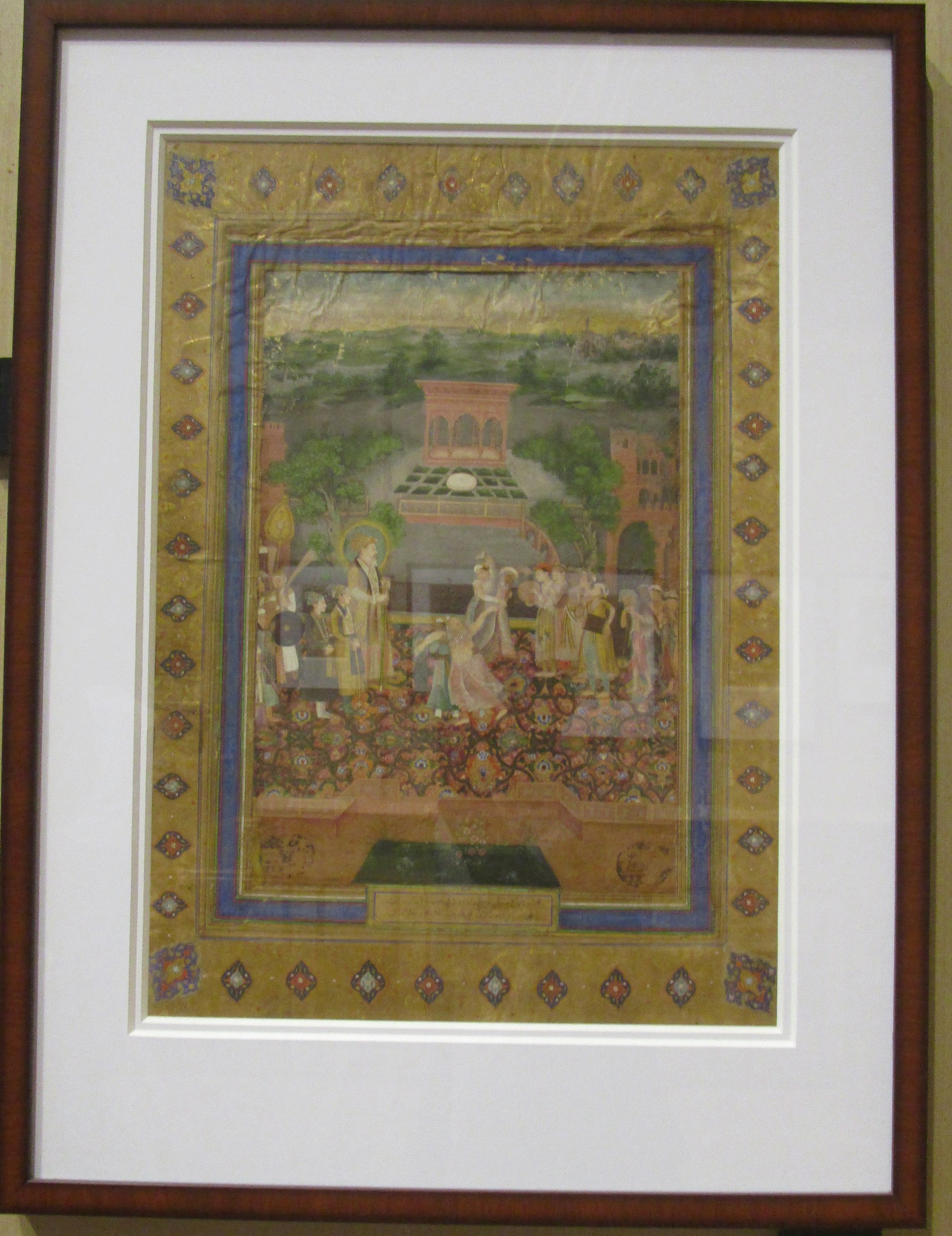
Emperor Shahjahan enjoying Sufi dance (1)
Unknown artist
- Source:
- Wikimedia Commons
- Rights:
- Reusable with conditions: credit the creator; share any adaptation under the same license. Source record ↗
- Recorded as:
- cc by-sa 4.0
This image is essential documentation of Sufi dance as it was performed and patronized in the Mughal court at its height. It shows that sacred dance was not marginal to court life but central to it, and that the boundary between spiritual ecstasy and political spectacle was deliberately managed and blurred. For historians of Islam and South Asia, it is rare visual evidence of the actual bodies, movements, and social context of Sufi practice in the pre-modern period.
What you are looking at
A Mughal court scene depicts Emperor Shah Jahan seated centrally in an elevated pavilion, surrounded by courtiers and attendants in a formal garden setting. The composition is organized in strict horizontal registers: the emperor's viewing platform in the middle distance, a performance space immediately below with musicians and dancers, and a densely populated crowd of spectators in the foreground. The architectural setting features a red sandstone or brick structure with arched openings, set within a formal quadrilateral garden with geometric water channels and cypress-like trees. The entire scene is rendered in the Indo-Persian manuscript tradition with flattened perspective, rich mineral pigments on paper, and an ornamental gold border with jewel-toned geometric patterns. The painting captures a moment of courtly entertainment, with figures in flowing robes and turbans arranged according to strict hierarchies of status and proximity to the emperor.
The dancing
The dancers in the foreground are depicted in dynamic, articulated poses suggesting rapid movement and spin. Their bodies are lean and elongated in the Mughal style, with arms raised and extended, suggesting the upright posture and expressive hand gestures characteristic of Sufi devotional dance. The musicians sit cross-legged in the performance space, playing wind and stringed instruments. Courtiers in the upper registers adopt formal, stationary poses of observation and attendance. The overall arrangement prioritizes visual hierarchy over naturalistic spatial relationship—the emperor is shown smaller in scale because he is protected and elevated, not because he is distant.
The dance depicted
The catalogue identifies this as Emperor Shah Jahan enjoying Sufi dance, and the image supports this identification. Sufi sacred dance (particularly the ecstatic whirling and swaying of dervish traditions, or devotional forms like the Sama ceremony) was performed in Mughal courts as entertainment and spiritual practice. The upright posture, raised arms, and spinning suggestion in the pose of the foreground figures align with Sufi movement vocabularies. The presence of musicians with drums and wind instruments is consistent with the musical accompaniment to such dances. This painting documents the court as a space where Persian-Islamic spiritual practices were patronized and observed as elite entertainment.
How it was made
This is a gouache or opaque watercolor painting on paper in the Indo-Persian manuscript tradition, identifiable by the flat color fields, careful linear detail, rich mineral pigments (lapis lazuli blue, gold leaf), and ornamental framing. The technique allowed for precise narrative detail and the simultaneous representation of multiple registers without Western perspectival recession. Such paintings were created for royal albums or manuscripts and circulated within elite courts and among patrons of Mughal cultural production. The 2016 date on the record likely indicates a modern reproduction or facsimile rather than the work's actual creation date in the 16th or 17th century.
About this work
This is a court spectacle painting from the Indo-Persian Mughal tradition, documenting the emperor as patron and witness to Sufi devotional dance. The work sits at the intersection of political authority, religious practice, and aesthetic patronage—it shows the Mughal court not as a space of secular entertainment alone, but as a site where ecstatic spiritual practice was regulated, observed, and incorporated into courtly ceremony. The painting belongs in a dance history gallery because it is evidence of how a major imperial power understood, staged, and valued sacred dance as a form of courtly knowledge.
How to look at it
Observe the artist's choice to freeze the dancers mid-movement: their bodies spiral and rise, captured in a moment of ecstatic abandonment. Notice how the emperor's stillness in the pavilion above contrasts with the energy of the dancing figures—the composition makes clear that his role is to witness and regulate, not to participate. The ornamental border frames the scene as a precious object, a record of courtly magnificence to be studied and admired. The density of the crowd and the layering of multiple registers suggest that this performance was a major event, not an intimate gathering.
The period
Shah Jahan reigned 1628–1658, a period of peak Mughal artistic and architectural production. The Indo-Persian painting tradition was at its height, synthesizing Persian miniature conventions with South Asian figural and narrative traditions. Sufi orders and their devotional practices were deeply embedded in Mughal court culture, though sometimes controversial among orthodox Islamic authorities. The emperor's role as patron of the arts and as a figure through whom divine favor flowed made his presence at such performances a form of legitimation. This painting likely dates from the 17th century, not 2016 as the record suggests.
Where it lives
The work is sourced from Wikimedia Commons. The date of 2016 likely indicates a digital reproduction or modern facsimile of a much older Mughal painting; the actual historical object and its current location are not recorded here.
Dance in this work
Questions about this work
Was Sufi dance really performed in Mughal courts?
Yes. Sufi orders were integral to Mughal court life and spiritual practice, and forms of Sufi devotional dance and music were regularly patronized by emperors. This painting is primary visual evidence of that practice. However, Sufi orders also faced periods of resistance from orthodox Islamic scholars, and not all emperors equally valued such performances.
What is the difference between this and European court dance paintings?
This painting flattens space and arranges figures by hierarchy rather than perspective. The emperor is shown smaller and elevated because of his status, not distance. There is no frame or stage separating performers from spectators. The painting prioritizes narrative detail and symbolic arrangement over illusionistic space—a fundamentally different visual logic from Western court dance imagery.
Who was Shah Jahan?
The fifth Mughal emperor (r. 1628–1658), famous as the patron who commissioned the Taj Mahal. He was a major patron of the arts, architecture, and courtly performance, and his reign represents the peak of Mughal cultural production and imperial confidence.
More dance artwork





