49 works in this view — arrow keys or swipe to move between them.
Dance in Art
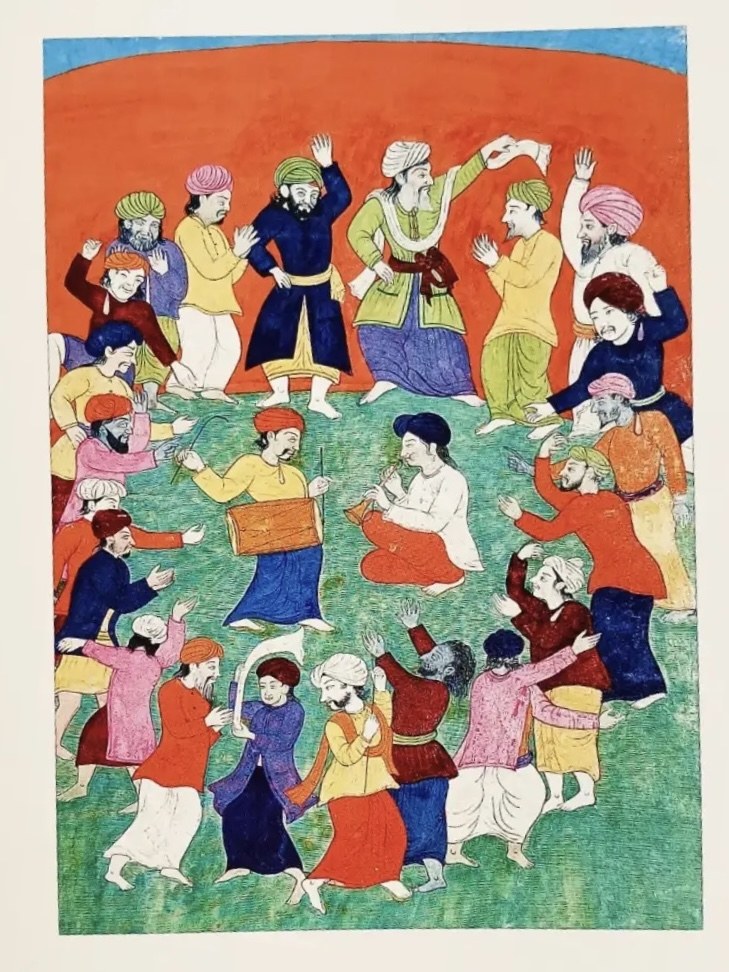
Painting of a bhangra dance performance
Unknown artist
- Source:
- Wikimedia Commons
- Rights:
- Public domain — free to use, share and adapt.
- Recorded as:
- public_domain
This image preserves a record of how bhangra was performed and practiced in a pre-globalized context—as a joyful, communal, multi-generational gathering rather than the competitive, stages, or commodified form it has become in diaspora and commercial contexts. For dancers and historians, it documents the social function of the dance and the values it embodies: inclusion, participation, celebration of harvest and community rather than individual achievement or spectacle.
What you are looking at
A lively gathering painted in bright tempera on paper shows a social bhangra celebration set against an orange sky. The composition divides into two zones: an elevated platform at top where musicians and elders stand in formal dress, and a ground level where dozens of figures—men, women, and children—dance and celebrate. The upper tier features musicians with traditional instruments and several figures in formal posture, some with raised arms in commanding or blessing gestures. Below, the dancers occupy a green ground in loose circular formations, wearing brilliant reds, yellows, blues, and pinks. Some figures crouch or sit, others stand in profile or three-quarter view, many with arms raised or extended outward. The painting's flat perspective and bright, unmixed pigments create a sense of energetic simultaneity—as if multiple moments of the celebration are visible at once. The style suggests a manuscript illumination or popular painting tradition rather than European perspective.
The dancing
The dancers show characteristic bhangra movement vocabulary: arms are raised and extended away from the body, shoulders appear engaged and mobile, and the stance is grounded with bent knees and a forward tilt of the torso typical of the form. Individuals and small groups occupy the space without strict linear formations—some face left, some right, some toward the viewer. The raised-arm positions with palms open or hands in gesture are consistent with Punjabi folk dance styling. Children and adults dance together without separation. The overall frame is one of joyful collective participation rather than exhibition—this is social and celebratory rather than staged.
The dance depicted
This depicts bhangra, the exuberant folk dance of Punjab in northern India and Pakistan. Bhangra traditionally celebrates the spring harvest (Vaisakhi) and has been performed at weddings, festivals, and communal gatherings for centuries. The painting shows the characteristic social form: a group celebration with both performers and observers, multiple generations participating, and the energetic upward thrust of the arms and torso that defines the dance. The presence of musicians at the top suggests the integral role of the dhol drum and traditional music. The inclusive, non-hierarchical arrangement of the dancers—children alongside adults, no stage or formal proscenium—reflects bhangra's function as a community practice rather than a codified theatrical form. This appears to be documentary or celebratory rather than an artist's imaginative invention.
How it was made
The work is a watercolor or tempera painting on paper, executed in flat areas of bright, saturated color with minimal modeling or shadow. The technique allows for rapid, expressive application and creates a decorative, illustrative quality suited to manuscript or popular art traditions. The absence of atmospheric perspective and the stacked composition suggest either a South Asian manuscript painting tradition or a print-based popular aesthetic—possibly influenced by or derived from printed media. The pigments appear to be mineral or synthetic colors applied with precision to delineate figures against the ground. This technique was economical and reproducible, which may account for its circulation in popular or educational contexts.
About this work
This is a documentary or celebratory painting of a bhangra gathering, rendered in the bright, flattened style of South Asian popular art or manuscript illumination. It captures the social form of the dance: multiple generations participating together, musicians providing accompaniment, the communal energy rather than individual virtuosity. The painting treats bhangra not as a theatrical spectacle to be watched from a distance but as an inclusive, participatory celebration—the viewer is immersed in the crowd rather than positioned as a spectator. Its style and subject matter suggest it was made for popular circulation, education, or cultural documentation within a South Asian context, rather than for an academic or museum audience.
How to look at it
The viewer should attend to the composition's non-linear, non-theatrical arrangement: this is not a performance staged for an audience but a crowd of people dancing together. Notice how bodies are distributed across the space in overlapping, informal groups rather than lines or formations. Look at the arm positions—consistently raised, extended, and mobile—and the bent-knee stance that anchors the movement. The presence of children, seated observers, and musicians integrated into the scene tells you this is a social and familial occasion, not a public spectacle. The artist's choice to depict many people in many poses simultaneously suggests the continuous, ongoing nature of the celebration rather than a single frozen moment.
The period
Bhangra has ancient roots in Punjabi harvest celebration, but this painting likely dates to the colonial or early-modern period when such scenes began to be documented visually—either by South Asian artists working in manuscript or popular print traditions, or in response to colonial ethnographic documentation. The style suggests a popular or semi-professional painter working in a tradition of manuscript illumination or woodblock-print aesthetics, adapted to paper and pigment media. Bhangra remained primarily a rural, seasonal, community practice until the mid-20th century, when urbanization, migration, and eventually global diaspora transformed it into a competitive, theatrical, and commercial form.
Where it lives
The work is held in Wikimedia Commons, suggesting it is either in the public domain or offered under an open license. No further holding collection, accession number, or location data is recorded.
Dance in this work
Questions about this work
Is this a historical document or an artistic interpretation?
It is likely both: a documentary image created by a popular or semi-professional artist to record or celebrate a real bhangra gathering, rather than an imagined or theatrical composition. The specificity of dress, gesture, and social arrangement suggests observation rather than invention, though the artist's style—flat perspective, bright colors, decorative composition—shapes how the scene is presented. It should be read as evidence of how bhangra was practiced and valued in its original social context.
How does this compare to bhangra as it is performed today?
Modern bhangra, especially in competitive and commercial contexts, is often performed by smaller groups on a stage, with codified choreography and competitive judging. This painting shows bhangra in its traditional social form: a community gathering where many people of different ages participate together, without formal competition or hierarchical structure. The values depicted here—inclusion, participation, celebration of shared harvest and community—differ from the spectacle and individual achievement emphasized in contemporary theatrical bhangra.
What are the musicians playing?
While individual instruments are difficult to identify precisely from the painting's style, the presence of musicians at the top of the composition reflects the essential role of traditional Punjabi music in bhangra. The dhol drum (a large, two-headed cylindrical drum) is the iconic instrument of bhangra, typically accompanied by other percussion and sometimes wind instruments. The musicians' placement at an elevated position suggests their importance to the celebration's success and energy.
Where and when was this painted?
The record provides no confirmed date, artist, or location. The style suggests a South Asian popular art or manuscript tradition, possibly created in Punjab or another region of India or Pakistan. The painting's technique, colors, and composition are consistent with late 19th or 20th-century popular painting or educational illustration, though an earlier date is possible.
More dance artwork





