49 works in this view — arrow keys or swipe to move between them.
Dance in Art
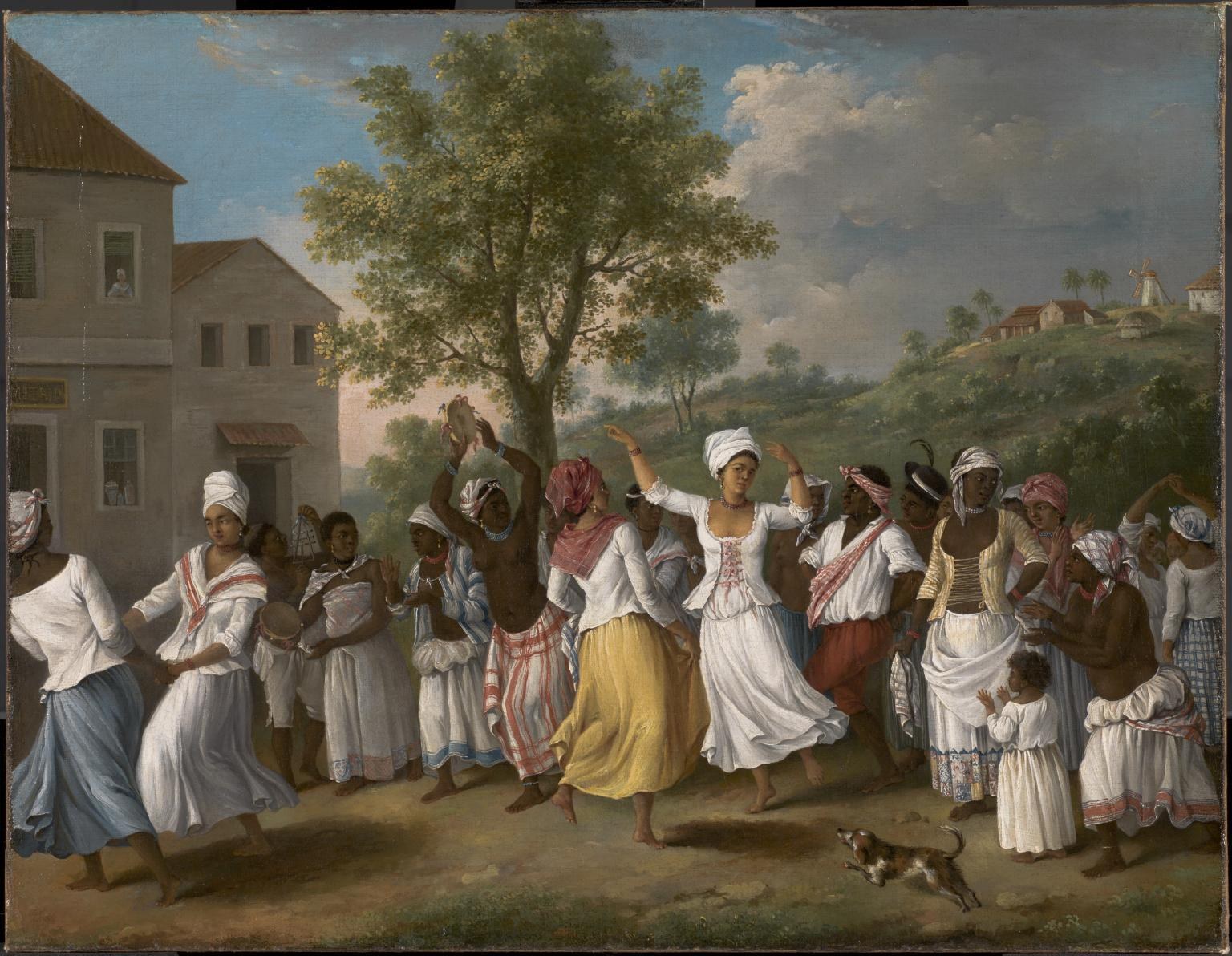
Agostino Brunias, A Negroes Dance in the Island of Dominica
Agostino Brunias
- Source:
- Wikimedia Commons
- Rights:
- Public domain — free to use, share and adapt.
- Recorded as:
- public_domain
These paintings are among the earliest European visual records of African-diasporic dance in the Caribbean, and they preserve details of costume, gesture, and social context that are otherwise absent from written sources. Despite their colonial framing, they offer evidence of the movement vocabularies, social practices, and cultural resilience of communities under slavery and in the post-slavery period.
What you are looking at
A large gathering of enslaved and free Black people dances outdoors in what appears to be a Caribbean plantation setting, circa late 18th century. The composition is anchored by a central female dancer in a white chemise and yellow skirt, arms raised in an exuberant gesture, surrounded by dozens of onlookers in various states of motion and repose. To the left stands a substantial colonial building with a tower; to the right, a hillside settlement recedes into atmospheric perspective. The sky is rendered in soft blues and whites with billowing clouds. The ground is bare earth, worn by use. White cloths wrap many heads; colored fabrics—reds, blues, yellows—appear in skirts and wraps. A small dog moves among the figures. The light is warm and even, suggesting midday. The scene carries the documentary pretense of an ethnographic record, yet the composition is carefully staged: the central dancer is spotlit by empty space, the crowd arranged in a loose amphitheater, the architecture framing the action.
The dancing
The principal dancer stands in a commanding contrapposto, weight shifted, one arm extended upward with the palm open, the other raised at shoulder height—a posture of exaltation or call-and-response. Her torso twists, suggesting rotation or preparation for a turn. Around her, figures are caught in varied attitudes: some clap, some sway, some stand at rest with hands on hips or at sides. The poses suggest individual improvisation rather than unison. Several figures appear to be in conversation or observation rather than active dance. The artist has rendered the bodies with anatomical attention but without the formal precision of academic figure painting; the sense is of capture rather than idealization.
The dance depicted
This depicts social dance in the enslaved and free Black communities of the Caribbean, most likely from Dominica given the title. The central gesture—arm raised, torso engaged—is consistent with ring dances, call-and-response forms, and the early creolized African-diasporic dances documented in 18th-century Caribbean sources. The presence of onlookers, the outdoor setting, and the mix of active dancers and spectators suggest a community celebration or market day gathering where dancing was central to social bonding and cultural expression. The specific form cannot be named with certainty from the image alone, but the vocabulary of the body—the improvisational quality, the emphasis on the torso and free arms, the integration of clapping—points to African-rooted movement vocabularies already transforming under the pressures and possibilities of the diaspora.
How it was made
This appears to be oil on canvas, executed with the smooth finish and atmospheric perspective characteristic of 18th-century European landscape painting. The technique allowed Brunias to work with rich color and layered glazes, building spatial depth through aerial perspective and careful tonal gradation. The work was likely created for European consumption—it circulated as engraved reproductions and was housed in collections like the Tate—and the oil medium signals its status as a finished studio work rather than a sketch. The technique itself, however, imposed European aesthetic conventions onto Caribbean subjects: the even lighting, the staged composition, the treatment of the landscape background all follow European picturesque conventions rather than documenting the scene as it occurred.
About this work
Agostino Brunias was an Italian-born painter who worked in the Caribbean in the mid-to-late 18th century, creating a substantial body of work depicting the lives, dress, and customs of enslaved and free Black people across the islands. This painting is one of several 'Negro Dance' scenes he produced, and it belongs to a larger visual archive of the Caribbean diaspora created by European artists for European audiences. The work is both document and construction: it records recognizable elements of Caribbean dance culture—the outdoor gathering, the dress, the social organization—while reshaping them through European compositional conventions and the artist's own aesthetic agenda. For dance historians, Brunias's scenes remain among the most detailed visual records of Caribbean movement in the 18th century, capturing a moment when African, European, and indigenous dance vocabularies were in rapid creolization.
How to look at it
Notice the hierarchy of activity in the composition: the central dancer is isolated and spotlit by empty space, while the crowd forms a loose, attentive circle around her. The artist has frozen the moment at a peak of expression—the arm raised, the torso twisted—rather than showing the continuity of movement. Observe the variation in pose among the surrounding figures: this is not a formal line dance or a synchronized group, but rather a flexible, improvisational gathering where individuals take turns or move as they wish. The architectural framing—the building to the left, the hillside to the right—is a European convention that distances the viewer as an observer of a 'scene,' yet the energy of the movement and the density of the gathering push back against that distance.
The artist
Agostino Brunias (c. 1730–1796) was born in Rome and trained in the European academic tradition. He emigrated to the Caribbean, where he spent much of his career documenting plantation life, market scenes, and social customs. He worked in Dominica and other islands, producing numerous paintings and drawings of daily life among enslaved and free Black populations. His work was engraved and circulated in Europe, establishing him as a primary visual documenter of Caribbean society for European audiences. While his paintings have been read as ethnographic or descriptive, they are thoroughly shaped by his European aesthetic training and the commercial demands of the European art market.
The period
In the late 18th century, European interest in the exotic and the colonial 'other' was at its height, and Caribbean subjects were fashionable in metropolitan art circles. Simultaneously, the Caribbean was undergoing rapid transformation: the sugar economy was expanding, the slave trade was at its peak, and the creolization of culture—the synthesis of African, European, and indigenous traditions—was accelerating. Dance was a central site of cultural negotiation and resistance in enslaved communities; it was also a marker of 'difference' that European observers found fascinating and often threatening. Brunias's work was created in this moment of intense visual and cultural appetite for Caribbean imagery, and it participated in both documenting and exoticizing Caribbean life.
Where it lives
The Tate Gallery, London, holds a version or related work titled 'Dancing Scene in the West Indies, c. 1764–1796.' The Wikimedia Commons source suggests multiple copies or versions of this composition circulated, consistent with Brunias's practice of producing variations for different clients and markets.
Dance in this work
Questions about this work
What dance is this?
The specific form cannot be identified from the image alone, but the movement vocabulary—the raised arms, the torso rotation, the improvisational quality, and the social context—suggests creolized African-diasporic dances that were developing in the Caribbean in the late 18th century. These would have blended African movement traditions with European and indigenous influences.
Is this painting a reliable record?
It is both record and construction. Brunias clearly observed Caribbean life closely and captured authentic details of dress, gathering, and movement. However, the painting reshapes these observations through European compositional conventions—the staged lighting, the picturesque landscape background, the theatrical framing. It should be read as a document filtered through European aesthetics and colonial perspective.
Who are the people depicted?
The painting includes both enslaved people and free Black people, as well as possibly mixed-race individuals. The title specifies Dominica, where Brunias worked. The dress, the outdoor gathering, and the context suggest a market day or holiday celebration, moments when enslaved people had some freedom to gather and dance.
Why did Brunias paint these scenes?
Brunias painted Caribbean life for European collectors and audiences who were hungry for images of the exotic colonial world. His work was engraved and circulated widely, making it commercially successful. He was documenting—but also exoticizing and aestheticizing—the people and cultures of the colonies he observed.
More dance artwork





