49 works in this view — arrow keys or swipe to move between them.
Dance in Art
Katthak Dance
Sneharshidasgupta
- Source:
- Wikimedia Commons
- Rights:
- Reusable with conditions: credit the creator; share any adaptation under the same license. Source record ↗
- Recorded as:
- cc by-sa 4.0
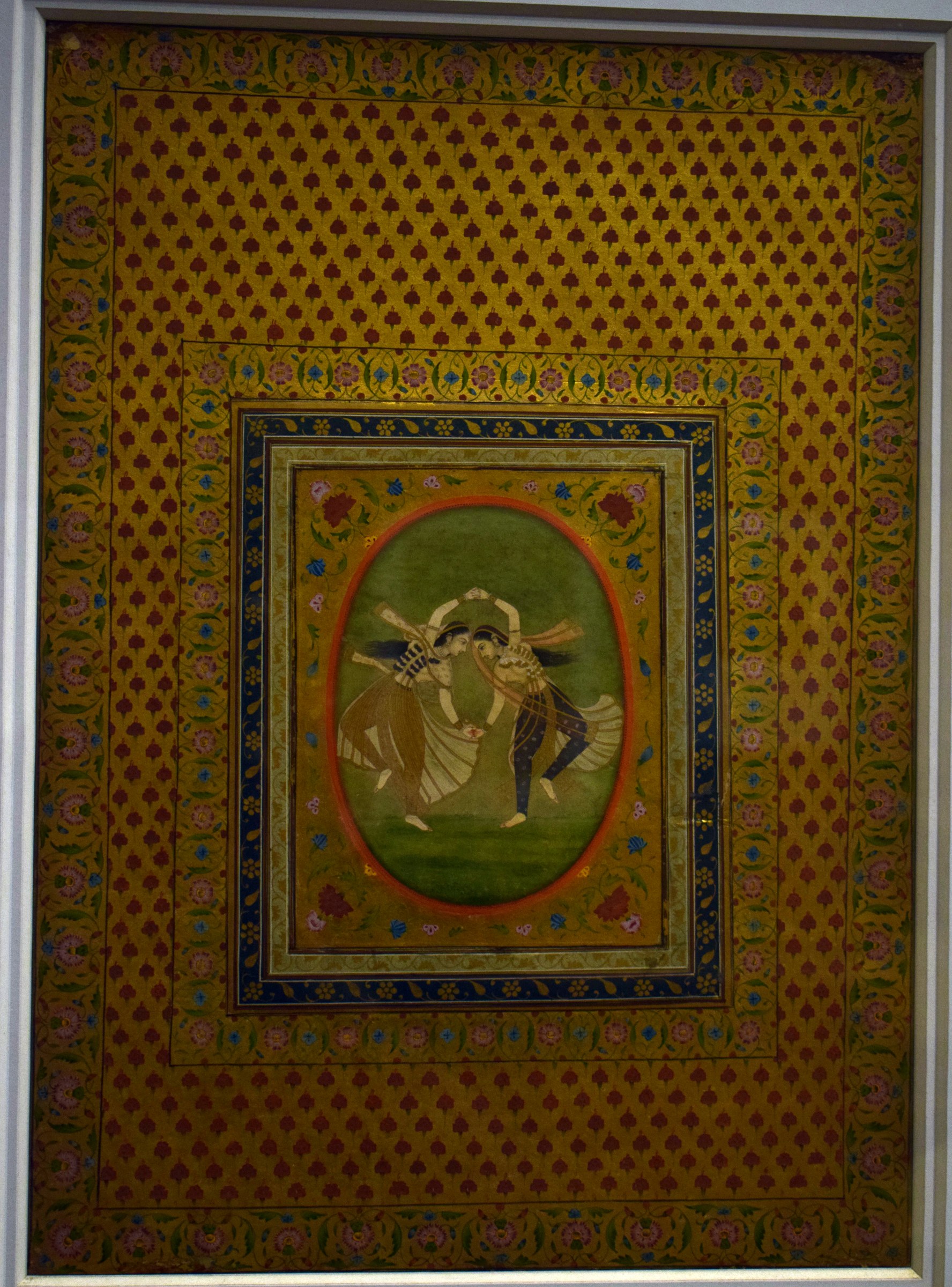
Kathak in its classical form is a lineage dance, transmitted orally and kinesthetically through families and court patronage. This miniature offers rare visual evidence of Kathak practice during or after the period of its courtly flourishing, preserving costume detail, jewelry, and the aesthetic moment a master painter chose to capture. For historians of Kathak, this image documents what was valued enough to be commissioned and preserved—and how the dance was visually understood by its own culture.
What you are looking at
Two figures occupy the center of an ornate oval composition set against a deep green ground. Both wear cream or pale muslin garments with visible pleating and volume, suggestive of classical or courtly dress. The figure on the left wears a tall, ornate crown or headdress of gold and jeweled material; the figure on the right wears a simpler headpiece. Both have their arms raised and bent, gesturing expressively toward each other. The composition is tightly framed, focusing entirely on the two dancers in profile and three-quarter view. The entire work is enclosed in nested decorative borders: an innermost red-orange oval frame, then a pale ground with small floral scatter, a dark blue band with repeating gold floral ornaments, and an outermost gold field filled with a regular repeating pattern of small red diamond or leaf shapes. This ornamental surround—characteristic of Indo-Persian manuscript painting—occupies nearly two-thirds of the total composition.
The dancing
Both figures stand with knees slightly flexed and weight distributed between their feet. Their arms are raised to roughly shoulder height with elbows bent, hands open and palms visible, suggesting a conversational or narrative gesture rather than a balletic extension. The postures are symmetrical and mirrored, creating a sense of dialogue or mutual address. The bodies are upright but mobile in feeling; the flowing garments suggest continuous motion. Neither figure appears to employ turnout or weight on the ball of the foot in the European balletic sense. The composition emphasizes upper-body gesture and facial expression over legwork.
The dance depicted
This work depicts Kathak, the North Indian classical dance tradition. The catalogue identifies it as such. The evidence lies in multiple elements: the ornate crown worn by the left figure (characteristic of Kathak's elaborate jewelry and headdress known as *mala*), the pale pleated skirts typical of Kathak costume, the raised-arm gesture vocabulary, and critically, the Indo-Persian manuscript painting style and decorative surround, which situates the image within the courtly and miniature-painting traditions of North India in which Kathak developed. Kathak emphasizes upper-body gesture, facial expression, and rhythmic footwork often performed in place—a tradition that developed in the courts of Mughal and later Indian kingdoms. The static, frontal moment shown here would represent a *mudra* (gesture phrase) or narrative moment in a performance.
How it was made
This is a miniature painting executed in what appears to be gouache or opaque watercolor on paper, using the conventions of Indo-Persian manuscript illumination. The precision of line, the flat color fields, the nested geometric frames, and the all-over patterning of the background are characteristic of this tradition, which requires a prepared surface, fine brushwork, and layering of pigments. The technique allowed for intimate, portable works intended for courtly viewing or private albums; the small scale and jewel-like quality indicate a luxury object made for a sophisticated audience familiar with both Kathak and miniature-painting aesthetics. The work is likely part of a series or album (*muraqqa*) rather than a standalone panel.
About this work
This is a miniature painting in the Indo-Persian tradition depicting two Kathak dancers in an exchange of gesture, their ornate costumes and expressive arm work rendered in the jewel-toned palette and intricate framing conventions of North Indian courtly art. Kathak is one of the eight classical forms of Indian dance, historically performed in the courts of Mughal rulers and later patronized by Hindu kingdoms. The work sits at the intersection of dance documentation and courtly luxury art—simultaneously a record of Kathak practice and a display of aesthetic refinement. Its inclusion in a dance gallery recognizes that miniature painting served as a primary means of recording and celebrating court dance practices before photography, and that the visual conventions of a tradition (costume, jewelry, gesture, spatial framing) can be read through its historical art.
How to look at it
Observe how the painter has chosen not a moment of footwork or traveling movement, but a stillness—a held gesture of address or greeting between the two figures. This emphasis on the *mudra* (expressive gesture of face, hands, and arms) reflects Kathak's heritage as a narrative dance form closely linked to poetry, storytelling, and emotional expression. Notice how the elaborate framing—the nested golden, patterned borders—situates the dancers not as isolated figures but as precious presences within a cosmos of courtly ornament. The painting asks the viewer to contemplate the gesture and the face as much as the body, a priority that has persisted in Kathak to the present day.
The artist
Sneharshidagupta is identified in the catalogue as the artist; however, the work's style is consistent with North Indian or Indo-Persian miniature painting traditions rather than with contemporary or modern artistic signatures. It is possible the artist is working in a historical or revivalist mode, or that the attribution is provisional. Without further documentation, the artist's intent—whether recording a historical moment, creating a homage to a tradition, or practicing the miniature form itself—cannot be definitively established. The work was sourced from Wikimedia Commons, indicating it has been digitized for public access.
The period
Kathak as a court form reached its peak during the Mughal period (16th–18th centuries) and continued to develop under later regional rulers. The dance was historically performed by courtesans (*tawaif*) and male professional dancers (*nritya-kar*) in the courts of emperors and nobles. The miniature-painting tradition that frames this image was itself a major courtly art form across the same period, reaching extraordinary refinement under patrons like Akbar and Shah Jahan. By the 19th and 20th centuries, Kathak faced decline under colonial rule, then was revived and re-codified by nationalist and classical-revival movements. This image's date of 2023 suggests it is a contemporary work responding to or emulating historical precedent, though without the artist's statement this remains uncertain.
Where it lives
The work is recorded as sourced from Wikimedia Commons, a digital archive of public-domain and openly licensed cultural materials. No holding institution, accession number, or physical location is documented in the catalogue record provided. The work's current physical location, if any, is unknown.
Dance in this work
Questions about this work
What is Kathak and how does it differ from other Indian classical dances?
Kathak is a North Indian classical dance tradition historically performed in the courts of Mughal and later Indian rulers. Unlike the southern forms Bharatanatyam or Kuchipudi, which emphasize sculptural poses and floor patterns, Kathak prioritizes narrative, facial expression, hand gesture (*mudra*), and rapid rhythmic footwork performed often in place or in a linear path. The dancer typically wears a long skirt, jewelry, and an ornate crown. Kathak draws on poetry, mythology, and devotional themes, and the relationship between dancer and audience centers on emotional resonance (*rasa*) rather than abstract geometric movement.
Why would Kathak be painted in a miniature rather than shown in another medium?
Miniature painting was the primary luxury visual medium in North Indian courts during Kathak's development. A small, jeweled painting could be owned, circulated, and studied by courtly audiences; it was an intimate, precious object. Before photography, such miniatures served to document and celebrate court practices, to commemorate performances or patrons, and to preserve visual records of costume, jewelry, and the dancer's bearing. A miniature of a dance was a status object and an artwork in its own right.
Can you tell from this image whether these are professional dancers or amateurs?
The quality of the painting, the ornate costume and jewelry, and the formal compositional framing suggest these are elite dancers—likely professionals or members of a royal household. The elaborate headdress on the left figure and the careful rendering of pleated garments indicate high status. However, the specific identity of the dancers, if historical, cannot be established from the image alone. The painting documents a kind of performance rather than a specific performance or performer.
What do the arm gestures mean in Kathak?
In Kathak, as in all Indian classical dance, hand and arm gestures (*mudra*) carry specific meanings drawn from Sanskrit linguistic and poetic traditions. A raised arm with open palm might indicate greeting, devotion, or the presence of a god or beloved; it can also signal transition between narrative sequences. Without knowing the specific narrative or *rasa* (emotional mood) this painting documents, the exact meaning cannot be stated. However, the mirrored, conversational quality of the two figures' gestures suggests dialogue—one dancer addressing the other, or both addressing a shared focus.
More dance artwork





