49 works in this view — arrow keys or swipe to move between them.
Dance in Art
Amalgamation waltz illustration
Edward Williams Clay (1799-1857)
- Source:
- Wikimedia Commons
- Rights:
- Public domain — free to use, share and adapt.
- Recorded as:
- public_domain
The work is significant for dance historians as a detailed record of waltz technique and ballroom convention in 1830s America, but equally important as evidence of how the waltz's physical intimacy made it a charged and symbolically loaded dance. The engraving demonstrates that dance history cannot be separated from the social and political content of the bodies dancing; the same closed embrace that made the waltz thrilling to some audiences made it a flashpoint for racialized anxiety to others.
What you are looking at
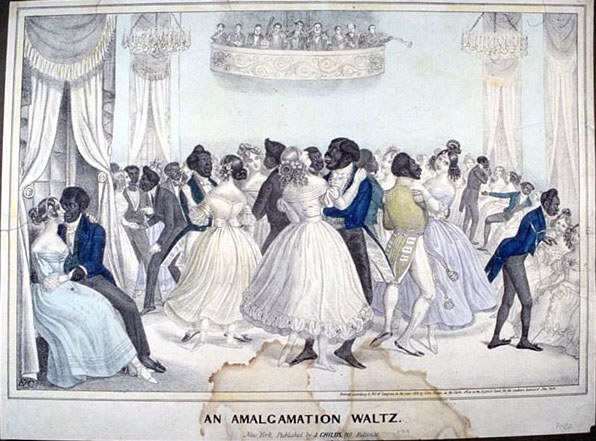
A crowded ballroom scene rendered in black and white engraving, with tall draped windows framing the composition and an ornate chandelier suspended above. The room is packed with figures in Regency-era dress: men in dark coats and breeches, women in high-waisted white gowns with short sleeves. The foreground shows couples in various stages of the waltz, bodies close together in the characteristic embrace of the period. The artist has captured a moment of social mixing—Black and white dancers occupy the same floor space, a deliberate and charged statement embedded in what appears to be a satirical print. The lighting is even and flat, typical of engraving, with shadow used only to define form and create depth into the crowded room.
The dancing
The dancers adopt the waltz closed position: partners facing each other with the man's right hand on the woman's back and her left hand on his shoulder, their other hands joined at shoulder height. Bodies are upright and formal, with the characteristic sway and turn of the Regency waltz visible in several couples. The artist shows varied states of the dance—some couples are mid-turn with skirts flaring, others are more stationary. The positioning and physical contact between dancers follows Regency ballroom convention precisely; this is not artistic invention but observed or studied practice.
The dance depicted
This is a Waltz, specifically a Regency-era English waltz from the 1830s. The waltz was still relatively new to English society at this date, having arrived from continental Europe only a generation earlier, and remained controversial in some circles. The engraving documents the dance as a social practice, not a theatrical form—these are fashionable people at a ball, not professionals. The title's reference to 'amalgamation' makes clear that the artist's primary subject is racial integration on the dance floor, not the dance itself, but the dance is rendered with enough specificity to confirm the artist understood waltz practice and the waltz's role as a vehicle for intimate social encounter.
How it was made
The work is an engraving, a technique that allowed mass reproduction and circulation as a satirical print. Engravings could be hand-colored or distributed in monochrome; this version appears uncolored, relying on fine line work to differentiate fabric, shadow, and spatial recession. The medium's precision and reproducibility made it ideal for satirical prints intended for a broad audience—this would have circulated as a separate sheet or in a periodical, not as a unique object. The flatness of the engraved line gives the work a somewhat wooden quality that paradoxically aids its satirical purpose: the formality of the medium matches the formality of ballroom conduct, even as the content disrupts social expectation.
About this work
This is a Regency-era waltz scene from approximately 1835, rendered as a satirical engraving and titled to reference its political content rather than its dance content. The artist, Edward Williams Clay, was an American caricaturist known for satirical prints on slavery and race. The work documents the waltz as it was actually danced in fashionable ballrooms of the period—a partnered, intimate dance in closed position—while using that dance as a setting for a pointed commentary on racial integration. It belongs in a dance gallery both as evidence of waltz practice and as a document of how dance functioned as a site of social transgression and anxiety in the antebellum United States.
How to look at it
Observe the precision with which the waltz position is rendered: the closed hold, the relative positions of torso and limbs, the turn and sway visible in the couple nearest the viewer. Notice the artist's eye for the moment mid-movement—skirts are flaring, weight is shifting, the dance is caught in motion, not posed. Then observe the composition: the deliberate positioning of Black and white figures as equal participants in the same ballroom space, occupying the same floor, in the same dance. The technical mastery of the engraving medium—its ability to render fabric, crowd, and spatial depth—lends a false authority to the scene that the title works against. The contradiction between the formal beauty of the medium and the transgressive content of the scene is the work's central effect.
The artist
Edward Williams Clay (1799–1857) was a Philadelphia-born printmaker and caricaturist who worked primarily in engraving and lithography. He is known for satirical prints on American political and social themes, including numerous works responding to abolitionism and slavery in the antebellum period. His style was sharp and economical, built on fine line work and exaggerated gesture. The 'Amalgamation' series, to which this print belongs, was explicitly pro-slavery propaganda using racial caricature and miscegenation anxieties to mock antislavery sentiment. The technical skill of his engraving is undeniable; his compositional control allowed him to pack complex social scenes with legible detail.
The period
The waltz arrived in England from Vienna only in the 1810s and remained controversial into the 1830s, attacked by conservatives for the closeness of the partners and the speed of the rotation. By the 1830s it had become fashionable in elite ballrooms but retained its association with modernity and slight impropriety. The period also saw increasing American anxiety about race and slavery, intensifying through the 1830s as abolitionism gained voice. Satirical prints like this one used dance—specifically the waltz's enforced bodily proximity—as a vehicle for expressing fears about social hierarchy and racial boundary-crossing. The engraving coincides with the novel from which it was drawn, Oliver Bolokitten's 'A Sojourn in the City of Amalgamation, in the year of our Lord 19--', a work of pro-slavery satire.
Where it lives
The work is a satirical engraving, likely a separate print sheet intended for sale or distribution in periodicals. It is known through the Wikimedia Commons collection and is associated with the 1835 novel 'A Sojourn in the City of Amalgamation, in the year of our Lord 19--' by Oliver Bolokitten, for which it may have served as an illustration or independent companion piece.
Dance in this work
Questions about this work
Why is a political satire about race in a gallery about dance?
Because the dance is not incidental to the satire—it is the satire's vehicle. The waltz's physical intimacy and requirement for close bodily contact made it a perfect medium for expressing anxieties about racial boundaries. The work is a primary historical document of how dance functioned as a site of social transgression. For dance historians, it is invaluable evidence of how the waltz was understood not just as a technique but as a social act.
Is this a record of how people actually danced?
Yes, with caveats. The waltz positions and frame are rendered with enough accuracy to suggest observation or study of actual ballroom practice. However, the scene's political content is explicitly fictional and propagandistic—it depicts a scenario that the artist and his audience found outrageous or threatening, not one that was common. The dance technique is likely accurate; the social scenario is imagined.
What is the connection between this print and the novel 'A Sojourn in the City of Amalgamation'?
The novel is a work of pro-slavery satire published in 1835 under a pseudonym. It depicts a fictional future American city where racial integration has occurred, presented as a dystopian or grotesque scenario. The engraving illustrates or complements the novel's satirical vision. Both the novel and the print use the scenario of integrated ballroom dancing to express racialized fears for a pro-slavery audience.
More dance artwork





