49 works in this view — arrow keys or swipe to move between them.
Dance in Art
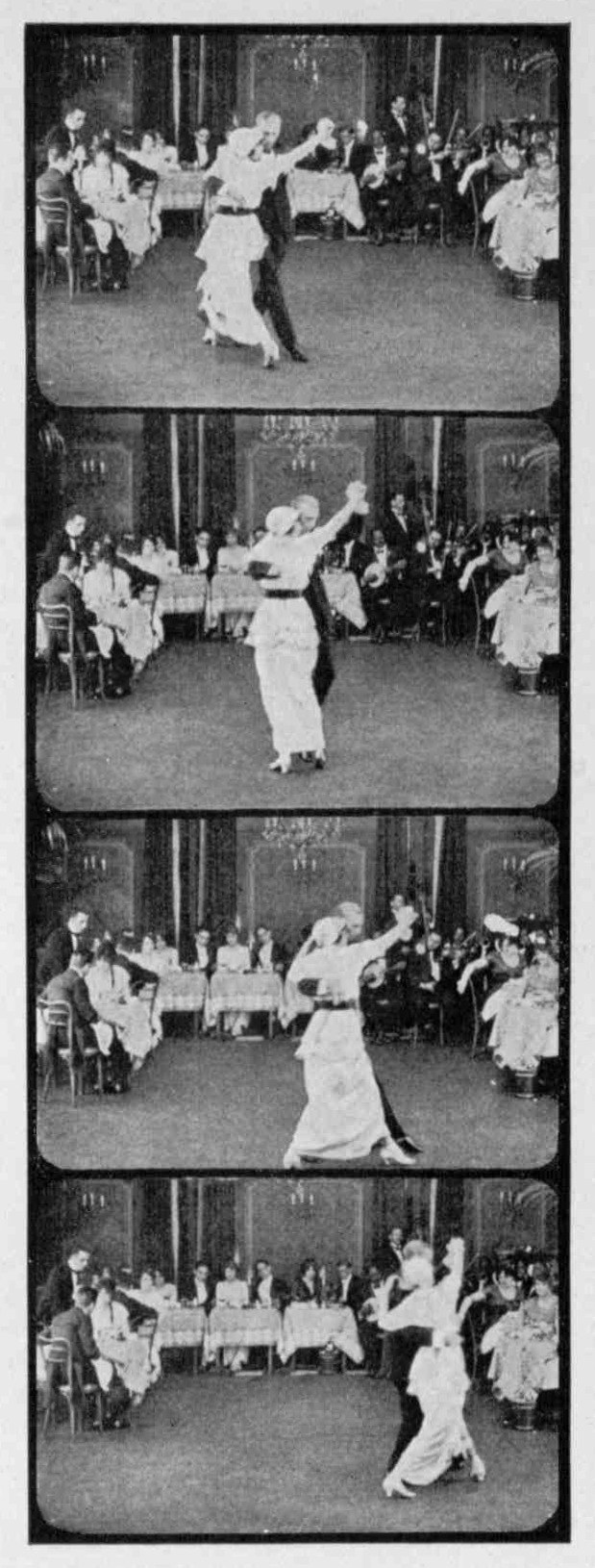
Modern Dancing (1914) - Vernon and Irene Castle - Illustration 18 (cropped) Hesitation Waltz-Waltz Walk
Vernon Castle and Irene Castle
- Source:
- Wikimedia Commons
- Rights:
- Public domain — free to use, share and adapt.
- Recorded as:
- public_domain
The Castles' innovations democratized ballroom dancing and made them cultural icons of the 1910s; their instructional books and the dances they popularized shaped American social dance for decades. This image is primary-source evidence of how the Hesitation Waltz was taught and performed at the highest level, and it shows the pedagogical methods by which dance knowledge was transmitted to the public before film and video. For historians of dance, costume, and popular culture, the Castles are essential: they bridge Victorian formality and modern social freedom, and this sequence captures that transition in dress, posture, and the deliberate cultivation of style.
What you are looking at
A photographic sequence of four frames arranged vertically captures a moment from a ballroom demonstration, likely from an instructional publication. The setting is an elegant interior with mirrored walls, chandeliers, and formally dressed spectators seated around the perimeter, watching the dancers at the center of the floor. In each frame, a man in black tailcoat and a woman in a white or cream-colored dress with dropped waist and shorter hemline (characteristic of 1914 fashion) progress through the steps of the Hesitation Waltz. The woman's skirt swings and lifts as they move, creating the flowing lines essential to the dance. The sequence freezes successive moments of the same figure, allowing viewers to see the progression of the movement from different phases.
The dancing
The couple maintains a closed ballroom hold throughout, with the man leading and the woman responding. The man's frame is upright and controlled; the woman's posture follows his lead with a slight lean characteristic of waltz technique. Her arms are relaxed, one hand resting on his shoulder, the other held in his hand at shoulder height. The frames show the couple traveling across the floor in a forward direction, with weight changes evident in the shifting of their bodies. The woman's skirt catches the motion, suggesting smooth, continuous movement rather than sharp or staccato steps. The positioning of their bodies relative to each other and the floor remains consistent with standard ballroom waltz frame.
The dance depicted
This is an instructional sequence demonstrating the Hesitation Waltz, a popular social dance of the early 20th century that combined waltz timing with the deliberate pauses (hesitations) that give the dance its name. The image documents Vernon and Irene Castle, the legendary ballroom dancing couple who revolutionized American social dancing in the 1910s. The Castles' version of the Hesitation Waltz became one of their signature dances, and this sequence appears to be from their instructional book *Modern Dancing* (1914), designed to teach the figure to amateur dancers. The four-frame sequence showing progression through the 'Waltz Walk' suggests this was how the Castles taught the basic traveling step, allowing readers to study each phase of the movement.
How it was made
These are photographic stills arranged in sequence, a common technique in early 20th-century dance instruction manuals. The photograph captures images with sufficient clarity to show posture and costume detail, though the black-and-white medium and reproduction quality obscure fine foot placement. The sequential arrangement—showing four successive moments of the same figure—was an innovative pedagogical technique that predated film and allowed static images to convey the temporal and spatial progression of movement. This approach suggests the images were created in controlled conditions, probably with multiple exposures or separate photographs of the same step taken in close succession, then arranged for publication.
About this work
This is an instructional sequence from Vernon and Irene Castle's *Modern Dancing* (1914), one of the most influential ballroom dance manuals of its era. The Castles were American ballroom champions who transformed social dancing from a formal, rigid practice into something more accessible and expressive. The Hesitation Waltz was one of their innovations—a simplification of classical waltz that incorporated deliberate pauses and was marketed as elegant yet learnable for the average dancer. This sequence documents not just a dance but a moment in American cultural history when ballroom dancing became a mass phenomenon and the Castles became celebrities whose every movement was studied and imitated by thousands.
How to look at it
Pay attention to the woman's skirt and how it responds to the movement—it is the most visible indicator of weight transfer and the smooth, continuous action of the waltz. Notice the consistency of the couple's frame across all four frames; the hold does not collapse or lose its shape, which is evidence of technical control. The sequence is designed to be read left to right, top to bottom, with each frame showing a successive moment of the same step, so study them in order to reconstruct the continuous movement. The formal dress and ballroom setting are not incidental: the Castles' innovation was to make this kind of dance accessible and respectable for the middle class, and the photography emphasizes elegance and refinement rather than exuberance or display.
The artist
Vernon and Irene Castle were an American ballroom dancing couple who became international celebrities in the 1910s. Vernon Blythe (1887–1918) and Irene Foote (1893–1969) married in 1911 and began performing in Broadway shows and at exclusive venues in Paris and New York. They became known for their elegance, innovation, and ability to simplify complex dances into forms that amateur dancers could learn and enjoy. Vernon Castle was killed in World War I while serving as a pilot; Irene continued performing and teaching for decades. *Modern Dancing*, published in 1914 and illustrated with photographic sequences like this one, was their most famous and influential publication, selling widely and establishing them as authorities on contemporary social dance.
The period
The 1910s saw a revolution in social dancing. The waltz, which had dominated 19th-century ballrooms, was being supplemented and challenged by new dances from America and Latin America—the foxtrot, one-step, turkey trot, and tango—many derived from or influenced by African American vernacular forms. The Castles' role was to legitimize and refine these new dances for middle- and upper-class white American audiences, stripping away elements that seemed too suggestive or syncopated and repackaging them as elegant and teachable. Their book *Modern Dancing* was part of a larger pedagogical turn: dance was no longer something you learned by imitation in ballrooms, but something you could study from instruction manuals, photographs, and notation. This shift coincided with the rise of photography and the emergence of dance as a subject worthy of serious instruction and publication.
Where it lives
This is Illustration 18 (cropped) from *Modern Dancing*, a book published by Vernon and Irene Castle in 1914. The image has been sourced from Wikimedia Commons, which hosts it as public-domain material. The original publication was an instructional manual with extensive photographic sequences designed to teach readers the Castles' versions of contemporary ballroom dances.
Dance in this work
Questions about this work
Who were Vernon and Irene Castle?
Vernon Castle (1887–1918) and Irene Castle (1893–1969) were an American ballroom dancing couple who became international celebrities in the 1910s. They performed in Broadway shows and at exclusive venues, and became known for introducing and popularizing dances like the Foxtrot and Hesitation Waltz. They published *Modern Dancing* in 1914, one of the most influential dance instruction books of its era. Vernon was killed in World War I; Irene continued performing and teaching for decades.
What is the Hesitation Waltz?
The Hesitation Waltz is a simplification of the classical waltz that incorporates deliberate pauses (hesitations) in the movement. The Castles popularized it as an elegant but learnable dance for social dancers who found the traditional waltz too complex. It retains the three-count timing of the waltz but uses longer, traveling steps and moments of stillness for dramatic effect.
How was *Modern Dancing* used?
Published in 1914, *Modern Dancing* was an instructional manual that used photographic sequences to teach readers how to perform the Castles' versions of contemporary ballroom dances. The book sold widely and became the standard reference for social dancers of the era. The photographic sequences, like this one, were innovative pedagogical tools that showed the progression of movement through successive frames.
Why did the Castles matter to dance history?
The Castles democratized ballroom dancing by making it accessible and respectable for the middle class. They simplified complex dances and marketed them as elegant and teachable. They also professionalized dance instruction and helped shift it from informal learning-by-imitation to systematic study from books, photographs, and notation. Their influence shaped American social dance for decades.
More dance artwork





