49 works in this view — arrow keys or swipe to move between them.
Dance in Art
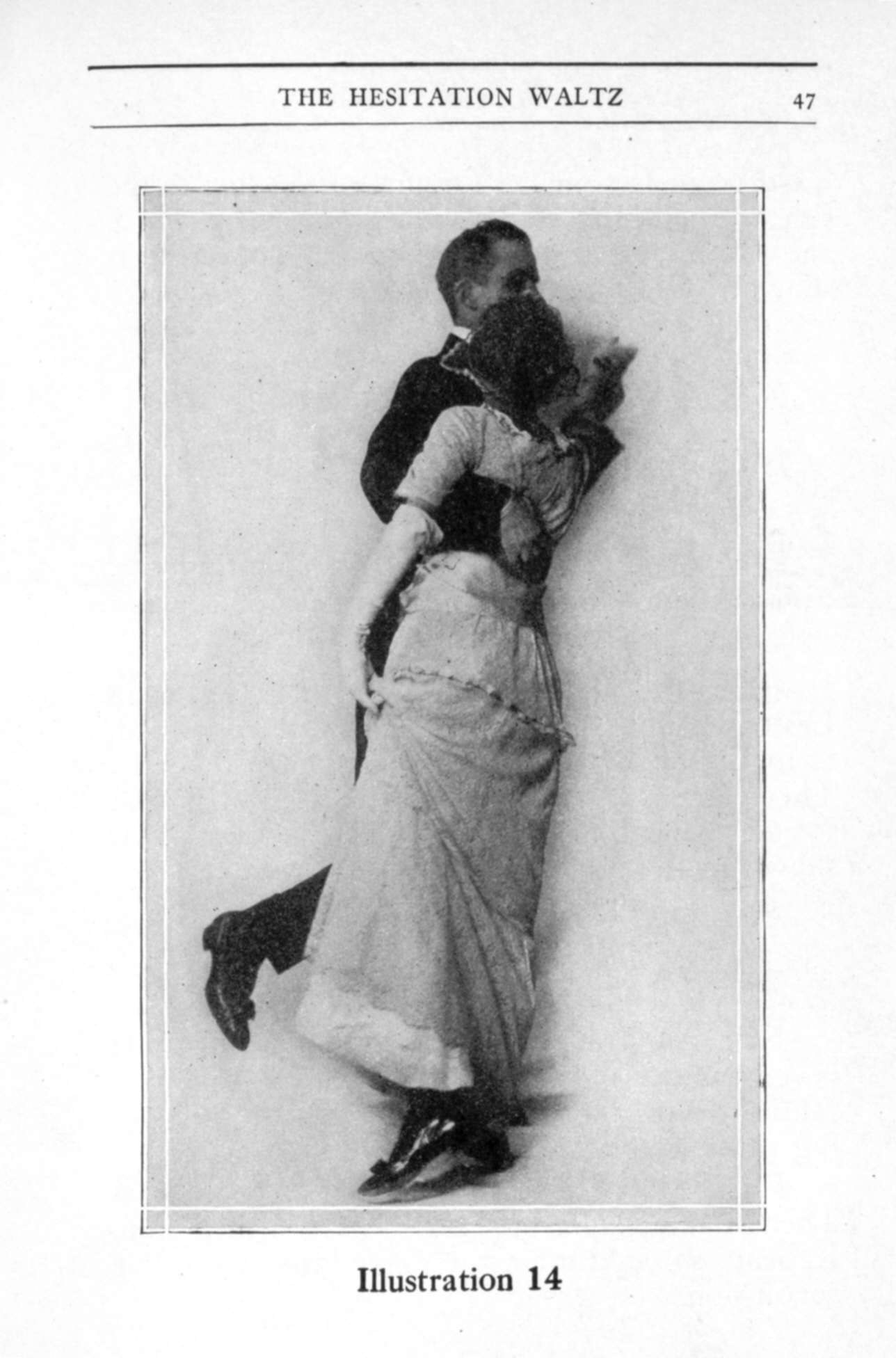
The Modern Dances - How to Dance Them (1914) - Illustration 14 HQ - Hesitation Waltz
Archibald Studio, Chicago, published by Saul Brothers, Chicago
- Source:
- Wikimedia Commons
- Rights:
- Public domain — free to use, share and adapt.
- Recorded as:
- public_domain
The Hesitation Waltz is often overlooked in favor of its descendants (the Foxtrot, the Quickstep), but it was a major transitional form that taught dancers how to add pause and weight to the three-beat waltz frame. This photograph preserves a specific teaching moment and shows how professionals of 1914 understood and demonstrated the dance to the public. It is evidence of how dance knowledge was disseminated in the machine age: via mass-produced photographs in instruction manuals.
What you are looking at
A couple dances in a vertical composition against a plain background, photographed from above at an angle that elongates their forms. The man, bearded and wearing a dark jacket over a light waistcoat, stands behind and supports a woman in a pale floor-length skirt and fitted bodice with puffed sleeves. His left arm is raised; her right arm extends upward. Their posture suggests a moment of suspension or hesitation in the dance—the woman's body leans back slightly, weight distributed between her feet, while the man's frame provides the ballast. The photograph is cropped tightly around the dancers, emphasizing their interlocked forms and the geometry of their limbs. The lighting is soft and even, characteristic of studio photography of the 1910s.
The dancing
The couple holds in a modified closed position: the man stands upright with his torso braced, his raised left arm supporting his partner's back and elevated right arm. The woman's frame is open and slightly rotated, her body tilted in a reclining line away from vertical. Both dancers face the same direction. The woman's feet remain in contact with the floor, the man's weight centered. The composition emphasizes the woman's passive recline and the man's active support, a characteristic frame for early 1910s social dance photography.
The dance depicted
This illustrates the Hesitation Waltz, a ballroom dance of the 1910s that simplified the three-beat waltz by substituting walks or pauses (hesitations) for conventional rotations. The dance was popular in America during the Gilded Age, particularly around 1912–1914, and appeared in both ballroom competitions and social settings. The moment captured here—the woman's lean-back position and the couple's shared axis—is typical of the Hesitation Waltz's characteristic slow, deliberate timing. The dance valued control and balance over speed, and this photograph documents that aesthetic precisely.
How it was made
This is a black-and-white studio photograph, most likely a gelatin silver print or lithographic halftone reproduction. It appears as an illustration in a printed book (*The Modern Dances—How to Dance Them*, 1914), suggesting it was either photographed for the publication or reproduced from an original photograph via halftone printing. The sharp focus and studio lighting are consistent with professional dance photography of the era. The vertical framing and overhead angle are deliberate choices that make the dancers' bodies legible to the reader consulting the text.
About this work
This is one of fourteen instructional dance photographs from a 1914 Chicago-published guide to modern ballroom dances. It documents the Hesitation Waltz at a moment of suspended motion—the woman leaning into her partner's support, both bodies aligned on a single axis. The photograph is a primary source for understanding how early 1910s ballroom dancers were taught to hold and move; it captures not just the position but the aesthetic ideal of restraint and balance that defined the Hesitation Waltz. The book itself, published by Saul Brothers and credited to the Archibald Studio, represents the explosive popular appetite for dance instruction as social dancing shifted from Victorian formality toward the faster, more improvised rhythms of modern ballroom.
How to look at it
Look first at the woman's body: her recline is the defining feature of this dance frame. Notice that she is not passively draped but actively controlling her weight and balance, anchored by her extended arm and the man's support. The photographer has chosen a moment of stillness—the 'hesitation'—to illustrate the hold, making the frame itself legible. The slight tilt of the composition adds to the sense of dynamic suspension. A reader consulting this in 1914 would have been learning not just where the body goes but how it feels: weighted, supported, and deliberately slow.
The artist
The Archibald Studio, based in Chicago, was a commercial photography business specializing in portraiture and instructional work. The studio's involvement in this dance manual suggests a broader professional market for instructional photography; other dance manuals of the 1910s similarly relied on professional photographers to demonstrate steps and positions. Nothing further is recorded about the studio's other work or principals.
The period
The Hesitation Waltz emerged around 1908–1912 as American and European ballroom dancers sought to modernize the Victorian waltz without abandoning its closed-position frame. The dance appealed to dancers who found the Foxtrot too athletic and the waltz too restrictive. By 1914, when this book was published, the Hesitation Waltz was already declining in favor of faster ballroom forms, but instruction books ensured its preservation and circulation. The 1914 publication date places this in the final moment of Edwardian social dance before World War I reshaped cultural and ballroom practices. The book itself reflects the expanding middle-class appetite for dance instruction and the rise of mass-market dance pedagogy.
Where it lives
This illustration comes from *The Modern Dances—How to Dance Them*, published in 1914 by Saul Brothers of Chicago and credited to the Archibald Studio. The source is Wikimedia Commons. It is one of a series of numbered instructional photographs in the book; this is labeled 'Illustration 14' and is paired with text explaining the Hesitation Waltz.
Dance in this work
Questions about this work
What is the Hesitation Waltz?
The Hesitation Waltz was a modified waltz popular from around 1908 to 1916. It simplified the three-beat waltz by replacing continuous rotations with walks and deliberate pauses, giving dancers more control and a slower, more stately tempo. It was an intermediate form between the Victorian waltz and the modern Foxtrot.
Why is the woman leaning back?
The backward lean is the characteristic frame of the Hesitation Waltz. It is not a fall but a controlled recline in which the woman maintains her balance and distributes her weight deliberately. This position was taught as an expression of the dance's aesthetic: elegant, restrained, and rhythmically deliberate.
Was this a professional dance or a social dance?
The Hesitation Waltz was primarily a social ballroom dance, performed at dances and social events by amateur couples. However, professionals and professional studios taught it, and competition dancers also performed it. This photograph is from an instructional manual, so it represents the dance as it was taught in studios.
Why publish a whole book of dance photographs?
In the 1910s, books with step-by-step photographs were the primary medium for learning ballroom dances outside of private lessons. A middle-class reader could buy this book and study the photographs alongside written descriptions to learn new dances at home. Saul Brothers and the Archibald Studio were capitalizing on a booming popular market for dance instruction.
More dance artwork





