49 works in this view — arrow keys or swipe to move between them.
Dance in Art
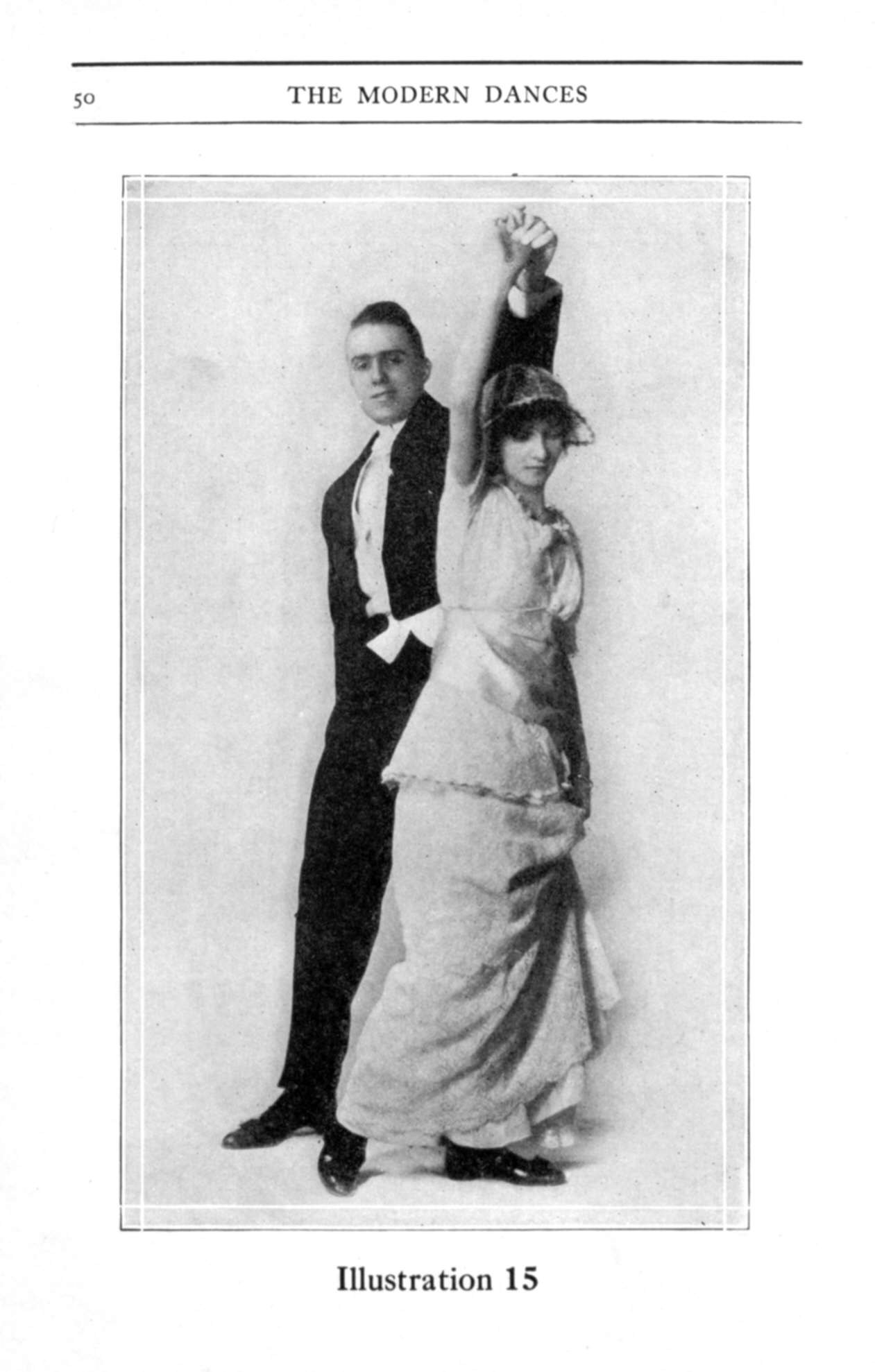
The Modern Dances - How to Dance Them (1914) - Illustration 15 HQ - Hesitation Waltz
Archibald Studio, Chicago, published by Saul Brothers, Chicago
- Source:
- Wikimedia Commons
- Rights:
- Public domain — free to use, share and adapt.
- Recorded as:
- public_domain
The Hesitation Waltz was the dominant competitive and social ballroom dance in America during the 1910s–1920s, yet it has been almost entirely eclipsed by the later standardized International Ballroom styles and is rarely danced or taught now. This photograph preserves the exact posture, hold, and frame of the period, allowing modern dancers and historians to see how the dance was actually executed. Instructional manuals like this one document the moment when dance instruction moved from private lessons and demonstration into mass-produced, illustrated form—a democratization of access that shaped modern ballroom dance culture.
What you are looking at
A couple in formal evening dress stands posed against a plain light background, demonstrating the Hesitation Waltz. The man, positioned behind and slightly to the left, wears a black tailcoat with white shirt front and black bow tie. The woman faces forward in a pale, possibly ivory or champagne-colored gown with lace or textured detailing at the bodice and a draped skirt that reaches the floor. Her hat—a close-fitting cloche or similar style typical of the 1910s—sits low on her forehead. The man's right arm is raised, his hand holding the woman's raised left hand high, while his left arm wraps around her waist from behind. The woman's right arm extends backward to rest on his shoulder. Their bodies are positioned at a slight angle to each other, the woman's weight forward, creating the characteristic tension and lean of the waltz position. The composition is frontal and symmetrical, with both dancers looking toward the camera rather than at each other—a documentary pose typical of instructional dance photography.
The dancing
The couple maintains a closed ballroom hold modified for the waltz: the man's right hand high and forward, the woman's left hand meeting it at approximately shoulder height, his left arm encircling her waist, her right arm over his shoulder. Their bodies show the slight sway and counter-balance essential to waltz technique—neither stands rigidly upright, but both demonstrate controlled posture from the core. The raised joined hands and the woman's backward lean suggest the moment in the waltz when the man leads an underarm turn or hesitation figure. The frame is open enough to show the full length of the woman's gown and the dancers' feet, though the exact foot position is not sharp enough to read clearly.
The dance depicted
This is the Hesitation Waltz, a social ballroom variant of the Viennese Waltz that was extremely fashionable in American and European ballrooms in the 1910s and 1920s. The hesitation—a delayed or interrupted step, typically a hold or suspended weight-change—gave the dance its name and distinguished it from the continuous rotating motion of classical waltz. The photograph is taken from an instructional manual, one of many published during this period to teach ballroom technique to the rapidly expanding middle-class dance audience. The pose demonstrates the correct hold and frame for the opening or a typical figure, with the woman's raised arm and leaned position suggesting the leader is about to execute a turn or hesitation step. No footwork is visible sharply enough to confirm the specific step being shown.
How it was made
This is a photographic reproduction, likely a gelatin silver print or similar photomechanical process, halftone-screened for print publication in a bound book. The quality is consistent with early 20th-century instructional dance photography—deliberately posed, well-lit, and composed for clarity rather than artistic effect. The use of a plain backdrop and frontal framing is typical of instructional manuals, where the goal was to show hold and position with maximum legibility rather than to capture movement or atmosphere. The photograph would have been made specifically for the Archibald Studio publication, with living models posing the figure.
About this work
This is one illustration from *The Modern Dances: How to Dance Them*, a 1914 Chicago instructional manual on ballroom and social dances published by Saul Brothers. The work documents the Hesitation Waltz, one of the most popular ballroom dances in early 20th-century America, at the moment when it was displacing the older Viennese Waltz and when commercial dance instruction was becoming a major industry. The photograph is a teaching document—it shows the correct closed-position hold, frame, and body alignment for dancers learning from a printed page. As evidence of what constituted proper ballroom technique in 1914, and as a snapshot of the social dance world on the cusp of transformation by jazz and ragtime, it is a primary historical source.
How to look at it
Look first at the hold and frame—the position of the hands and arms, the distance between the partners, and the angle of the bodies to each other. This is what the photograph was designed to teach. Notice the woman's backward lean and the man's forward position; this counter-balance is fundamental to waltz technique and is often the first thing beginners learn to feel. The raised joined hands position and the woman's arm over his shoulder show one of the characteristic positions of the Hesitation Waltz, likely the moment before or during a hesitation or turn figure. The formal dress and upright carriage reflect the ballroom context in which this dance was performed—this was respectable, middle-class social dancing, not cabaret or theatrical performance.
The artist
The Archibald Studio was a commercial photography studio based in Chicago operating in the early 20th century. It produced instructional and promotional photographs for publishers and small businesses. The studio's work on dance manuals reflects the growing market for illustrated instructional books on social dance, a boom driven by the craze for modern ballroom styles and the entrepreneurial energy of the dance instruction trade. The studio's approach was documentary and functional—clarity and legibility were paramount.
The period
The 1910s were a period of explosive change in American social dancing. The Hesitation Waltz and other 'modern' ballroom dances (the Foxtrot, Tango, and One-Step) had only recently arrived from Europe and were causing considerable moral panic among older generations while captivating the young. Dance instruction was booming: professional teachers advertised widely, and how-to manuals flooded the market—some dignified, some sensational. The Archibald Studio's 1914 manual sits in this landscape as a straightforward, respectable guide for middle-class dancers. Photographically, the use of posed models and plain backgrounds reflects the conventions of instructional photography of the era, before action photography became technically feasible for print.
Where it lives
This illustration comes from *The Modern Dances: How to Dance Them*, published in 1914 by Saul Brothers of Chicago and credited to the Archibald Studio. The book appears to have been widely distributed and is held in multiple archives. This particular image was sourced from Wikimedia Commons, which hosts a high-quality scan of the full printed book.
Dance in this work
Questions about this work
What is the Hesitation Waltz?
The Hesitation Waltz was a ballroom dance developed in the early 1910s that combined elements of the Viennese Waltz with a characteristic hesitation—a hold or delayed step—that interrupted the continuous rotation of classical waltz. It was extremely popular in American and European ballrooms until the 1920s, when it began to be standardized into the modern Waltz. The dance required a strong partnership and good connection, as the leader had to signal the hesitation clearly through the frame.
How do I know this is the Hesitation Waltz and not another waltz?
The image is labeled 'Illustration 15' and the catalogue identifies it as depicting the Hesitation Waltz. We cannot deduce the specific waltz variant from the photograph alone—the closed position and raised joined hands are common to all waltzes of the period. The raised-hand frame and leaned position are consistent with the Hesitation Waltz as shown in other period manuals, but footwork, which would be diagnostic, is not visible clearly enough in the photograph.
Why is this photograph dressed in such formal clothes if it's just a lesson?
The Hesitation Waltz was danced in ballrooms and at formal social events, so the photograph shows the dress context in which dancers would actually perform the figure. Instructional manuals of the 1910s often emphasized that correct posture and frame had to work equally well in street clothes or evening dress, and showing the dance in its actual social context made the instruction more relevant to readers.
Who were the models?
The catalogue record does not name the models, and they are not identified in the book. They were professional dance instructors or models hired by the Archibald Studio for the purpose of demonstrating figures in the manual. Names of such models are rarely recorded in instructional publications of this period.
More dance artwork





