49 works in this view — arrow keys or swipe to move between them.
Dance in Art
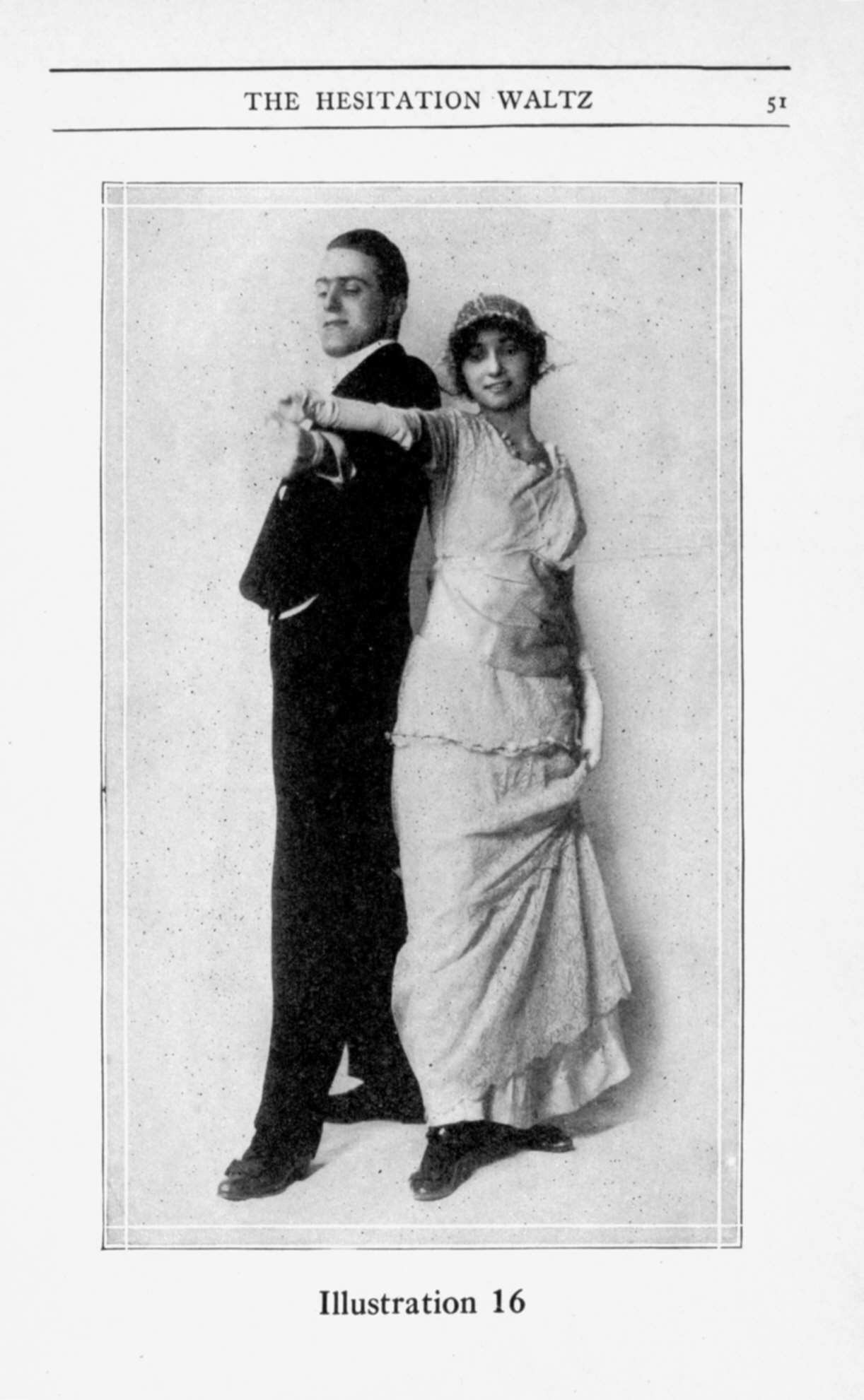
The Modern Dances - How to Dance Them (1914) - Illustration 16 HQ - Hesitation Waltz
Archibald Studio, Chicago, published by Saul Brothers, Chicago
- Source:
- Wikimedia Commons
- Rights:
- Public domain — free to use, share and adapt.
- Recorded as:
- public_domain
The Hesitation Waltz was a transitional dance that marked the ballroom's adaptation to modern rhythms and the rise of American dance instruction as a commercial industry. This image is one of the few surviving visual records of how this dance was actually taught and understood in its own moment, captured not by a dance historian looking backward but by an instructor and photographer codifying current practice for their contemporaries.
What you are looking at
A man and woman pose in ballroom position against a plain white background, likely a studio setting. The man wears formal evening attire: a dark, single-breasted jacket with a visible white shirt front and what appears to be white tie or shirt front studs. The woman wears a pale, high-waisted dress with distinctive horizontal pleating or ruching across the bodice and skirt, and a dropped waistline typical of 1910s fashion. The man stands slightly behind and to the side of the woman, his left arm extended outward at shoulder height with a gentle bend, his right arm positioned at her waist. The woman faces forward, her posture upright, with one arm extended to meet his and the other likely at his shoulder. Their bodies are angled in classic ballroom frame, their feet positioned to suggest the characteristic gait of the waltz—the man's weight appears forward, the woman's held centrally. The photograph is sharp and well-lit, typical of studio dance instruction photography of the early 20th century.
The dancing
The couple occupies a closed ballroom position with the man slightly taller and positioned as the lead. His left arm is extended at shoulder height with a gentle lateral opening, while his right hand contacts her waist. The woman's frame is upright and receptive, her left arm extended to his right hand, her right arm curved toward his shoulder. Both dancers face the camera with formal, composed expressions suggesting they are demonstrating rather than performing with abandon. Their posture conveys the restrained, elegant carriage expected of ballroom dancers: controlled, symmetrical, and centered in the body.
The dance depicted
This is the Hesitation Waltz, a slow waltz variant that was fashionable in American and European ballrooms during the 1910s–1920s. The dance is characterized by its controlled, stately rhythm with periodic hesitation steps that create dramatic pauses in the otherwise continuous waltz flow. The illustration comes from an instructional manual ('The Modern Dances—How to Dance Them'), meaning it was created to teach amateur dancers the prescribed frame, position, and posture of the dance rather than to document improvisation or performance. The Hesitation Waltz was marketed as a 'modern' dance precisely because it broke from the relentless three-beat momentum of classical Viennese waltz, introducing syncopation and held notes that aligned it with the rhythmic innovations of jazz-age ballroom.
How it was made
This is a photographic print, most likely a gelatin silver print from an original studio photograph. The image appears to have been reproduced for mass publication in the instruction book, a common practice for dance instruction manuals in the early 20th century. The photographic medium allowed for precise documentation of ballroom position and frame, making it ideal for instructional purposes where readers needed to study exact arm angles, body alignment, and relative positioning of partners. The clear, frontal composition and neutral background maximize visibility of the dancers' line, a convention of dance photography instruction that persists today.
About this work
This is one of a series of photographic illustrations from 'The Modern Dances—How to Dance Them,' a 1914 instructional manual published by Saul Brothers in Chicago. It documents the Hesitation Waltz in its peak moment of fashionability, when social dancing was rapidly modernizing and American publishers competed to capture and codify the latest steps for the middle-class ballroom public. The photograph operates as both a visual record of early 20th-century ballroom fashion and posture, and as a pedagogical tool—a frozen, repeatable image meant to be studied and imitated by dancers learning from a book. The work sits at the intersection of dance history, popular instruction, photography, and fashion, and represents a moment when American dance instruction moved definitively toward photographic illustration and away from written description alone.
How to look at it
Notice the precision of the ballroom frame: the man's left arm held open and lateral, the woman's weight centered rather than leaning into him, the space preserved between their bodies. This posture is central to understanding the Hesitation Waltz—it is not a close, romantic hold but a formally controlled partnership. The horizontal pleating of the woman's dress is not decorative: it allows visibility of the leg line and skirt flow that define the visual line of the waltz. The dancers' still faces and formal presentation signal that this is an instructional pose, not an action photograph; the reader should study the geometric relationships between the bodies rather than look for captured momentum.
The artist
The photograph was credited to the Archibald Studio in Chicago, one of several commercial photography studios that specialized in dance and theatrical portraiture in the early 20th century. These studios worked closely with dance teachers and publishers to produce instructional and promotional images. The Archibald Studio's work for Saul Brothers suggests a established relationship serving the midwestern American dance instruction market.
The period
In 1914, American ballroom dancing was undergoing rapid transformation. The Waltz had dominated 19th-century dance floors, but the 1910s brought new rhythms—ragtime, jazz, the One Step, the Foxtrot—that destabilized classical ballroom technique. The 'Modern Dances' instruction manual was a response to this moment of change: it sought to legitimize and systematize new social dances for an anxious middle-class audience eager to stay current without losing respectability. The Hesitation Waltz occupied a middle ground—modern enough (it had syncopation, hesitation, novelty) but respectable (it retained the frame, the partner connection, and the formal dress code of traditional waltzing). Photographically, 1914 was early enough that dance instruction still relied heavily on still images rather than film, making posed studio photographs the primary visual teaching technology.
Where it lives
This photograph is held in the Wikimedia Commons, which identifies it as a page illustration from 'The Modern Dances—How to Dance Them' (1914), published by Saul Brothers in Chicago. It is one of a numbered series of instructional illustrations in that volume; the image bears the credit 'Illustration 16 HQ—Hesitation Waltz' and 'Archibald Studio, Chicago.'
Dance in this work
Questions about this work
What is the Hesitation Waltz?
The Hesitation Waltz was a fashionable American social dance of the 1910s–1920s, a variant of the classical Waltz that introduced deliberate pauses or 'hesitations' in the dance phrase. Rather than the continuous three-beat flow of Viennese waltz, the Hesitation Waltz broke the rhythm with held notes, creating a more syncopated, jazzy effect. It was considered 'modern' because it incorporated elements of ragtime and jazz rhythms while retaining the formal ballroom frame and partner connection.
How do I know this is from an instructional manual?
The neutral, frontal composition; the plain white background; the formal, composed poses; and the deliberate, readable frame all signal an instructional photograph rather than a performance or social snapshot. The dancers are 'showing' the position rather than dancing through it. The image is designed to be studied, copied, and repeated—it is a visual recipe, not a captured moment.
What can we learn about 1910s fashion and posture from this image?
The woman's dress shows the high waistline and horizontal pleating typical of 1910s women's fashion; the horizontal lines may also have been chosen to make the leg action of the waltz more visible to students. Both dancers exhibit the upright, pulled-up posture expected in formal ballroom dancing, with no forward lean or hip drop. The man's dark jacket and white shirt front follow formal evening dress codes, indicating that ballroom dancing remained a context for respectable, class-marked dress even as the dances themselves were modernizing.
Who would have used this manual, and how?
The manual was aimed at middle-class amateur dancers—people who wanted to stay current with fashionable social dances but needed instruction. They would have studied these photographs at home or with a teacher, using them as visual guides to posture, frame, and relative positioning. This was the primary way social dances were learned and transmitted before instructional film and video.
More dance artwork





