49 works in this view — arrow keys or swipe to move between them.
Dance in Art
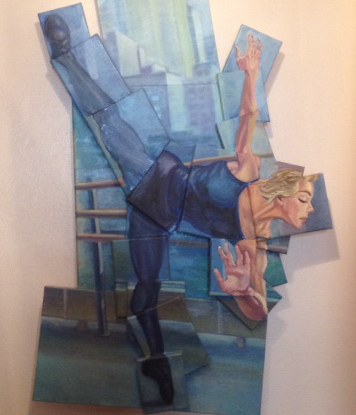
Kat Wildish Ballet Painting by Scott Rose
Kat Wildish
- Source:
- Wikimedia Commons
- Rights:
- Reusable with conditions: credit the creator; share any adaptation under the same license. Source record ↗
- Recorded as:
- cc by-sa 4.0
The work demonstrates how contemporary visual artists engage with ballet as a subject: not through romantic idealization but through formal and conceptual intervention. By fragmenting the composition and introducing architectural abstraction, the artist treats ballet as a discipline of structured, geometric bodily practice rather than as ethereal or otherworldly. This approach is relevant to how ballet is represented in 21st-century art practice.
What you are looking at
A collage-style portrait of a dancer in contemporary ballet attire, composed of overlapping rectangular fragments that create a fractured, multi-perspective representation. The figure is shown in a dramatic arabesque or extended leg pose, wearing dark (possibly black or navy) performance clothing. The background fragments contain architectural and urban imagery—geometric building forms, window grids, and what appears to be city infrastructure—rendered in cool blues, greens, and grays. The composition assembles these pieces at irregular angles, some overlapping, others separated, creating a sense of movement and spatial complexity that echoes the dancer's own dynamic pose. The lighting is soft and diffused, with the photographic or painted elements of the figure contrasting against the architectural abstraction surrounding it.
The dancing
A single dancer occupies the composition, captured mid-extension in what appears to be an arabesque or attitude derrière, with one leg raised high and extended behind the body. The raised leg is fully straightened and appears to reach toward or above the height of the head, a classical ballet line. The upper body is angled and the supporting leg bears the dancer's weight. The pose demonstrates training in turnout and articulation of the extended limb. The formal, controlled extension suggests a classical technique rather than contemporary or pedestrian movement.
The dance depicted
This is a portrait of ballet, specifically a moment of classical ballet technique. The arabesque is one of the foundational positions of classical ballet vocabulary and typically appears in adagio passages or sustained poses in repertory. The artist has chosen to freeze a moment that displays extension, line, and the characteristic elongation of the classical aesthetic. Without additional context on the dancer or specific work, the image documents ballet as a disciplined physical practice emphasizing vertical alignment and spatial extension.
How it was made
This appears to be a mixed-media or collage work combining photography or photorealistic painting of the dancer with painted or printed architectural fragments. The rectangular pieces are arranged to create visual and compositional tension—some overlap the figure, others recede behind it, creating depth through layering rather than perspective. The technique suggests either a hand-assembled collage (cut paper or canvas sections) or a digitally composed image that mimics collage's fragmentation. This approach modernizes the portrait by treating the dancer's body as one element among architectural and urban forms rather than as the sole subject, implying connections between bodily discipline and built environment.
About this work
This is a portrait of a ballet dancer in an arabesque pose, created as a fragmented collage that surrounds the figure with architectural and urban imagery. The work dates to 2016 and is attributed to Scott Rose. The composition uses collage techniques—overlapping rectangular forms with distinct color temperatures—to complicate the simple subject of a ballet portrait. Rather than presenting the dancer as isolated or idealized, the work embeds the figure within a context of geometric architectural forms, suggesting themes about the dancer's relationship to space, structure, and the built environment. The fractured composition echoes the motion and spatial complexity of the pose itself.
How to look at it
Attend first to the dancer's body and the classical line being demonstrated—the extended leg, the supported frame, the moment of suspension. Then follow how the architectural fragments interrupt and frame this figure: note which pieces overlap the body, which recede, and how the color temperature shifts between the cool-toned urban fragments and the warmer, more naturalistic tones of the figure itself. The tension between these two visual languages—classical ballet discipline and contemporary urban fragmentation—is the work's primary subject. The arabesque position itself suggests a moment of sustained extension, a pause in motion rather than its peak or its landing.
The artist
Scott Rose is a painter and mixed-media artist working in contemporary portraiture and collage. Little is publicly documented about Rose's broader practice or training from this image alone, but the work's technical sophistication and conceptual approach suggest familiarity with both classical ballet vocabulary and contemporary art strategies of fragmentation and layering. The inclusion of a specific dancer's name (Kat Wildish) in the title indicates this is a commissioned or collaborative portrait rather than a generic study.
The period
In the 2010s, ballet was experiencing renewed interest from contemporary visual and performance artists. This period saw increased dialogue between classical ballet institutions and contemporary art contexts. Simultaneously, collage and fragmentation became standard strategies in digital-age portraiture and image-making, reflecting how digital tools enable rapid layering and recomposition. The architectural language in the background connects to broader discourses about embodiment, space, and the city that occupied artistic practice in this era.
Where it lives
The work is documented on Wikimedia Commons. No collection or holding location is recorded in the catalogue. The source attribution indicates the image is held or circulated in a digital commons context rather than in a single institutional collection.
Dance in this work
Questions about this work
What dance move is the dancer doing?
An arabesque—one of classical ballet's fundamental extended positions, where the dancer stands on one leg with the other leg raised and fully straightened behind the body to approximately hip or head height. It is a pose used in classical ballet to demonstrate line, extension, and control.
Why is the portrait fragmented into pieces?
The collage technique creates visual complexity and suggests connections between the dancer's disciplined body and the geometric, architectural environment. Rather than presenting the dancer as an isolated figure, the overlapping urban forms imply that ballet training and performance are embedded within—or in dialogue with—structured, built space.
Is this a painting, a photograph, or something else?
It appears to be a mixed-media work combining photorealistic representation of the dancer with painted or collaged architectural elements. The exact technique cannot be determined from the image alone, but the layering of distinct visual languages—the naturalistic figure and the geometric urban forms—is intentional.
More dance artwork





