49 works in this view — arrow keys or swipe to move between them.
Dance in Art
A Ballet Theme
Aristarkh Lentulov
- Source:
- Wikimedia Commons
- Rights:
- Public domain — free to use, share and adapt.
- Recorded as:
- public_domain
The painting documents a crucial moment when visual modernism and dance were in active dialogue, particularly within the Russian avant-garde and the Diaghilev orbit. It demonstrates how early twentieth-century artists responded to ballet not as a subject for literal representation, but as an occasion for formal experimentation and the visual translation of movement, speed, and theatrical spectacle into Cubist language. For dance scholars, the work is a primary document of how dance was perceived and valued by the artistic avant-garde.
What you are looking at
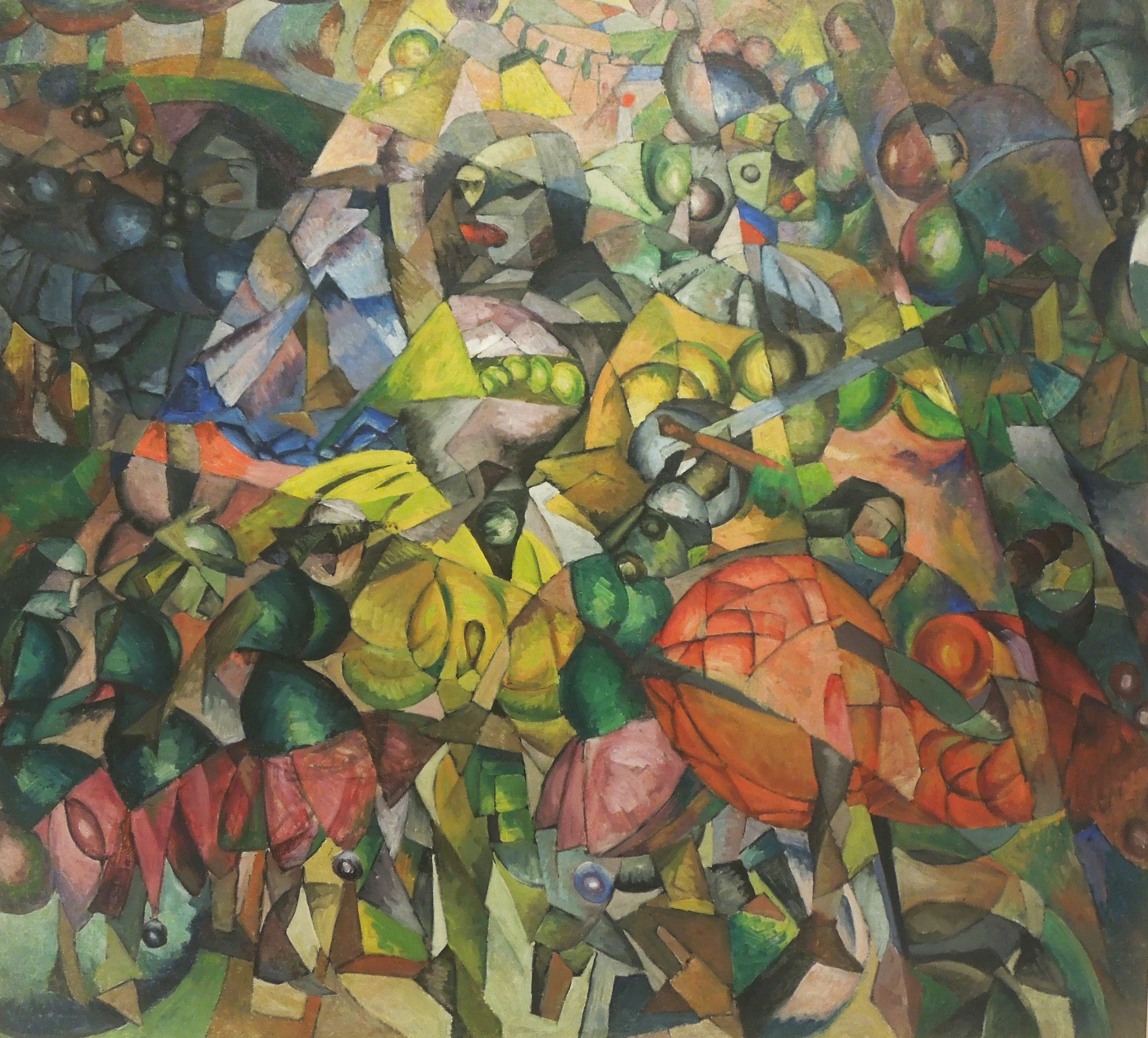
A densely crowded theatrical scene rendered in Cubist style, with multiple figures in dynamic poses arranged across the canvas in a tumultuous composition. The painting is dominated by fragmented, angular forms painted in yellows, greens, reds, and flesh tones, with bold black outlines dividing the picture plane. At least a dozen human figures are visible, some clearly in mid-motion with raised arms and turned torsos. Several wear what appear to be skirts or drapery rendered in warm reds and oranges. The setting is compressed and airless, with no clear ground plane or spatial recession; instead, overlapping geometric planes suggest multiple viewpoints and moments compressed into a single image. The energy is frenetic—bodies interpenetrate and tilt at unnatural angles, as if the moment of the dance has been fractured into simultaneous glimpses of different poses.
The dancing
The bodies are rendered as interlocking planes of color and line, making traditional anatomical reading difficult, yet limbs are clearly active—arms are raised, extended, and gestural; several figures appear to be in turning or spiraling positions. Some forms suggest dancers in profile, others frontal; the variety of viewpoints creates an impression of continuous motion rather than a single frozen moment. Multiple skirts billow in reds and oranges, suggesting rapid movement or the painter's interest in the costume as a dynamic formal element. The density of overlapping forms makes it impossible to count discrete dancers with certainty, but the composition conveys group choreography or an ensemble scene rather than solo performance.
The dance depicted
The title *A Ballet Theme* and the theatrical density of the composition suggest Russian Imperial or early Soviet ballet, most likely from the Diaghilev circle's Ballets Russes context in which avant-garde visual artists were engaged with dance. The Cubist language does not depict any specific ballet, but rather abstracts the essential energy and compositional chaos of the stage during a climactic ensemble moment. The skirts and the theatrical scale point to classical ballet vocabulary, but the painting's fragmentation defies any literal reading of steps or positions. This is a painter's response to the *idea* of ballet—its spectacle, speed, and the multiple bodies in concert—rather than a documentary record of choreography.
How it was made
Oil paint on canvas. The work employs Analytic Cubist fragmentation and Synthetic Cubist color, breaking the stage scene into overlapping geometric planes outlined in bold black. The opacity of oil and the bold linear armature allow for both transparent layering and clear structural definition, creating visual intensity even within the crowded composition. This technique was well suited to capturing the experience of rapid theatrical action and the painter's fragmented, synesthetic response to live performance—a common preoccupation of European modernism in the early 1910s.
About this work
Aristarkh Lentulov's *A Ballet Theme* is an early modernist response to the spectacle of Russian ballet, rendering a theatrical ensemble moment through Cubist abstraction rather than literal representation. Painted in 1912, it captures the visual excitement of early twentieth-century dance without depicting a specific narrative, instead distilling the essential impression of bodies in rapid, coordinated motion across a stage. The work exemplifies the intersection of avant-garde visual art and dance that defined the Ballets Russes era, a period when painters, choreographers, and composers collaborated to create radical theatrical experiences. For dance historians, the work documents not what the ballet *looked like* in literal terms, but how modernist painters *experienced* and conceptualized the dynamism and formal complexity of the art form.
How to look at it
The painting rewards slow attention to the layering of planes and the subtle emergence of forms from the color field. Begin by following the black outlines, which articulate distinct figures and limbs even as the Cubist vocabulary makes them formally ambiguous. Look for the recurring motifs of raised arms and tilted torsos that suggest balletic extension and turning. The warmest colors—reds and oranges—often mark the skirts or drapery, which the painter has emphasized as dynamic sculptural elements. Rather than seeking a coherent narrative moment, attend to the impression of *simultaneity* that Cubism creates: the painting does not show you a single instant, but rather layers multiple temporal moments and viewpoints to suggest the continuous, multidirectional energy of an ensemble on stage.
The artist
Aristarkh Lentulov (1882–1943) was a Russian painter and set designer who trained in Moscow and Paris, absorbing both Russian icon painting and European modernism. He was closely associated with the Russian avant-garde and worked as a designer for theatrical productions, including works connected to the Ballets Russes sphere. His painting practice combined Cubist and Futurist influences with Russian Constructivism, and his interest in ballet was part of a broader engagement with theatrical spectacle as a site of modernist innovation. He worked extensively as a stage designer, which informed his compositional approach to crowded, kinetic scenes.
The period
The painting dates to 1912, the height of the Ballets Russes' early influence in European modernism. Diaghilev's company had arrived in Paris in 1909, and by 1912 the collaboration between avant-garde painters, composers, and choreographers had become a defining force in early twentieth-century culture. Painters including Picasso, Matisse, and the Russian avant-garde were designing sets and costumes or creating independent works inspired by dance. Simultaneously, Cubism was at its Analytic phase (1908–1912), fragmenting form and perspective to capture multiple viewpoints and simultaneous moments. The painting sits at the intersection of these currents: a modernist painter's formal investigation of how to visually represent the kinetic energy of ballet using the vocabulary of Cubist abstraction.
Where it lives
The work is documented on Wikimedia Commons. No holding collection or accession information is currently recorded.
Dance in this work
Questions about this work
What ballet is depicted here?
None in particular. The title *A Ballet Theme* indicates that Lentulov is abstracting the general experience and formal properties of ballet—speed, spectacle, ensemble choreography—rather than illustrating a specific work. The painting is a modernist painter's interpretation of the *idea* of ballet, not a document of a particular performance or narrative.
Why is the painting so fragmented and hard to read?
Lentulov is using Cubist formal language to convey the rapid, multidirectional energy of dancers in motion and the painter's experience of watching theatrical action unfold from a fixed perspective. Cubism's simultaneous viewpoints and overlapping planes allow him to suggest movement and the compression of many bodies on stage in a single, dizzying moment.
Is this a document of how ballet actually looked?
Not in a literal sense. It is a modernist interpretation of the *experience* and *formal impression* of ballet—how the painter perceived its speed, spectacle, and compositional complexity. For that reason, it is more valuable to historians as evidence of how the avant-garde understood and valued dance than as a record of actual choreography.
Who was Lentulov and why did he paint ballet?
Aristarkh Lentulov was a Russian painter and stage designer closely associated with the Russian avant-garde and the Ballets Russes sphere. His work as a theater designer directly informed his interest in painting theatrical scenes. For modernist painters of his generation, ballet was not merely entertainment but a site of formal experimentation and a collaboration between multiple arts.
More dance artwork





