49 works in this view — arrow keys or swipe to move between them.
Dance in Art
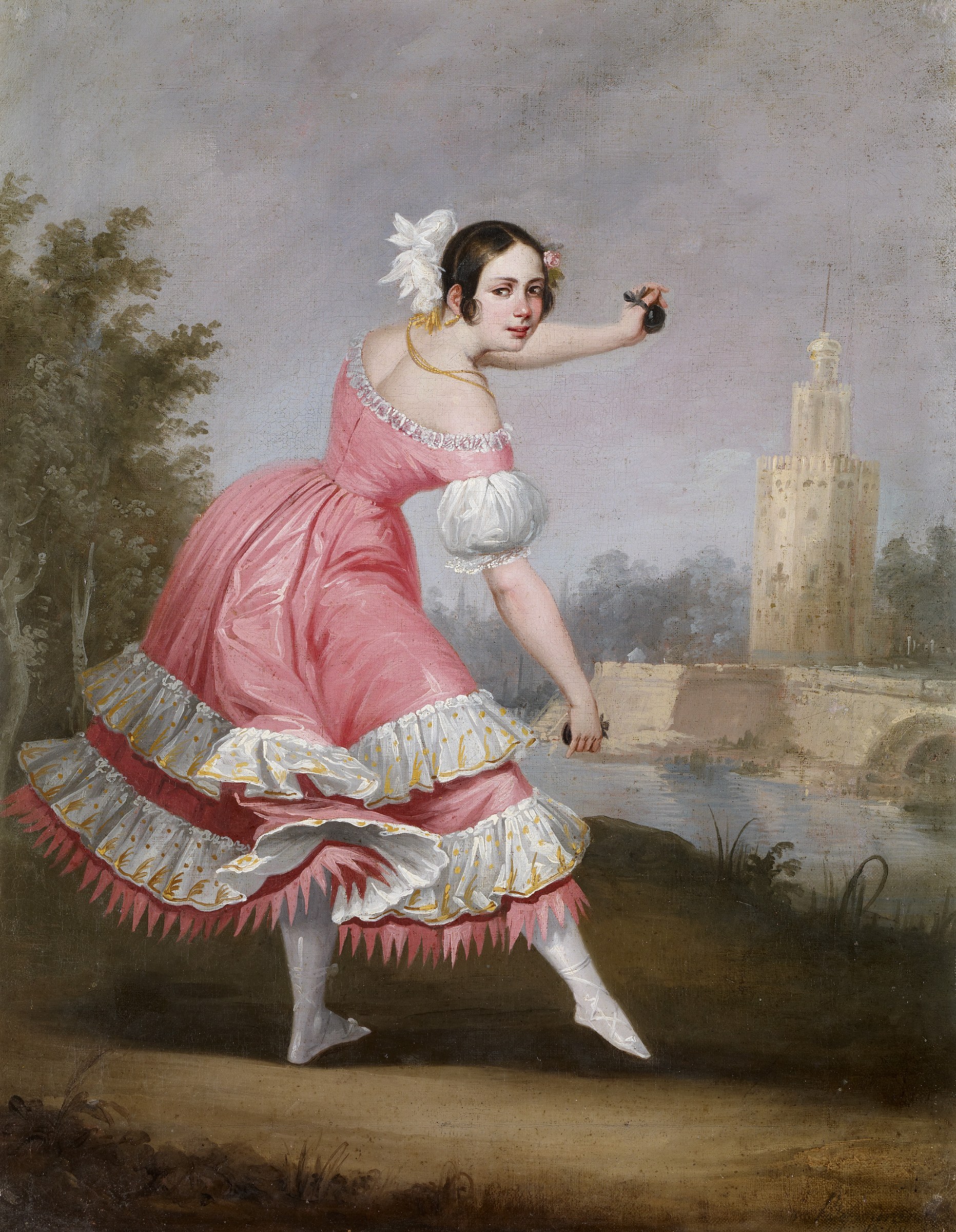
A Bolero dancerlabel QS:Les,"--"label QS:Len,"A Bolero dancer"label QS:Lde,"Eine Bolerotänzerin"
Antonio Cabral Bejarano
- Source:
- Wikimedia Commons
- Rights:
- Public domain — free to use, share and adapt.
- Recorded as:
- public_domain
This painting is valuable documentation of how Spanish dance was performed and presented in 19th-century European contexts—not as folk practice but as a refined stage form. It shows the visual language used to market and legitimize a non-European dance to salon and theatre audiences: through costume, through technical display, and through integration into European romantic landscape painting. For historians of 19th-century dance and the circulation of Spanish and Latin dances in Europe, this work is a direct visual record of performance style, bodily technique, and theatrical presentation.
What you are looking at
A young woman in a vivid rose-pink dress performs a bolero against a Romantic landscape of trees, water, and a distant tower. She is caught mid-movement, her body twisted in an exuberant pose with her left arm extended upward holding a dark object (possibly castanets or a fan), while her right hand rests on the stone parapet before her. Her skirt, trimmed with deep pink scalloped flounces edged in gold, swirls around her; her white puffed sleeves and the white frilled petticoat visible beneath emphasize the lift and energy of the turn. A white ribbon or silk bow adorns her dark hair. The setting is calm and pastoral—green trees frame the left side, still water reflects the distant architecture—creating a marked contrast with the vivacity of the dancer's pose. The painting has the soft, warm palette and romantic mood characteristic of 1840s academic art, with careful attention to the texture of silk, lace, and the play of light on the dancer's skin and costume.
The dancing
A single female dancer occupies the composition, her body in a dynamic contrapposto turn with considerable vertical extension. Her weight appears on her right leg while her left leg rises slightly behind, and her torso twists to follow the upper body's reach. The raised left arm suggests a gesture particular to bolero—either holding castanets or in the graceful port de bras typical of Spanish dance. Her head is turned toward the raised arm, and her gaze follows the movement, creating an integrated line of energy from the grounded supporting leg through the extended arm. The dancer's frame is open and loose rather than in a closed partnership hold, confirming the solo performance of bolero as a display piece.
The dance depicted
This is a bolero dancer, as the title states, and the work documents the bolero as it was performed in European salons and theatres in the mid-19th century. The bolero at this period was a solo or partnership Spanish dance that had become fashionable in ballrooms and on the concert stage across Europe. The painter has captured the characteristic Spanish costuming—the pink dress with scalloped tiered flounces, the white sleeves, the ribbon in the hair—that signaled the dance's national origin to a European audience. The raised arm and dynamic twist of the torso align with the balletic, elevated style that European performers brought to the bolero, distinguishing it from folk practice. The solitary, frontal presentation and the controlled elegance of the pose suggest a theatrical or salon performance rather than social dancing.
How it was made
This appears to be an oil painting on canvas, executed with the smooth finish and colour saturation characteristic of academic salon painting of the 1840s. The artist has rendered the fabric textures with meticulous attention—the sheen of the pink silk, the crisp white linen of the petticoat ruffle, the soft play of light on skin—using techniques of glazing and fine brushwork. The composition is formal and staged rather than documentary, with the landscape backdrop and the careful arrangement of the figure suggesting a studio work intended for exhibition and sale to collectors. The painting's scale and finish indicate it was created for the art market and display, not as a sketch or study.
About this work
This painting documents the bolero as a fashionable European stage dance of the 1840s, capturing both the costume and the movement vocabulary that made it popular in salons and theatres. Bejarano has frozen a moment of dynamic motion—the twist and reach of a turn—and presented the dancer in Spanish dress against a romantic landscape, following conventions of exotic and national-character dances in European art of the period. The work is significant because it shows how the bolero was performed and understood by European audiences: as a theatrical, balletically refined dance, executed by a solo female performer in a display of technical skill and national costume.
How to look at it
The painter has chosen the moment of maximum extension and twist—the peak of the turn—which showcases the dancer's control and elevation. Notice the direction of the gaze and the line from the supporting leg through the raised arm: this integrated verticality is characteristic of the European balletic approach to bolero. The contrast between the composed, romantic landscape and the emphatic gesture of the dancer's body creates tension between picturesque beauty and theatrical display. The meticulous rendering of the costume's movement—the swirl and weight of the skirt, the crisp flounces, the flow of the sleeve—shows how dress was integral to the visual and kinetic impact of the dance.
The artist
Antonio Cabral Bejarano was a Spanish painter active in the 19th century, known for portraits and genre scenes. His inclusion of dance subjects reflects the popularity of Spanish and national-character dances in European salon culture during the 1840s. The precision of the costume and the technical understanding of the figure's movement suggest familiarity with actual stage performance, either through direct observation of theatre or through close study of dancers.
The period
The 1840s saw the height of Romantic ballet in Europe, characterized by emphasis on the female dancer, ethereal movement, and exotic or national settings. Alongside classical ballet, non-European and national dances—particularly Spanish dances like the bolero and cachucha—became fashionable as entertainment and as subjects for visual art. European painters drew on these dances as opportunities to display technical skill in rendering costume, movement, and landscape, while audiences were fascinated by the promise of authenticity and cultural difference. The bolero had been adapted into European ballroom culture and theatre in the late 18th century and remained popular through the mid-19th. This painting participates in the broader cultural economy of exoticism and national character in which Spanish dance held a prominent place.
Where it lives
The work is held in Wikimedia Commons and identified from that source. It is a salon painting, likely created for exhibition and private collection.
Dance in this work
Questions about this work
What is a bolero and how does this painting relate to how it was actually danced?
The bolero is a Spanish dance that became fashionable in European ballrooms and theatres in the late 18th and 19th centuries. This painting shows the theatrical, balletically refined version as performed on European stages—emphasizing elevation, extension, and technical display. The solo female performance, the precise costume, and the controlled line of the body reflect European salon and theatre conventions rather than Spanish folk practice, which typically involved partnerships and different movement qualities.
Why is she wearing that specific dress?
The pink silk dress with scalloped tiered flounces, white puffed sleeves, and white petticoat frills is Spanish national costume, or the European interpretation of it. For 19th-century audiences, this costume signaled both the dance's origins and its exotic appeal. The fabric's movement and shimmer were integral to the visual effect of the performance.
Is she holding castanets?
The dark object in her raised hand is likely castanets, which are central to bolero performance. From this distance and without colour detail, the object is not entirely certain, but castanets would be consistent with the dance and the gesture shown.
More dance artwork





