49 works in this view — arrow keys or swipe to move between them.
Dance in Art
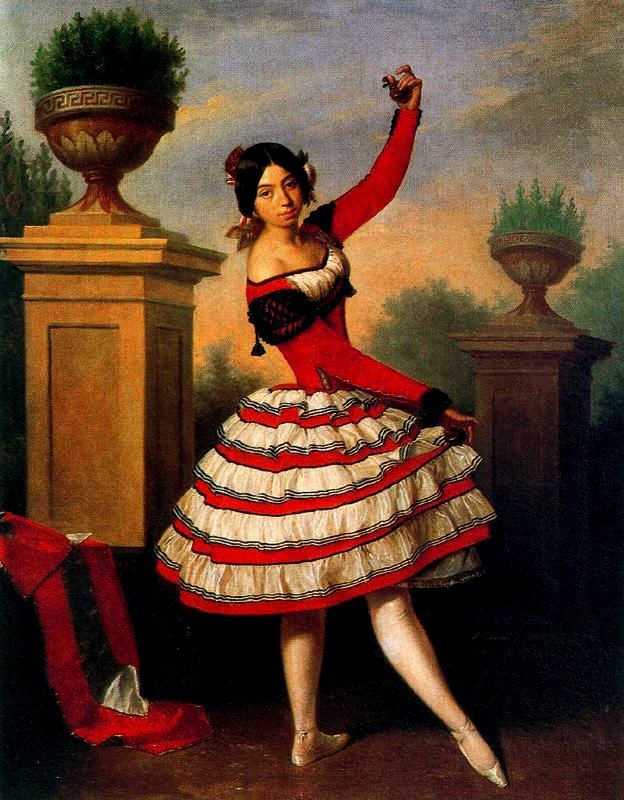
La bailaora Josefa Vargas (1840)
Antonio María Esquivel
- Source:
- Wikimedia Commons
- Rights:
- Public domain — free to use, share and adapt.
- Recorded as:
- public_domain
For dance historians, this painting is documentary evidence of flamenco costume, technique, and presentation at a moment when the form was professionalized and staged in theaters rather than purely social spaces. For art historians, it exemplifies the Romantic era's fascination with capturing the ephemeral moment of performance—freezing time to preserve something inherently transient. For any viewer, it captures the sheer physical intelligence and elegance of trained movement in a way that no written description could.
What you are looking at
A young woman in theatrical dress performs a dynamic solo against a Neoclassical garden backdrop. She wears a striking red off-shoulder bodice with a voluminous skirt of cream and red striped tiers, each layer edged in matching ribbon. Her dark hair is arranged with ornamental combs or flowers, and her body is caught mid-movement—her left arm raised overhead with hand turned, her torso twisted, her weight lifted as though in the midst of a spinning turn or traveling step. Her right leg extends behind her; her left bears the movement. The setting, indicated by tall ornamental urns on pedestals flanking the figure and a muted landscape beyond, suggests a grand garden or courtyard stage. Soft, golden light floods the scene, creating warm shadows on the ground. A draped red fabric falls at lower left, possibly indicating theatrical drapery or the artist's nod to stage design. The painting's palette—ochres, reds, pale cream, and subtle greens—and the formal composition place this firmly within the Romantic era tradition of depicting professional dancers in their starring moments.
The dancing
The dancer stands in a lifted, rotating position with her supporting leg (left) slightly bent beneath her, the supporting foot turned out. Her raised right arm extends overhead with the hand relaxed, a line of energy running from her shoulder through fingertips. Her left arm is extended lower and inward toward her torso, creating a spiraling frame through the upper body. The turn of her head and torso suggests continued momentum through rotation. Her costume allows the viewer to see that she is en demi-pointe or on a lifted ball of the foot—the silhouette and posture indicate trained technique in the theatrical dance practice of the period.
The dance depicted
This is Spanish theatrical dance—almost certainly flamenco or a close theatrical cousin of flamenco as performed in 1840s Spain. The striped skirt, the precise cut and color of the garment, and the gesture all point to bailaora (female flamenco dancer) practice. The woman is captured mid-turn, likely in a moment of the rapid spinning or traveling movements characteristic of tangos, alegrías, or similar styles. What distinguishes this from pure folk performance is the theatrical staging and the painter's attention to a posed, museum-worthy moment rather than vernacular social practice. The raised arm position and the turn of the body are consistent with 19th-century flamenco technique as it appeared in theatrical contexts, though the exact palo (style) cannot be determined from the image alone.
How it was made
Oil on canvas, as established from the painting's surface, handling, and color saturation. The artist has rendered the figure with academic precision—anatomically correct proportions, careful modeling of the face and hands, and skillful handling of fabric and light. The Neoclassical setting and the theatrical framing suggest this was created as a formal commemorative portrait of a professional dancer, likely for exhibition or for a patron of the theater. Oil portraiture was the dominant mode for memorializing performers of note during this period, lending authority and permanence to what was otherwise considered ephemeral art.
About this work
This is a portrait of a professional Spanish dancer (bailaora) caught in the dynamic moment of a solo performance. The painting belongs to a well-established 19th-century tradition of theatrical portraiture in which painters documented the leading dancers of their time in moment of triumph or signature display. It serves as a record both of a specific performer—Josefa Vargas—and of the costuming, technique, and presentation conventions of Romantic-era Spanish dance as practiced in theatrical contexts. The work sits at the intersection of portraiture, dance documentation, and theatrical art, offering viewers of any era a vivid window into how a trained professional body moved and how that movement was understood and valued by the visual culture of the 1840s.
How to look at it
Pay close attention to the turn of the dancer's body and the lift through her standing leg—these details convey technique and training. Notice how Esquivel has chosen to freeze not a static pose but a moment of active rotation, suggesting both the speed and the control required of a professional performer. The composition of the arms—one raised, one lower—is the characteristic contra-body use that generates the spiral and momentum of flamenco turning. The light catching the striped skirt and the fabric's volumes show how movement and dress work together; the skirt is cut to move with rather than against the body's rotation.
The artist
Antonio María Esquivel (1806–1857) was a Spanish Romantic painter known for historical scenes, religious works, and theatrical portraiture. He worked in Madrid during a period of increasing interest in Spanish national identity and cultural forms. His portraiture often celebrated professional performers and notable figures of his time, and he brought academic training and formal composition to subjects that might otherwise have been considered entertainment or low art. Esquivel's work helped establish the visual legitimacy of theatrical professionals within fine art discourse.
The period
The 1840s saw flamenco consolidating its form as a distinct theatrical art. What had been regional, vernacular, and often tavern-based practice was being professionalized, staged, and incorporated into the repertoires of major theaters in Madrid and other Spanish cities. Simultaneously, the Romantic movement was at its height, and European visual culture was deeply invested in capturing the exotic, the passionate, and the ephemeral—all qualities associated with Spanish dance. Paintings of dancers became a recognized genre; museums and wealthy collectors sought them as records of celebrated performers and as embodiments of aesthetic ideals about beauty, movement, and national character.
Where it lives
The work is recorded as dated 1840 and currently derives from Wikimedia Commons. No collection information, accession number, or conservation history is recorded in the available catalogue data.
Dance in this work
Questions about this work
Was this a famous dancer?
Josefa Vargas was a professional bailaora (flamenco dancer) active in Spanish theaters in the 19th century. While we have this portrait as evidence of her existence and status, detailed biographical information is limited. The fact that Esquivel painted her portrait and the work was preserved suggests she was a performer of sufficient note to be worth commemorating in oil paint—a form of cultural validation.
Is this really flamenco?
The garment, the gesture, and the theatrical staging all align with Spanish theatrical dance of the period. In 1840, the form was in transition from tavern entertainment to staged performance, and artists sometimes labeled it simply as Spanish dance or bailaora (the female dancer). The term flamenco itself was not yet standardized. What we see here is theatrical Spanish dance as understood and presented by the Madrid art world of that decade.
Why is she spinning?
Rapid turns and spins have been central to Spanish dance for centuries. They demonstrate technical control, cardiovascular stamina, and elegance, and they are visually spectacular. The painter chose this moment—mid-turn—to show both the dancer's skill and the kinetic energy of the performance.
What does the setting mean?
The Neoclassical garden urns and formal backdrop situate the dancer in a theatrical stage space rather than a street or tavern. This signals that Vargas is a professional performer in a prestigious venue, not a vernacular entertainer. The Neoclassical framing also reflects the academic tradition in which Esquivel was trained—it elevates the subject through association with Classical taste.
More dance artwork





