49 works in this view — arrow keys or swipe to move between them.
Dance in Art
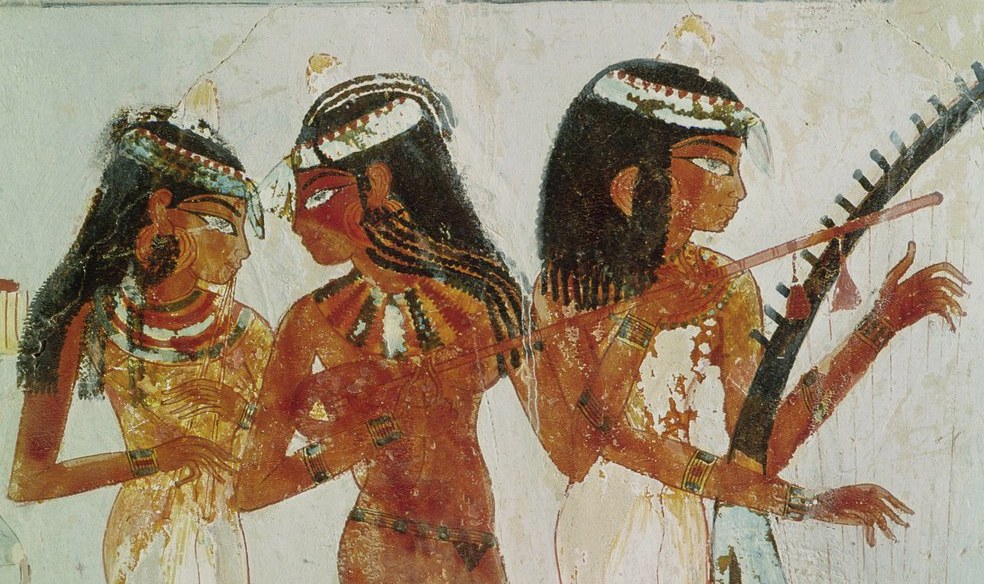
Egyptian 18th Dynasty - Musicians and a Dancer from the Tomb of Nakht New Kingdom cropped
unknown painter, Egypt, 18th Dynasty , c. 1422-1411 BCE
- Source:
- Wikimedia Commons
- Rights:
- Public domain — free to use, share and adapt.
- Recorded as:
- public_domain
This is primary evidence for how ancient Egyptian ritual dance was performed, how musicians were organized, and which instruments accompanied dance in a high-status context. Few artistic traditions provide such precise visual documentation of both instrument and movement. Dancers and historians studying the reconstruction of historical dance forms rely on tomb paintings like this one as the only surviving record of gesture, spacing, and musical accompaniment in pre-classical dance.
What you are looking at
Three female musicians and a dancer are shown in profile against a pale ground, rendered in the Egyptian New Kingdom style with ochre and red pigments. The leftmost figure plays a double-pipe wind instrument (zummâra), holding it to her mouth with both hands. The central figure plucks a harp—an arched instrument with multiple strings held vertically. The rightmost figure, identified as the dancer, holds what appears to be a sistrum or ceremonial rattle in her raised right hand and gestures expressively with her left arm extended. All three wear the fitted sheaths, broad collars, and elaborate dark wigs characteristic of elite Egyptian dress. White linen garments, gold ornaments at wrist and ankle, and diadems across their foreheads mark their high status. The figures stand in a shallow register with no ground line or architectural setting; the composition emphasizes the relationship between musician and dancer.
The dancing
The dancer's posture is upright and frontal in the Egyptian convention, with her weight centered. Her right arm is raised to shoulder height holding the sistrum; her left arm extends diagonally across her body in a gesture that suggests rhythmic movement or emphasis. The musicians flank her—their heads inclined toward their instruments, their bodies still. The dancer's stance conveys animation where the musicians are focused on their playing; her open palm and raised arm read as invitation or affirmation. The spatial arrangement suggests a linear performance, not a coupled dance.
The dance depicted
This is sacred or ceremonial music-making in an Egyptian temple or elite household setting, circa 1422–1411 BCE. The sistrum marks this as ritual music associated with the goddess Hathor or other deities; the combination of harp, double-pipe, and sistrum is documented in tomb paintings and temple reliefs. The dancer may be a professional musician-dancer attached to a temple or the household of a high official. Her raised arm and upright posture do not suggest footwork or traveled movement; the dance is likely a form of rhythmic gesture—swaying, hand-clapping, or processed stepping in place—coordinated with the music. The image documents a professional performance context rather than social dance.
How it was made
This is a fresco or tempera painting on plaster, executed in the characteristic Egyptian New Kingdom style with limited colour palette: ochre, red, black, and white. The figures are drawn with crisp outline and filled flatly—no modelling or shadow. The technique relies on line, silhouette, and symbolic proportion (the musician and dancer are rendered nearly the same size to indicate equal status in the composition). The preservation shows wear and paint loss, particularly on the dancer's right shoulder and across the ground, consistent with tomb-wall painting exposed to centuries of weathering and periodic disturbance. This is a copy or photograph of a tomb wall, not a portable object.
About this work
This is a detail from the tomb of Nakht, a high official of the 18th Dynasty, now known through museum photographs and copies. It documents the professional female musicians and dancers employed in elite households and temples of New Kingdom Egypt. The painting records not a moment of entertainment but a formal ritual: the orchestration of sacred sound and gesture in service to deity or deceased. The three figures show the division of labour in Egyptian musical performance—each musician masters a distinct instrument while the dancer provides rhythmic visual accompaniment. The work is valuable because it combines musical and choreographic evidence: it names instruments through their visual form, shows their playing position, and captures the movement vocabulary of an ancient dance practice that left no written description.
How to look at it
The Egyptian artist has chosen to show the instruments in their playing position and the dance in a posture of active performance—the sistrum held aloft, the arm extended. Look at the contrast between the inward focus of the musicians, bent toward their instruments, and the outward, upright bearing of the dancer. The raised arm and open hand are the signature of Egyptian dance gesture; this posture recurs across tomb paintings and indicates ritual affirmation or invocation. Notice also the careful rendering of each instrument's structure: the harp strings are marked individually, the double-pipe is shown in cross-section, and the sistrum's frame is visible. The painting is documentary as well as celebratory.
The period
The 18th Dynasty (c. 1550–1295 BCE) saw the height of Egyptian imperial prosperity and the extensive decoration of rock-cut tombs in the Valley of the Nobles at Thebes. Tomb paintings served a religious function—they were thought to sustain the deceased in the afterlife by magically providing the pleasures, services, and rituals enjoyed in life. Images of musicians and dancers appear in nearly every elite tomb of this period, indicating their importance to both secular and religious practice. The New Kingdom saw increased professionalization of music and dance; women musicians were highly trained and often drawn from multiple social ranks. The musical instruments shown here—the double-pipe, harp, and sistrum—are documented across New Kingdom Egypt and appear consistently in tomb paintings, temple reliefs, and musical texts.
Where it lives
This image is a record of a wall painting in the rock-cut tomb of Nakht at Thebes (modern Luxor), Egypt, dating to the mid-18th Dynasty. The painting remains in situ in the tomb, now known as TT52 in the numbering system of the Valley of the Nobles. The source cited is Wikimedia Commons, indicating this is a photograph or published reproduction, not the original artefact.
Dance in this work
Questions about this work
What is the sistrum and why did Egyptian dancers carry it?
The sistrum is a rattle with a handle and a frame strung with metal rings or beads that jingle when shaken. It was sacred to the goddess Hathor and used in temple rituals and music-making. The dancer holds it not as an accompaniment to her own movement but as a ritual object; shaking the sistrum was itself a form of rhythmic gesture and invocation.
Were these women professional dancers or casual performers?
These were professional musicians and dancers, likely trained from childhood and employed by the tomb owner's household or by a temple. Their fine dress, gold ornaments, and inclusion in the tomb painting indicate high status and valued skill. Professional female musicians held recognized positions in Egyptian society and could own property and conduct business independently.
What was the purpose of including music and dance scenes in tomb paintings?
Tomb paintings were believed to sustain the deceased magically in the afterlife. By depicting scenes of music, dancing, feasting, and entertainment, the tomb owner ensured access to these pleasures for eternity. The image functioned as a permanent ritual offering, renewing itself each time the tomb was entered or the painting viewed.
How do we know this painting is from the tomb of Nakht?
Tomb paintings in the Valley of the Nobles are catalogued, numbered, and often copied or photographed by excavators and scholars. This detail is identified in the catalogue record as coming from the tomb of Nakht (TT52), a mid-18th Dynasty official. The style, technique, and arrangement of musicians match other documented scenes from this tomb.
More dance artwork





