49 works in this view — arrow keys or swipe to move between them.
Dance in Art
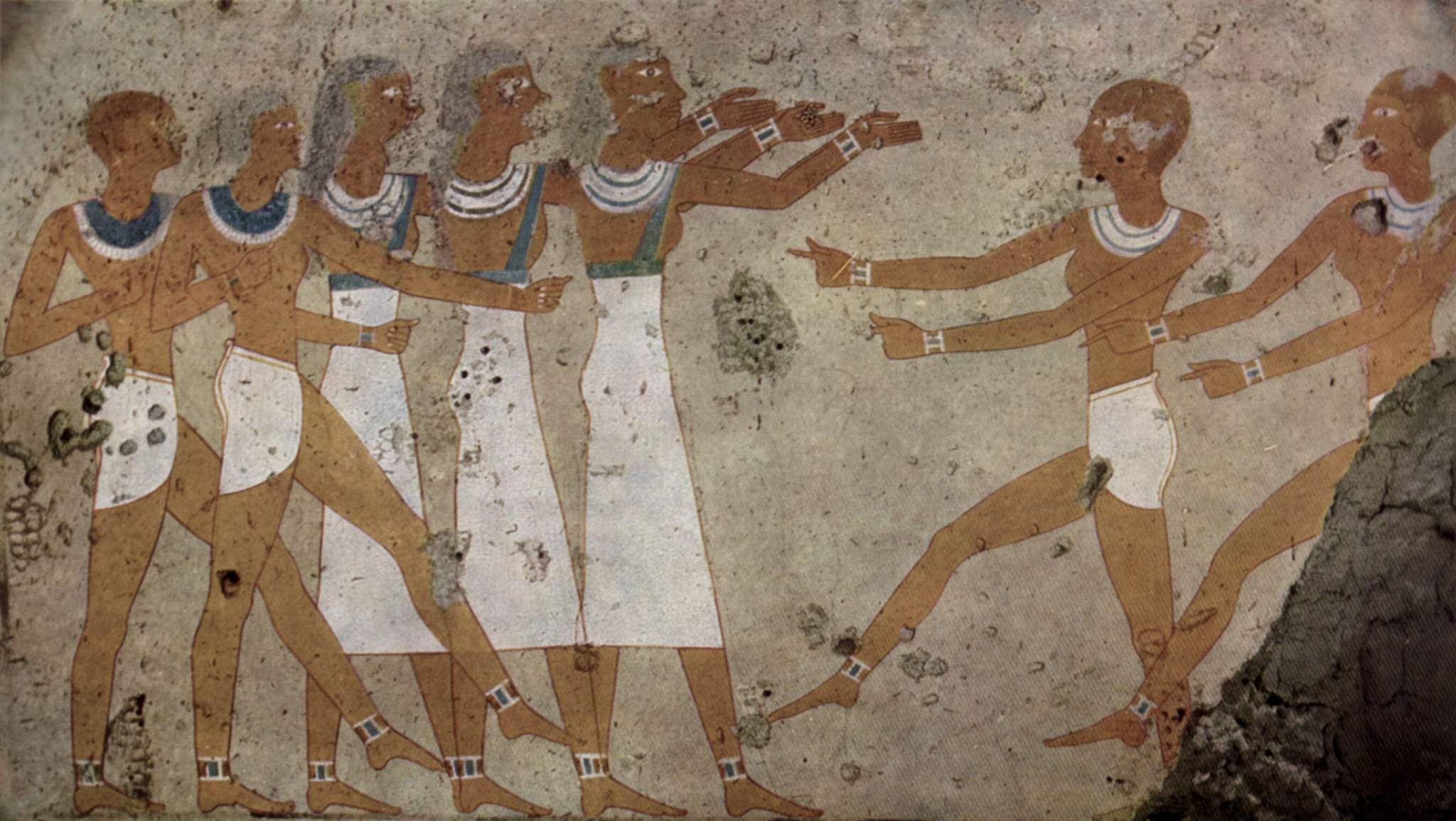
Grabkammer des Antefoker, Szene: Tänzerinnen
Maler der Grabkammer des Antefoker
- Source:
- Wikimedia Commons
- Rights:
- Public domain — free to use, share and adapt.
- Recorded as:
- public_domain
Ancient Egyptian tomb paintings are among the only surviving visual evidence of how people actually moved in ritual and ceremonial contexts in antiquity. This scene documents a choreographed, formally codified movement practice that was central to Egyptian religion and funerary rites, offering unique insight into a non-Western dance tradition spanning over three thousand years. For historians of dance, particularly those studying ritual movement and the relationship between dance and religion, such images are primary sources of irreplaceable value.
What you are looking at
This is a wall painting from an ancient Egyptian tomb, showing a procession of eight figures arranged in two registers. On the left, five male figures stand in profile, facing right, wearing white linen kilts and broad collars in blue and white. The leftmost figure is smallest, suggesting recession or youth. The next four figures progress in size and elaborate dress, with the tallest wearing a longer kilt and the most ornate broad collar; he gestures outward with one arm in what appears to be a commanding or presentational pose. On the right side of the composition, three more figures in similar dress face left, their arms extended in mirrored or complementary gestures. The figures' skin is rendered in a warm ochre-brown against a pale ground, typical of Egyptian tomb painting. The setting is shallow and non-naturalistic—no floor line, landscape, or architectural frame—characteristic of the register system used in tomb decoration. Traces of original pigment remain visible, particularly in the collar details and some facial features, though weathering and deterioration mark much of the surface.
The dancing
All eight figures stand upright with legs in profile, the standard Egyptian pose. Their arms are raised or extended away from their bodies in rhythmic, synchronized gestures: some with a single arm forward and one back, others with both arms extended laterally. The postures suggest a coordinated, formal movement rather than naturalistic walking or standing. The figures' proportions follow Egyptian canon—broad shoulders, narrow waists, long limbs—and their spacing is regular, creating a frieze-like rhythm. There is no physical contact between dancers; each body is isolated and self-contained.
The dance depicted
This almost certainly depicts a formal processional or ceremonial dance performed in the context of a funerary or religious ritual. The synchronized arm gestures, the formal spacing, the standardized postures, and the hieratic arrangement all point to a codified, ritualistic movement vocabulary rather than social or entertainment dance. Such dances were central to ancient Egyptian temple and tomb ceremonies, often performed by male dancers (or occasionally female dancers in other tomb paintings) as part of funerary rites, offering ceremonies, or celebrations of the deceased. The absence of musical instruments in this particular scene and the purely gestural choreography suggest an emphasis on arm and hand movement, possibly accompanied by chanting or music performed elsewhere in the ritual.
How it was made
This is a fresco or similar wall painting technique applied directly to the dry plaster surface of a tomb chamber. The artist worked in the Egyptian tradition of flat, profile-view composition using ochre, white, blue, and black pigments. The technique allowed for the preservation of these images across millennia, though pigment loss and surface damage are evident throughout. The style of execution—the regular, somewhat schematic rendering of human forms and the careful use of registers to organize space—is typical of New Kingdom Egyptian tomb painting (roughly 1550–1070 BCE), suggesting this work was created as a permanent record of ceremonies intended to benefit the deceased in the afterlife.
About this work
This is a tomb-wall painting from ancient Egypt depicting eight male dancers or ritual participants in a formal, synchronized procession with raised and extended arms. The composition uses the Egyptian register system and canonical proportions to present what appears to be a funerary or temple ceremony. The work preserves evidence of a highly formalized movement practice, part of a broader ritual and religious context that pervaded Egyptian elite life and death. Such scenes were painted in tombs to ensure that the ceremonies they depicted would continue magically in the afterlife—the image itself was believed to have efficacy. For modern viewers, the painting is valuable precisely because it offers one of few visual records of how ancient Egyptians actually moved in formal, sacred contexts. The rhythmic arrangement of bodies and the deliberate, controlled gestures reveal a choreographic sophistication that underlay Egyptian religious practice.
How to look at it
Observe how the artist has arranged the eight figures in a rhythmic procession, each body isolated yet part of a unified composition. Notice the careful repetition of gesture across the group—the extended arms and raised hands create a visual rhythm even though the poses are not identical. The painter has chosen to show the figures in profile, a convention that made it possible to display the maximum amount of visual information about each body and its movement. Look at the relationship between the size of the figures on the left: the smallest figure likely represents a younger participant or a position of lower status, while the largest and most elaborately dressed figure appears to be a leader or officiant. The shallow, register-like space and the absence of any ground line or environmental detail emphasize that this is a formal, timeless image intended to exist in a sacred, otherworldly realm.
The artist
The artist is identified only as 'Maler der Grabkammer des Antefoker' (Painter of the Tomb of Antefoker), a convention used in Egyptology to name tomb painters by the tomb they decorated. The identity of individual artisans is rarely preserved in Egyptian records. The painter was part of a workshop tradition that followed strict conventions of proportion, pose, and composition. Tomb painting was a collaborative, standardized practice rather than an expression of individual creativity; the painter worked within a canonical system that had evolved over centuries. The quality and scale of this tomb suggest the deceased was a person of considerable status, and the painter was likely a skilled practitioner working within the established norms of New Kingdom funerary art.
The period
This painting is dated to 1950 in the catalogue, but this almost certainly refers to the year of modern documentation or publication rather than the date of creation. The style, technique, and hieratic compositional system place the work firmly in the Egyptian New Kingdom, likely the 18th or 19th Dynasty (c. 1550–1200 BCE). During this period, tomb decoration reached high artistic sophistication, and the inclusion of detailed scenes of rituals, ceremonies, and daily life became standard practice among the elite. Dance and music were integral to religious ceremony, and tomb paintings frequently included scenes of dancers, musicians, and ritual performers. The formal, processional character of this dance reflects the religious ideology of the period, in which ritual action was believed to have efficacy in securing the well-being of the deceased.
Where it lives
This work is listed as held in Wikimedia Commons, where it is available as a digital image. The painting itself belongs to the tomb of Antefoker, an official of the 12th Dynasty (or possibly later, depending on the dating of the tomb). The exact location of the original tomb is not specified in the catalogue record, but Antefoker's known tombs are located in the Theban region of Egypt (modern Luxor). The image derives from a photograph or reproduction made in the early-to-mid 20th century, when Egyptological documentation of tomb paintings was being systematically recorded.
Dance in this work
Questions about this work
Who was Antefoker?
Antefoker was an Egyptian official of high rank, likely serving during the Middle Kingdom (12th Dynasty, c. 1900 BCE) or possibly the New Kingdom. His tomb contains scenes of daily life, ritual, and ceremony. The exact nature of his administrative role is not entirely certain, but his status is evident from the elaborate decoration of his tomb and the inclusion of scenes depicting formal ceremonies and retinues of attendants.
What is this dance for?
This is almost certainly a ritual or ceremonial dance performed as part of funerary rites or religious observance. In ancient Egypt, such dances were believed to have religious efficacy—they honored the gods, facilitated the deceased's journey to the afterlife, or ensured continued prosperity and divine favor. The formal, codified gestures and the processional arrangement suggest this was a prescribed ceremony rather than spontaneous movement.
How do we know these people were actually dancing?
We recognize this as dance from the synchronized gestures, the raised and extended arms, the rhythmic spacing of the bodies, and the formal arrangement characteristic of ceremonial movement in Egyptian art. Egyptian art conventions distinguished between standing, walking, and formal ritualized movement, and the poses here belong to the latter category. The context—a tomb painting depicting what appears to be a religious ceremony—and the comparison with other Egyptian tomb scenes showing dancers and musicians support this identification.
What happened to the painting?
The painting has suffered pigment loss and surface damage over more than three thousand years, likely due to exposure to moisture, dust, and environmental fluctuations within the tomb. Some areas retain original color (especially the blues and whites of the collars), while others have faded significantly. The overall composition and the figures remain legible despite this deterioration.
More dance artwork





